2026 Honda Elevate Facelift Launched in India at ₹11.80 Lakh – New ZX+, Ventilated Seats & 360° Camera
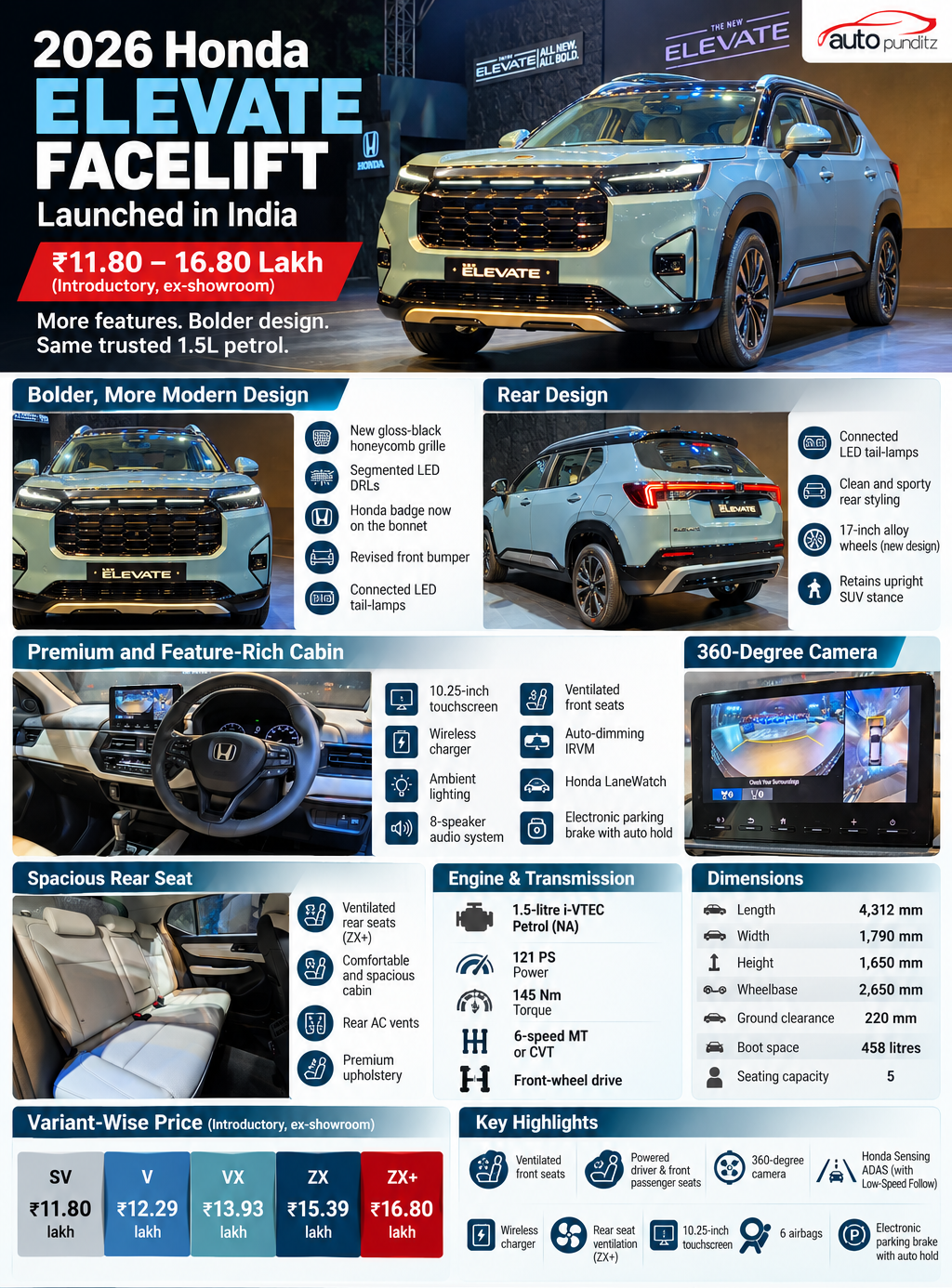
Honda Cars India has launched the 2026 Honda Elevate facelift in India, with introductory ex-showroom prices ranging from ₹11.80 lakh to ₹16.80 lakh. The update marks the first major refresh for the midsize SUV since its India debut in 2023.
India is also the first market globally to receive the new Elevate, highlighting the importance of the model and the Indian market in Honda's global SUV strategy.
Rather than changing the fundamental character of the Elevate, Honda has focused on addressing one of the biggest criticisms of the outgoing SUV — its relatively limited feature list compared with newer rivals.
The facelift therefore brings a refreshed exterior, a more premium cabin, additional convenience features and a new ZX+ flagship variant, while retaining Honda's familiar 1.5-litre naturally aspirated petrol engine.
2026 Honda Elevate Facelift Price
The new Elevate has been launched at an introductory price of ₹11.80 lakh, while the range goes up to ₹16.80 lakh ex-showroom.
The starting price remains particularly important because Honda has added considerable equipment without dramatically shifting the Elevate's entry positioning.
The facelift continues to be offered across the familiar SV, V, VX and ZX trims, while the new ZX+ sits at the top of the range.
Honda had opened pre-launch bookings on October 1 for a booking amount of ₹21,000.
What's New on the 2026 Honda Elevate?
The facelift isn't a complete redesign. Instead, Honda has concentrated on three areas:
A bolder exterior design
A more premium and better-equipped interior
More convenience and technology features
Mechanically, the Elevate remains largely unchanged.
Exterior – Familiar Shape, Much Bolder Face
Honda has retained the Elevate's upright and boxy SUV proportions, but the front end now looks significantly more contemporary.
The facelift gets a redesigned gloss-black honeycomb grille, while new segmented LED daytime running lights visually extend across the front.
Another noticeable change is the placement of the Honda badge. Instead of sitting prominently within the grille, the emblem has been repositioned higher onto the bonnet.
Honda has also reduced the chrome-heavy appearance of the previous model, giving the facelift a cleaner and sportier look.
At the rear, the SUV receives connected LED tail-lamps, with a light element extending across the tailgate.
The changes aren't radical, but they successfully modernise the Elevate without compromising its upright SUV identity.
Higher variants also receive distinctive 17-inch alloy-wheel treatments.
Interior – This Is Where the Bigger Upgrade Has Happened
The cabin is arguably more important than the exterior changes.
Honda has upgraded the dashboard materials, upholstery and overall cabin presentation while adding several features that Elevate buyers had been asking for.
Depending on the variant, the facelift now offers equipment such as:
Ventilated front seats
Ventilated rear seats
8-way powered driver's seat
4-way powered front passenger seat
360-degree surround-view camera
Front parking sensors
Wireless smartphone charging
PM2.5 cabin air filtration
Ambient cabin lighting
10.25-inch touchscreen infotainment system
8-speaker audio system
Auto-dimming IRVM
Honda LaneWatch
Electronic parking brake
Auto brake hold
These additions significantly narrow the feature gap between the Elevate and rivals such as the Hyundai Creta and Kia Seltos.
Honda Elevate Facelift – Variant-Wise Changes
Elevate SV
The SV continues as the entry-level Elevate.
It retains the essential equipment buyers expect from the SUV, including LED projector headlamps and DRLs, LED tail-lamps, automatic climate control and push-button start.
It also gets a PM2.5 cabin filter and a black fabric interior with an ivory-and-black cabin theme.
For buyers primarily interested in the Elevate's engine, space and practicality rather than premium equipment, the SV continues to provide the lowest entry point.
Elevate V
The V builds on the SV with additional infotainment and connectivity equipment.
Important features include:
8-inch touchscreen infotainment system
Rear-view camera
Honda Connect
Rear USB Type-C charging ports
Paddle shifters on CVT
The CVT configuration also gains additional convenience and braking equipment, including an electronic parking brake and auto brake hold.
Elevate VX
The VX is likely to emerge as one of the more interesting variants for value-conscious buyers.
It adds several features that significantly improve the ownership experience, including:
Single-pane electric sunroof
Wireless smartphone charger
Ambient lighting
Honda LaneWatch
LED front fog lamps
17-inch diamond-cut alloy wheels
Six-speaker audio system
Connected exterior lighting elements
For buyers who don't necessarily require all the flagship features, the VX offers a useful balance between equipment and price.
Elevate ZX
The ZX receives some of the facelift's most significant comfort and technology upgrades.
Key additions include:
Ventilated front seats
Perforated leather upholstery
10.25-inch touchscreen
8-speaker audio system
Auto-dimming IRVM
Premium soft-touch cabin materials
Honda Sensing ADAS
The facelift also expands the functionality of Honda Sensing with Low-Speed Follow, improving the usability of adaptive cruise control in slower traffic conditions.
The ZX therefore becomes a much stronger proposition than the equivalent variant of the outgoing Elevate.
Elevate ZX+
The biggest addition to the range is the new ZX+ flagship variant.
Honda has used this variant to introduce several features previously missing from the Elevate.
The ZX+ adds:
8-way powered driver's seat
4-way powered front passenger seat
Ventilated rear seats
360-degree surround-view camera
Front parking sensors
Rear-seat ventilation is particularly noteworthy because midsize SUV buyers increasingly consider rear-seat comfort when purchasing a vehicle primarily for family use.
The ZX+ therefore positions the Elevate more convincingly against the top variants of its feature-rich rivals.
Engine and Gearbox – No Mechanical Revolution
Honda has resisted the temptation to alter the Elevate's powertrain.
The SUV continues with the familiar 1.5-litre, four-cylinder naturally aspirated i-VTEC petrol engine.
Honda Elevate Engine Specifications
Specification | 2026 Honda Elevate |
Engine | 1.5-litre i-VTEC petrol |
Cylinders | 4 |
Aspiration | Naturally aspirated |
Maximum Power | 121 PS |
Maximum Torque | 145 Nm |
Manual Gearbox | 6-speed MT |
Automatic | CVT |
Drivetrain | Front-wheel drive |
The absence of a turbo-petrol engine means the Elevate continues to target buyers who prefer predictable, linear power delivery over outright performance.
Honda's CVT remains particularly relevant for buyers looking for an easy-to-drive automatic SUV for a mix of urban and highway use.
No Strong-Hybrid Elevate Yet
One of the more notable omissions continues to be a strong-hybrid powertrain.
Honda already has strong-hybrid technology in India, but it hasn't extended that option to the Elevate with this facelift.
That leaves rivals such as the Maruti Suzuki Grand Vitara and Toyota Urban Cruiser Hyryder with a clear advantage for buyers specifically seeking strong-hybrid efficiency.
Similarly, there is no diesel or turbo-petrol engine.
Honda is instead keeping the Elevate's powertrain strategy deliberately straightforward — one 1.5-litre naturally aspirated petrol engine with manual and CVT options.
Honda Elevate Dimensions
The facelift retains the Elevate's fundamental dimensions and practical packaging.
Dimension | Honda Elevate |
Length | 4,312 mm |
Width | 1,790 mm |
Height | 1,650 mm |
Wheelbase | 2,650 mm |
Ground Clearance | 220 mm |
Boot Space | 458 litres |
Seating Capacity | 5 |
The 220 mm ground clearance continues to be one of the Elevate's notable strengths for Indian road conditions.
A 2,650 mm wheelbase combined with the upright body shape also allows Honda to retain the spacious cabin that has been one of the Elevate's key selling points.
Safety and Honda Sensing ADAS
The Elevate continues with six airbags, while higher variants offer Honda's Honda Sensing ADAS suite.
Depending on the variant, the safety and driver-assistance equipment includes:
Collision Mitigation Braking System
Adaptive Cruise Control
Lane Keeping Assist
Road Departure Mitigation
Lead Car Departure Notification
Low-Speed Follow
Vehicle Stability Assist
Hill Start Assist
Multi-angle rear-view/360-degree camera depending on variant
The addition of a factory-integrated 360-degree camera and front parking sensors is particularly useful because it addresses another practical weakness of the previous model.
Where Does the Elevate Now Stand?
The outgoing Elevate wasn't necessarily lacking in fundamentals.
It already offered good cabin space, excellent ground clearance, a proven petrol engine and straightforward automatic transmission.
Its biggest weakness was that customers walking into competing showrooms could find noticeably longer feature lists.
The facelift directly targets that problem.
Features such as ventilated seats, powered front seats, rear-seat ventilation, 360-degree camera, larger infotainment screen and additional parking assistance make the new Elevate much easier to compare against similarly priced competitors.
AutoPunditz Buyer's View – Which Elevate Should You Consider?
For value-focused buyers: Elevate VX
The VX appears to offer a strong balance for buyers who want more than the basics without paying for every flagship feature.
The sunroof, wireless charging, LaneWatch, ambient lighting, upgraded audio and 17-inch alloys cover many of the features buyers actually use regularly.
For the best overall package: Elevate ZX
The ZX could be the sweet spot of the facelifted range.
Ventilated front seats, the larger 10.25-inch infotainment screen, upgraded audio, more premium upholstery and Honda Sensing make it substantially better equipped than before.
For many family buyers, this should provide most of the equipment that matters without necessarily requiring the flagship ZX+.
For maximum comfort: Elevate ZX+
The ZX+ makes sense for buyers who want the most complete Elevate experience.
Powered front seats, rear-seat ventilation, the 360-degree camera and front parking sensors are meaningful additions rather than purely cosmetic upgrades.
It could be particularly relevant for chauffeur-driven owners or families where rear-seat comfort is an important consideration.
Who Should Buy the New Honda Elevate?
The 2026 Elevate should remain on the shortlist for buyers looking for:
A spacious five-seat family SUV
A naturally aspirated petrol engine
Smooth CVT automatic
High ground clearance
Comfortable everyday usability
Improved safety and ADAS equipment
Long-term ownership rather than outright performance
The facelift makes considerably more sense for buyers who liked the Elevate previously but rejected it because of its relatively limited equipment list.
Who Should Consider an Alternative?
The Elevate may not be the first choice if your priority is:
Maximum fuel efficiency: Strong-hybrid alternatives deserve consideration.
Performance: Turbo-petrol Creta, Seltos, Kushaq and Taigun variants provide alternatives for buyers wanting stronger acceleration.
Diesel: The Elevate still doesn't offer one.
Multiple powertrain choices: Honda's single-engine strategy is considerably simpler than some competitors.
Auto Punditz Verdict
The 2026 Honda Elevate facelift is less about reinventing the SUV and more about fixing its most obvious weakness.
Honda has wisely retained the Elevate's core strengths — its spacious cabin, upright SUV proportions, 220 mm ground clearance and proven 1.5-litre naturally aspirated petrol engine — while significantly upgrading the equipment package.
The arrival of ventilated front and rear seats, powered front seats, a factory-fitted 360-degree camera, front parking sensors and improved infotainment makes the Elevate substantially more competitive than before.
The introductory ₹11.80 lakh starting price is also significant, particularly because Honda has managed to improve the SUV's equipment without radically moving its entry price.
The VX should appeal to value-conscious buyers, the ZX looks like the strongest all-round choice, while the new ZX+ finally gives Honda a properly equipped flagship variant.
The biggest missed opportunity remains the absence of a strong-hybrid powertrain. With Grand Vitara and Hyryder offering strong-hybrid technology, Honda could have created a compelling alternative by pairing the Elevate's practical package with its own hybrid expertise.
Nevertheless, for buyers who don't need a diesel, turbo-petrol or strong hybrid and instead want a spacious, straightforward and well-equipped petrol family SUV, the facelifted Honda Elevate is now a much stronger contender.
The Elevate hasn't fundamentally changed — and that may be exactly the point. Honda has retained what worked and addressed what was missing. The result is a more complete midsize SUV that should now be much harder for Indian family-car buyers to overlook.