


GST Council’s New Reforms Could Boost India’s Auto Manufacturing and Exports – Here’s How
India’s automotive manufacturing ecosystem could emerge as a key beneficiary of the 57th GST Council meeting, which has approved a broad set of reforms aimed at improving working capital, easing input tax credit restrictions, accelerating refunds, simplifying interstate movement of goods and strengthening export competitiveness.
Unlike the previous GST Council meeting, which focused heavily on rate rationalisation, the latest round of reforms is centred more on process efficiency, liquidity and ease of doing business. Importantly, the Council has not announced a fresh change in GST rates for passenger vehicles.
For the automotive industry, the impact could be felt across OEMs, component suppliers, EV manufacturers, engineering service providers, exporters and contract manufacturers.
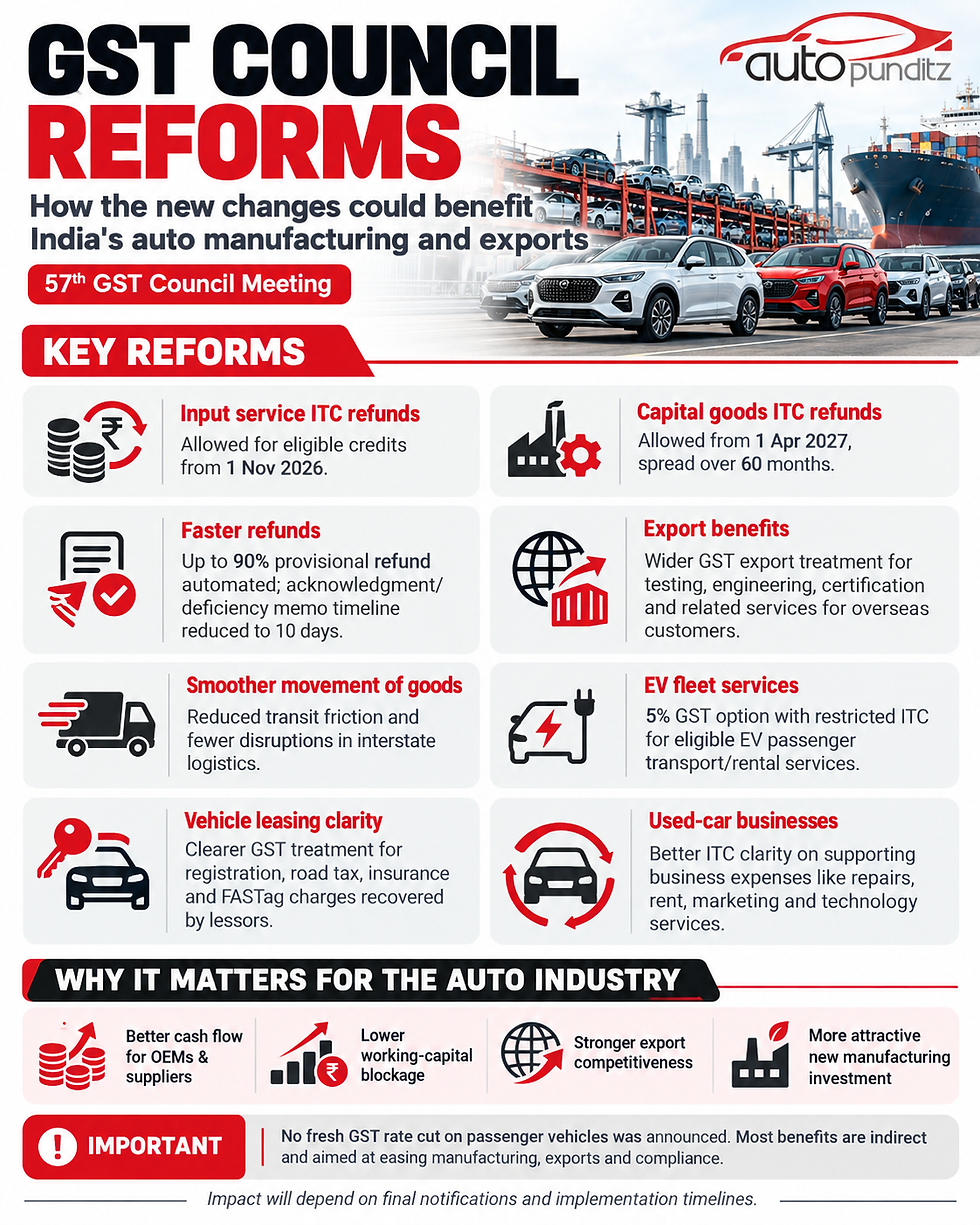
Why the GST reforms matter for the auto industry
Vehicle manufacturing requires large investments in factories, tooling, machinery, R&D, logistics and supplier development. When input tax credits accumulate but cannot be refunded quickly, manufacturers effectively have capital locked up with the tax system. This increases working-capital requirements and can make new investment more expensive.
The latest GST Council recommendations attempt to address precisely this problem by widening refund eligibility and automating parts of the refund process. That could be particularly important for companies investing in new EV plants, battery production, automotive electronics, powertrain components and export-oriented manufacturing capacity.
Refunds on input services from November 2026
One of the biggest changes is the proposed expansion of refunds under the inverted duty structure. The GST Council has recommended allowing refunds of accumulated input tax credit relating to input services for eligible credits availed from 1 November 2026.
Until now, businesses operating under an inverted duty structure could accumulate credits that were difficult to recover because the refund mechanism was more restrictive. The Council itself says the change is intended to reduce working-capital constraints and remove blocked ITC.
Why this matters for automotive companies
Automakers and suppliers purchase a wide range of services during product development and manufacturing, including:
engineering and design
software development
testing and validation
logistics
consultancy
technical services
plant maintenance
A broader ability to obtain refunds on accumulated credits could reduce the amount of capital tied up in the tax system. This is especially relevant as vehicle development becomes more software- and engineering-intensive.
Capital-goods ITC refunds from April 2027
An even more significant reform for manufacturers relates to capital goods.
The GST Council has recommended allowing accumulated ITC on capital goods for eligible zero-rated supplies and inverted-duty cases. The refund will be spread over 60 months and will apply to eligible ITC on capital goods availed from 1 April 2027.
That could have a meaningful impact on companies investing heavily in:
assembly lines
stamping equipment
die-casting machinery
battery manufacturing equipment
motor production lines
paint shops
automation
robotics
testing facilities
Why this is important
Automotive manufacturing is capital intensive. A company setting up a new plant or production line can spend hundreds or even thousands of crores before a single vehicle reaches the customer. If GST paid on machinery remains blocked for long periods, it increases the effective cost of investment. The new refund mechanism could improve project economics and potentially make India more attractive for future vehicle and component manufacturing investments.
Faster refunds: 90% can be released provisionally
The Council has also recommended a major change in the refund process. For eligible claims relating to zero-rated supplies and the inverted duty structure, 90% of the amount claimed can be provisionally sanctioned automatically, subject to system-based risk assessment. The time allowed for issuing an acknowledgement or deficiency memo is also proposed to be reduced from 15 days to 10 days.
Impact on auto exporters
This could be particularly helpful to vehicle and component exporters. India already exports cars, two-wheelers, commercial vehicles, tractors, tyres, castings, electronics and a wide range of automotive components. Faster GST refunds mean exporters may have to wait less time to recover taxes already paid. That improves cash flow and reduces the need to fund working capital through borrowings. For smaller Tier-2 and Tier-3 suppliers, this could be especially significant.
Export benefits widened for engineering and testing services
Another reform with direct relevance to the automotive industry involves the definition of exports. The Council has recommended changing GST rules so that services performed in India on goods belonging to an overseas customer can potentially qualify under export provisions based on the location of the recipient.
This could cover services such as:
testing
certification
research
engineering
validation
repair
processing
The Council says the change will allow Indian service providers working for foreign recipients to access export-related GST benefits more easily.
Why this matters for automotive R&D
India has become an important global automotive engineering centre.
Several global manufacturers and suppliers use Indian teams for:
vehicle development
software engineering
embedded systems
ADAS development
simulation
powertrain engineering
EV development
homologation support
The revised treatment could improve India's competitiveness as a location for global automotive engineering and validation work.
Foreign branches can more easily qualify for export treatment
The Council has also recommended removing a restriction that made it harder for an Indian company supplying services through its overseas branch to qualify those services as exports. The change is intended to make it easier for Indian service providers to claim refunds for services supplied to or through their foreign offices. For automotive engineering companies and suppliers with global operations, this could reduce tax uncertainty around cross-border service transactions.
Contract manufacturing could become more attractive
The reforms could also strengthen India’s position as a contract-manufacturing base.
A related clarification allows goods sold to an overseas buyer but delivered into an Indian SEZ or Free Trade Warehousing Zone to receive zero-rated treatment when applicable payment conditions are met. Industry reporting suggests the broader changes could make contract manufacturing for overseas principals more attractive and support global companies looking to shift parts of their supply chains to India.
Potential automotive relevance
This could support India’s ambitions to become a larger manufacturing and export hub for:
EV components
battery systems
electric motors
automotive electronics
castings and forgings
transmissions
vehicle sub-assemblies
complete vehicles
The benefit will ultimately depend on how the final rules are implemented.
Easier movement of components across states
Automotive supply chains are highly interconnected. A vehicle assembled in Maharashtra, Tamil Nadu, Gujarat or Karnataka may use components sourced from suppliers located across several states. The GST Council has recommended tighter and more standardised rules around the interception of goods in transit. It has also proposed that confiscation provisions under Section 130 should not apply to goods and conveyances while in transit in the specified circumstances. The stated objective is smoother goods movement and better transportation efficiency.
Why this matters
Modern automotive plants typically operate on tightly controlled inventory cycles. Any delay in the movement of a critical component can potentially disrupt an entire production line. Reducing unnecessary checks and uncertainty around interstate movement could improve supply-chain efficiency for manufacturers and suppliers.
Wider input tax credit eligibility
The Council has also recommended removing restrictions on ITC for several categories of expenditure, including certain insurance services, telecommunication infrastructure and other business expenses. The broader direction is toward allowing businesses to recover more legitimate input taxes instead of carrying them as embedded costs. Industry estimates suggest the reforms across sectors could potentially unlock ₹50,000–60,000 crore of input tax credits annually, although the eventual benefit will depend on the final legislation and implementation. For the automotive industry, that could translate into improved liquidity across both large OEMs and the supplier ecosystem.
EV passenger transport gets a specific GST option
The Council has also made a directly EV-related recommendation. Passenger transport and rental services using electric vehicles will be allowed an option to pay 5% GST with restricted input tax credit, where the vehicle is supplied with an operator and charging cost is included in the consideration.
This relates primarily to mobility and rental services rather than the GST rate on the purchase of electric vehicles themselves. It could nevertheless improve clarity for EV fleet operators, mobility companies and commercial passenger-transport businesses.
Motor vehicle leasing rules get clarification
Another automotive-specific recommendation concerns vehicle leasing.
The Council has proposed clarifying the GST treatment of statutory and ancillary charges such as:
registration fees
road tax
insurance
FASTag charges
when these are initially paid by the lessor and subsequently recovered from the vehicle lessee. This could reduce disputes and improve pricing transparency for corporate leasing and fleet businesses.
Second-hand vehicle businesses also get ITC clarity
The Council has further clarified that businesses operating under the GST margin scheme for second-hand vehicles can claim ITC on various business inputs and services, including:
spares
repairs and maintenance
technology services
rent
marketing
advertising
The restriction applies to tax paid on the second-hand vehicle itself rather than these supporting expenses. This could help organised used-car retailers by reducing ambiguity around operating expenses.
No new GST cut on cars
One point is particularly important for consumers. The latest GST Council meeting did not announce another reduction in GST rates on new passenger vehicles.
The reforms are largely related to tax administration, refunds, ITC, exports and compliance.
Therefore, buyers should not expect an immediate reduction in ex-showroom car prices purely because of the 57th GST Council meeting. Any consumer-price impact would be indirect and longer term, through potentially lower manufacturing and financing costs.
How the reforms could affect the automotive value chain
Area | Potential impact |
Vehicle manufacturing | Lower working-capital blockage |
New factories | Better recovery of capital-goods ITC |
Auto components | Faster refunds and improved liquidity |
Vehicle exports | Faster GST refund processing |
Engineering/R&D exports | Wider export-service eligibility |
EV manufacturing | Potential benefit from capital-intensive investments |
Logistics | Smoother interstate movement |
EV fleets | 5% GST option on eligible passenger transport services |
Vehicle leasing | Greater tax clarity |
Used cars | Wider ITC clarity on operating inputs |
Could this attract more automotive investment?
The reforms do not provide a direct automotive subsidy. However, they could make India structurally more attractive for manufacturing. For global automakers considering where to locate their next vehicle programme, battery facility, engineering centre or export operation, tax efficiency and working-capital requirements can influence investment decisions alongside labour costs, infrastructure and market size.
The ability to recover taxes more efficiently therefore matters.
India's automotive sector could be one of the beneficiaries because of its large and growing export-oriented manufacturing base.
Auto Punditz Take
The biggest takeaway from the 57th GST Council meeting is that the reforms are less about changing the tax printed on a car invoice and more about reducing the hidden friction involved in manufacturing one. Faster refunds, wider input-tax-credit eligibility, better treatment of capital goods and clearer export rules can collectively reduce the amount of money trapped inside the tax system.
That matters enormously in an industry where companies are simultaneously spending heavily on EVs, batteries, software, electronics, new factories and localisation.
India is already attempting to position itself as both a major domestic automotive market and a global manufacturing hub. The latest GST reforms could strengthen the second part of that equation by improving cash flows and reducing tax-related complexity for manufacturers and exporters.
However, much of the benefit will depend on how quickly the recommendations are converted into legislation, notifications and functioning GST-portal processes.
So while these reforms are unlikely to make cars cheaper overnight, they could gradually make building cars, components and automotive technology in India more competitive.


