


India Wants 100% Ethanol Fuel: Can E100 Really Replace Crude Oil?
India’s fuel transition story has moved from a cautious experiment to an aggressive national strategy. After achieving the 20% ethanol blending milestone ahead of the original 2030 timeline, the government is now preparing the next big step: higher ethanol blends such as E85 and E100, backed by flex-fuel vehicles and dedicated ethanol dispensing stations.
The idea is powerful: reduce India’s dependence on imported crude oil, cut emissions, create a new revenue stream for farmers, and keep more fuel money within the domestic economy. But the central question remains — can India realistically replace petrol with 100% ethanol fuel?
The answer is more nuanced than a simple yes or no.
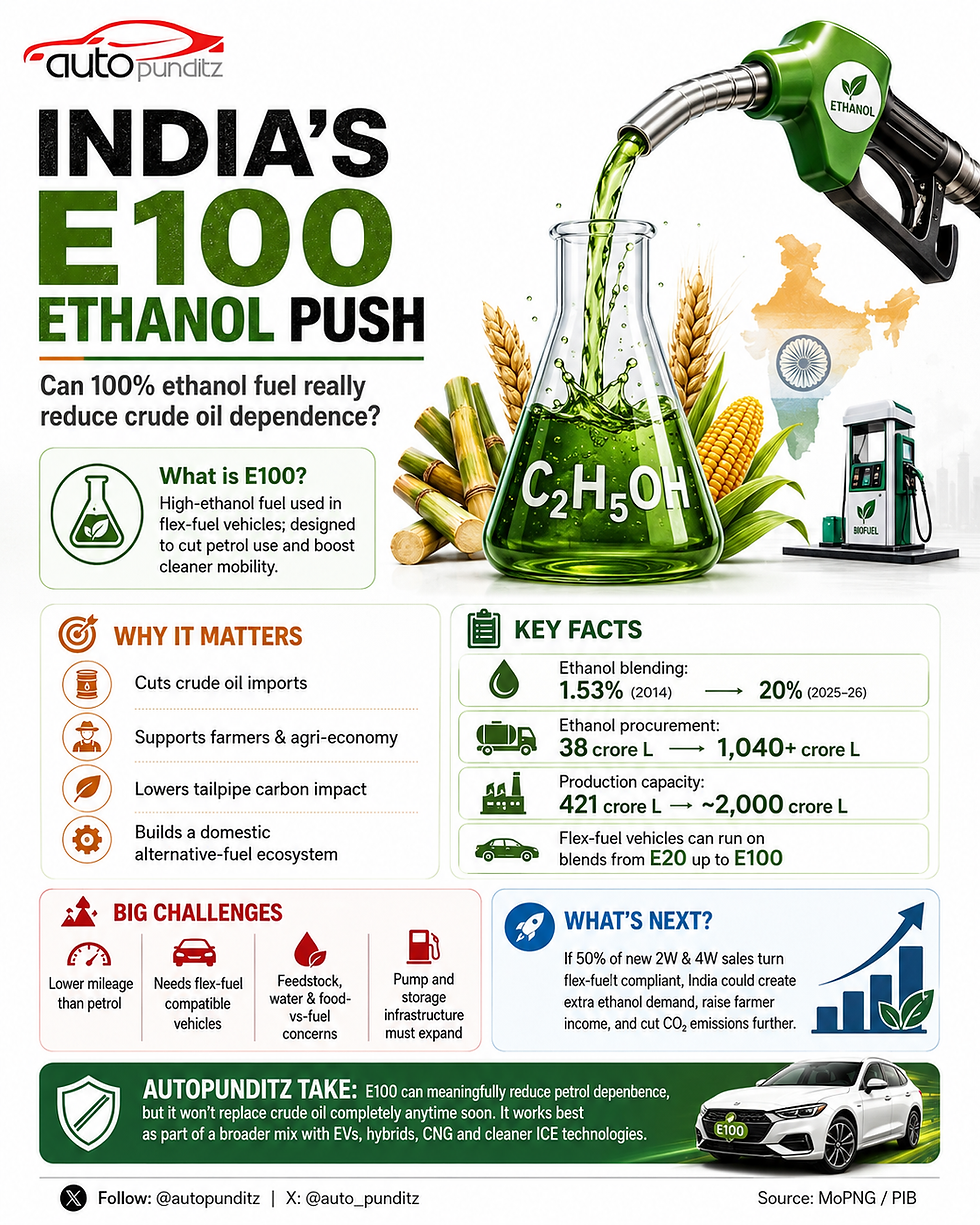
What is E100 fuel?
Ethanol is an alcohol-based fuel produced from biomass such as sugarcane, maize, surplus rice, damaged grains and other agricultural feedstocks. In petrol pumps, the “E” number indicates the percentage of ethanol in the fuel.
E20 means 20% ethanol and 80% petrol. E85 means 85% ethanol and 15% petrol. E100, despite the name, is generally not absolutely pure ethanol. Autocar India explains that E100 typically contains around 93–95% ethanol, along with 5–7% petrol and other solvents to help with cold starts, fire visibility and fuel stability.
This is important because E100 is not a drop-in replacement for petrol in regular vehicles. It needs compatible engines, fuel systems, calibration and a distribution ecosystem.
India’s ethanol journey: from E10 to E20 and now beyond
India’s ethanol-blending programme has accelerated sharply over the past decade. According to the Ministry of Petroleum and Natural Gas, ethanol blending was just 1.53% in 2014. India achieved 10% blending in June 2022, five months ahead of schedule, and the original 20% target was advanced from 2030 to 2025.
Government data also shows blending rose from 12.06% in Ethanol Supply Year 2022–23 to 14.60% in 2023–24 and 17.98% in 2024–25 up to February 2025. By July 2025, the government said India had achieved 19.93% blending for the month and 19.05% average blending in the ongoing supply year.
This makes ethanol one of India’s fastest-moving alternative fuel programmes. Unlike EVs, which require new charging infrastructure and new vehicle purchase behaviour, ethanol blending works through the existing liquid fuel network — at least up to a point.
Why India is pushing ethanol so hard
India imports a large share of its crude oil requirement. Every increase in global oil prices impacts the country’s trade deficit, inflation and fuel prices. Ethanol gives India a domestic alternative that can partially substitute petrol.
The government has projected that achieving 20% ethanol blending would require around 1,016 crore litres of ethanol by 2025, with total ethanol demand including other uses estimated at about 1,350 crore litres. To meet this, India would need around 1,700 crore litres of ethanol production capacity, assuming 80% plant efficiency.
For India, ethanol is not just a fuel story. It is also an agriculture, rural income and energy-security story.
The benefits are clear:
India can reduce crude oil imports.
Farmers get an additional market for sugarcane, maize, damaged grains and surplus rice.
Oil marketing companies get a cleaner blending component.
The auto industry gets another pathway alongside EVs, hybrids and CNG.
Consumers may get cheaper fuel where high-ethanol blends are priced significantly below petrol.
India has recently launched E85 fuel, priced around ₹20 per litre cheaper than the prevailing E20 fuel, as part of the government’s push toward higher ethanol blends and flex-fuel vehicles.
Flex-fuel vehicles: the missing link
E100 cannot become mainstream unless vehicles are built for it. This is where flex-fuel vehicles come in.
A flex-fuel vehicle can run on different petrol-ethanol blends, typically from normal petrol blends up to high ethanol blends like E85. The engine control unit automatically adjusts fuel injection and ignition timing depending on the ethanol content.
Maruti Suzuki has showcased a WagonR flex-fuel passenger car, while two-wheeler manufacturers such as Hero MotoCorp have also introduced flex-fuel models. Recent reports note that the government is now promoting flex-fuel vehicles as the next step after E20.
For India, this could be significant. Two-wheelers and small cars dominate fuel consumption at the mass-market level. If ethanol adoption has to scale, it cannot remain limited to niche vehicles.
Can existing petrol cars run on E100?
No. Regular petrol vehicles should not be filled with E85 or E100 unless the manufacturer specifically certifies them as flex-fuel compatible.
Ethanol has different chemical properties compared to petrol. It is more corrosive, absorbs more moisture, and has lower energy density. Higher ethanol blends need compatible rubber parts, seals, fuel lines, injectors, fuel pumps and engine calibration.
Even with E20, many consumers have raised concerns about mileage and long-term compatibility, especially for older vehicles. It is reported that the E20 rollout created anxiety in the Indian auto market because older vehicles were originally certified for lower ethanol blends such as E5 or E10, and users were concerned about fuel efficiency loss and potential engine impact.
The government has responded to such concerns and has maintained that the E20 transition is manageable, but E85 and E100 will require a much more deliberate vehicle-technology transition.
The mileage question: cheaper fuel, but lower efficiency
Ethanol contains less energy per litre than petrol. That means a vehicle running on high ethanol blends generally consumes more fuel for the same distance.
So even if E85 or E100 is cheaper per litre, the real-world savings depend on the price gap and the drop in fuel efficiency.
For example, if ethanol fuel is 20–25% cheaper but the vehicle returns 20–30% lower mileage, the consumer’s actual running cost benefit may be small. If the government and oil companies price ethanol aggressively, flex-fuel vehicles may become attractive.
If the price gap narrows, consumers may not see a strong reason to switch.
This is the same reason Brazil’s ethanol market works dynamically: consumers often choose between petrol and ethanol based on price and mileage economics.
Food vs fuel: the biggest policy challenge
India’s ethanol programme has so far leaned heavily on sugarcane, maize, surplus rice and other grain-based feedstocks. As the programme grows, the country will need to balance energy security with food security.
Maize has recently emerged as a major ethanol feedstock. The Economic Times reported that maize became India’s leading ethanol feedstock in the first six months of Ethanol Supply Year 2025–26, surpassing traditional sugarcane-based sources.
This diversification is positive, but it also raises concerns. Down To Earth reported that the Economic Survey 2025–26 flagged early warning signs that ethanol demand could reshape crop priorities, with land potentially moving toward maize and away from pulses and oilseeds.
For India, this is a delicate balance. Using surplus or damaged grains for ethanol is sensible. But if food crops are aggressively diverted into fuel production, it can affect food prices, animal feed costs and crop diversity.
Infrastructure: pumps, storage and fuel logistics
E100 is not just a vehicle issue. It is also a fuel retail issue.
India’s current fuel network has been built around petrol and diesel. High ethanol blends need separate storage, dispensing and quality-control systems. Ethanol also absorbs water more easily, which means handling and storage quality become critical.
The government is already moving in this direction. Union Petroleum Minister Hardeep Singh Puri reportedly said around 500 E100 ethanol dispensing stations are targeted by December 2026, with a larger target of 5,000 stations by 2027.
That is a start, but India has tens of thousands of fuel stations. For ethanol to become mainstream, availability must move beyond pilot corridors and metro showcases.
Environmental benefits: cleaner, but not zero-emission
Ethanol can help reduce certain emissions and lower the lifecycle carbon footprint when produced sustainably. It is renewable in the sense that it is derived from crops and biomass rather than fossil crude oil.
However, ethanol is not zero-emission. It still burns in an internal combustion engine. Its true environmental benefit depends on how the crop is grown, how much water is used, what fertilisers are applied, how ethanol is distilled, and how efficiently the vehicle uses it.
This is why ethanol should be seen as one part of India’s cleaner mobility strategy — alongside EVs, hybrids, CNG, hydrogen pilots, public transport and stricter fuel efficiency norms.
What it means for automakers
For automakers, flex-fuel technology offers an additional route to comply with cleaner mobility goals without fully shifting to EVs. This is especially relevant in India, where the internal combustion engine will continue to dominate sales for several years.
However, manufacturers will need to invest in:
Ethanol-compatible engines and components
Improved fuel sensors and engine management systems
Durability testing for Indian weather and usage conditions
Consumer education
Dealer training
Warranty clarity
NITI Aayog’s ethanol roadmap had earlier estimated that E20-compatible vehicles could cost about ₹3,000–₹5,000 more for four-wheelers and ₹1,000–₹2,000 more for two-wheelers compared with vehicles designed only for petrol. Flex-fuel vehicles for E85/E100 may require more extensive changes, but mass production can help reduce the cost gap.
Can E100 replace crude oil in India?
E100 can reduce petrol consumption, but it cannot fully replace crude oil in the near future.
There are four reasons.
First, India’s vehicle parc is huge and mostly not flex-fuel compatible. Millions of existing cars and two-wheelers will continue to need petrol or E20.
Second, ethanol production has limits. Feedstock availability, crop cycles, water use and food security will restrict how much ethanol India can sustainably produce.
Third, ethanol has lower energy density, so more litres are needed for the same mobility output.
Fourth, crude oil is used not only for petrol but also for diesel, aviation fuel, petrochemicals, lubricants and industrial products.
So the realistic goal is not complete replacement of crude oil. The realistic goal is partial substitution of petrol, especially in passenger vehicles and two-wheelers, while reducing the import bill and supporting domestic agriculture.
Auto Punditz view
India’s ethanol push is one of the most practical near-term alternatives to petrol, especially because it can use the existing internal-combustion ecosystem. E20 has already moved from policy target to market reality, and E85/E100 can become the next important bridge fuel.
But the transition must be managed carefully. Ethanol can work well if India builds flex-fuel vehicles, ensures transparent fuel pricing, protects consumers from compatibility confusion, expands ethanol pumps, and avoids converting food security into a fuel-security problem.
E100 is not a magic replacement for crude oil. But as part of a diversified mobility strategy, it can reduce India’s petrol dependence, support rural incomes and give automakers another cleaner technology pathway. For Indian consumers, the success of ethanol will finally depend on three simple questions: Is the vehicle compatible? Is the fuel easily available? And does the lower price truly offset the lower mileage?
Until those answers become clear, E100 will remain a promising but still evolving chapter in India’s fuel revolution.


