


India Opens Bidding for 10 GWh Battery Manufacturing: What It Means for EVs and Domestic Cell Production
India has invited global bids for 10 GWh of manufacturing capacity under its Advanced Chemistry Cell Production Linked Incentive scheme, specifically for grid-scale stationary energy storage. This investment could impact India's EV industry by enhancing domestic cell manufacturing, supplier capabilities, technical expertise, and battery-material localization.
The Ministry of Heavy Industries has issued a Request for Proposal to select companies for giga-scale ACC manufacturing facilities in India. The tender is part of the government’s ₹18,100 crore Production Linked Incentive scheme for Advanced Chemistry Cell battery storage.
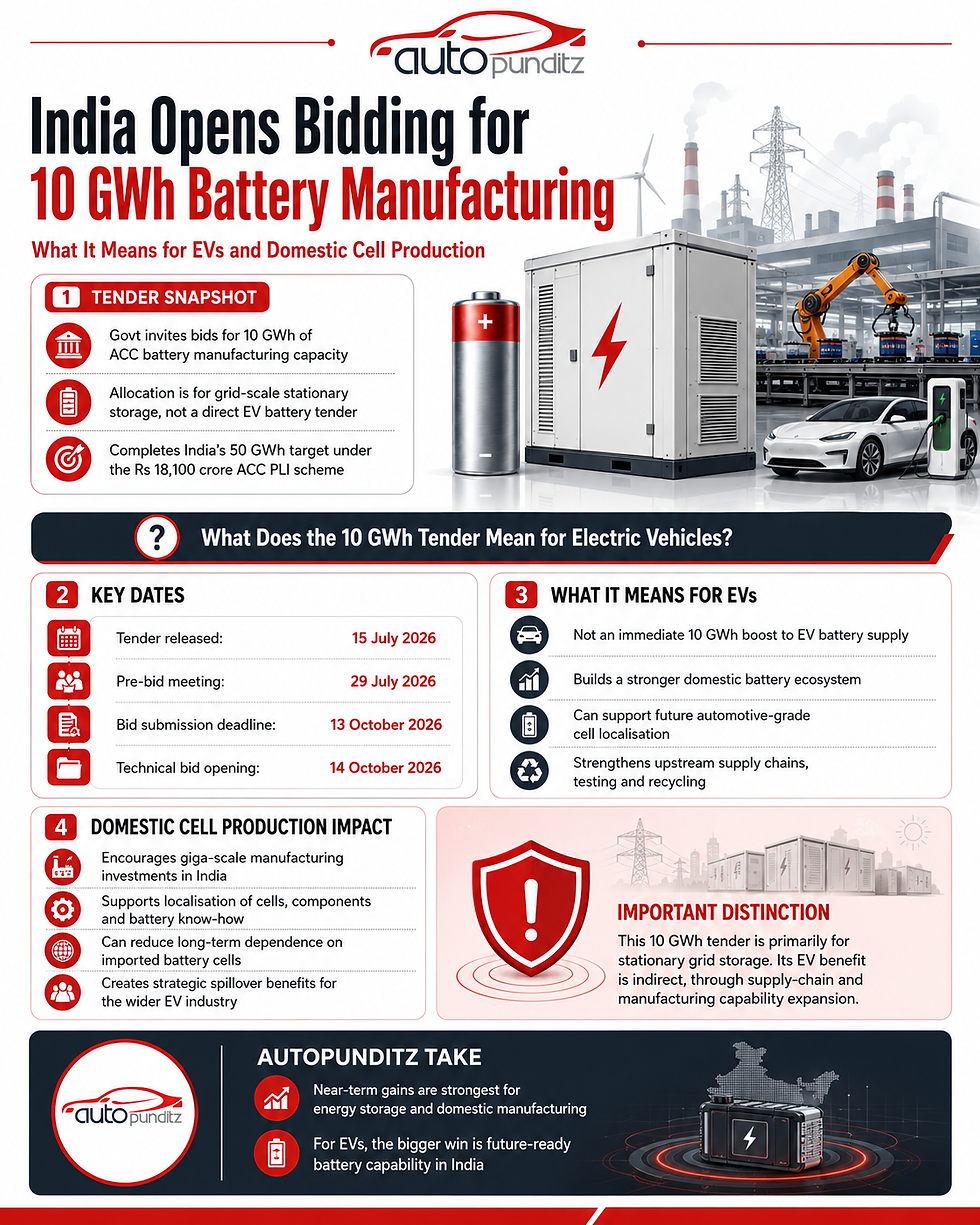
Government Battery Tender: Important Dates
Tender milestone | Date |
Tender documents released | 15 July 2026 |
Pre-bid conference | 29 July 2026 |
Last date for bid submission | 13 October 2026 |
Technical bid opening | 14 October 2026 |
The entire bidding process will be conducted online through the Central Public Procurement Portal. Companies will be evaluated through a two-stage Quality and Cost Based Selection mechanism, combining technical capability with the commercial terms offered by bidders.
Completing India’s 50 GWh ACC Manufacturing Target
The Union Cabinet approved the National Programme on Advanced Chemistry Cell Battery Storage in May 2021. The programme carries a budgetary allocation of ₹18,100 crore and targets the creation of 50 GWh of domestic ACC manufacturing capacity.
According to the Ministry of Heavy Industries, beneficiaries representing 40 GWh of the targeted capacity have already been selected. The latest tender covers the remaining 10 GWh and completes the capacity-allocation target envisaged under the original programme.
The government expects the scheme to attract both Indian and international battery manufacturers, reduce the country’s dependence on imported cells and establish a globally competitive domestic battery-manufacturing industry.
What Is Grid-Scale Stationary Storage?
Grid-scale battery systems store electricity generated by power plants, particularly renewable-energy projects, and release it when electricity demand increases or renewable generation declines.
Solar power generation, for example, peaks during daylight hours, while electricity demand can remain elevated during the evening. Large battery installations allow excess daytime electricity to be stored and supplied to the grid later.
Such storage systems can also help power utilities manage fluctuations in renewable generation, improve grid stability, reduce peak-power procurement requirements and provide more dependable round-the-clock renewable electricity.
The government has therefore reserved the entire 10 GWh manufacturing allocation for Grid-Scale Stationary Storage, rather than prescribing its use for electric cars, scooters or commercial vehicles.
What Does the 10 GWh Tender Mean for Electric Vehicles?
The immediate capacity created through this tender will primarily serve stationary energy-storage applications. Therefore, it should not be interpreted as the direct addition of 10 GWh of locally manufactured automotive battery cells.
Nevertheless, the programme could indirectly benefit electric-vehicle manufacturers. Large-scale cell production can improve India’s access to battery materials, separators, electrolytes, battery-management systems, thermal-management components, testing facilities and recycling infrastructure.
It could also encourage global cell manufacturers and technology providers to establish operations in India. Once manufacturing capability, skilled manpower and supplier networks are developed, companies may find it easier to invest in separate automotive-grade cell lines.
Automotive batteries have different requirements from stationary-storage batteries, particularly regarding weight, energy density, fast charging, thermal performance, crash protection and durability under vehicle operating conditions. The spillover into EVs will therefore depend on the technologies chosen by successful bidders and whether they subsequently expand into mobility-focused cells.
The existing article is factually aligned with the proposed topic, but changing the headline, introduction and adding this dedicated EV section would make the article more directly focused on EV-industry implications and domestic cell production.
Domestic Value Addition Remains Critical
Under the broader ACC PLI framework, selected manufacturers are required to achieve at least 25% domestic value addition and progressively increase it to 60% within five years.
The scheme also prescribes a mandatory investment of ₹225 crore for every GWh of committed manufacturing capacity within the specified implementation period.
These conditions are intended to ensure that companies do more than assemble imported battery components in India. The long-term objective is to localise important stages of battery production and create domestic capabilities across materials, cells, modules and associated technologies.
Actual localisation will nevertheless remain challenging because several battery raw materials, processing technologies and cell-manufacturing equipment continue to be concentrated outside India.
Tender Comes as Battery Storage Deployment Accelerates
India’s battery-storage market is expanding rapidly alongside the addition of solar and wind capacity.
Around 260 GWh of energy-storage projects were reportedly at different stages of development in India in July 2026. Installed battery-storage capacity had increased from approximately 0.78 GWh at the end of 2025 to around 8.7 GWh during the first half of 2026, according to industry estimates cited by Reuters.
However, developers are also facing increasing battery and raw-material costs. Higher prices can affect the viability of storage projects that were awarded on expectations of continuously declining cell prices.
Domestic cell production could provide India with greater supply-chain resilience, although localisation alone will not guarantee lower battery prices. Manufacturing scale, technology, raw-material sourcing, plant utilisation and financing costs will ultimately determine whether locally produced cells can compete with imports.
Execution Will Be More Important Than Capacity Announcements
The launch of the tender represents an important policy milestone, but the success of the programme will depend on how quickly the selected manufacturers can commission their factories and achieve meaningful domestic value addition.
Building a battery gigafactory requires substantial capital, specialised machinery, consistent raw-material supply, technical expertise and reliable long-term demand. Selecting beneficiaries is therefore only the first stage of a much longer manufacturing journey.
The two-stage selection process may help the government assess both the technical strength and commercial competitiveness of bidders. The quality of the selected companies, the credibility of their investment plans and their ability to execute projects within the prescribed timelines will determine the tender’s ultimate impact.
Auto Punditz Take
The 10 GWh tender signals that India’s battery strategy is expanding beyond electric vehicles and increasingly recognising stationary storage as a large independent market.
For the automobile industry, the immediate benefit may not come through additional EV-cell availability. Instead, the strategic advantage lies in the creation of a deeper battery supply chain covering materials, electronics, testing, manufacturing talent and recycling.
A successful tender could attract global battery specialists, generate large manufacturing investments and reduce India’s exposure to imported energy-storage technology. It could also establish capabilities that automotive manufacturers may eventually leverage for locally sourced EV batteries.
The policy direction is encouraging, but the next test will be execution. India must now convert allocated gigawatt-hours into operational factories, competitive battery cells and sustainable domestic supply chains.


