JSW Motors To Unveil Its Car Brand On Diwali; First NEV Bookings Likely From November
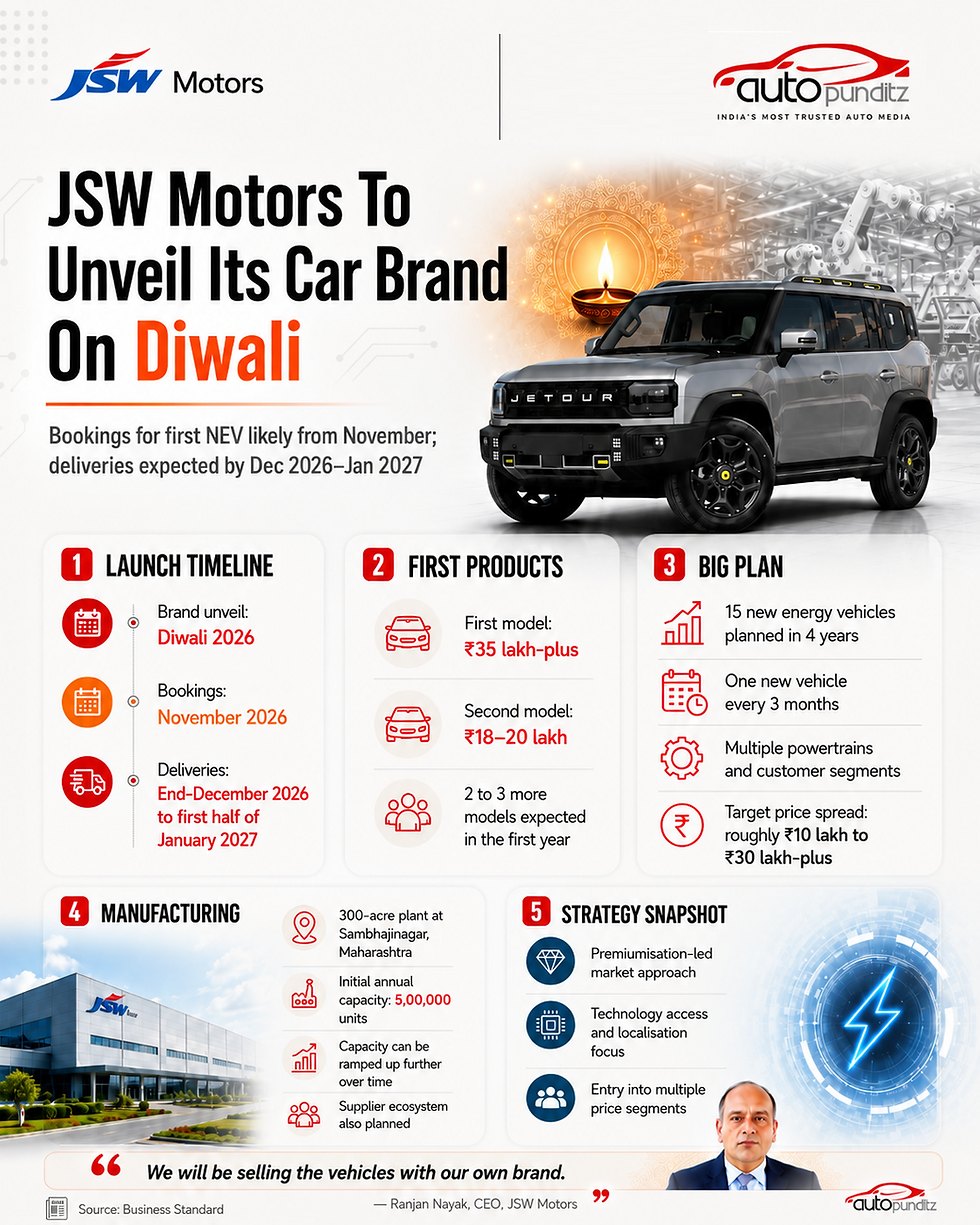
JSW Motors is preparing to make a major entry into India’s passenger vehicle market, with plans to unveil its new car brand around Diwali. The company’s first new energy vehicle is expected to open for bookings in November, with customer deliveries likely to begin either by the end of December 2026 or in the first half of January 2027.
This marks a significant step for the JSW Group, which already has exposure to the passenger vehicle space through its stake in JSW MG Motor. However, the upcoming brand is expected to be positioned as JSW Motors’ own passenger vehicle identity, built around new energy vehicles and localized technology partnerships.
JSW’s First Model To Target Premium End Of The Market
JSW Motors is expected to begin its journey at the upper end of the market. The first offering is likely to be priced above ₹35 lakh and is expected to be a rebadged version of the Jetour T2 from China’s Chery Motors.
This will be followed by another model in the ₹18 lakh–₹20 lakh price bracket. The company is also expected to introduce two to three more models within the first year of operations, indicating an aggressive product rollout strategy from the very beginning.
The Indian electric passenger vehicle market is currently led by Tata Motors and Mahindra, which together control a large share of the battery electric vehicle space. JSW’s entry could add fresh competition, especially if it is able to localize technology and offer multiple body styles across price points.
15 NEV Models Planned In Four Years
JSW Motors has outlined an ambitious product roadmap. The company plans to bring 15 new energy vehicles across different powertrains and customer segments over a four-year period.
The planned price range is expected to stretch from around ₹10 lakh to over ₹30 lakh. This suggests that JSW does not want to remain limited to the premium EV space. Instead, the company appears to be preparing a wide portfolio that can address mass-market, mid-market and premium buyers.
The strategy is not just focused on battery electric vehicles. The broader “new energy vehicle” approach may allow JSW to explore multiple electrified powertrains, depending on market demand, cost structure and technology availability. JSW's aspiration is to become the Maruti of the NEV space.
Expected Product Rollout Plan
JSW Motors’ rollout plan appears aggressive:
Key Area | Plan |
Brand unveiling | Around Diwali |
Bookings | Expected from November |
Deliveries | December-end 2026 or first half of January 2027 |
First model price band | ₹35 lakh-plus |
Second model price band | ₹18 lakh–₹20 lakh |
Total NEV plan | 15 vehicles in four years |
Launch frequency | One new model every three months |
Initial capacity | 5 lakh units annually |
Manufacturing From Sambhajinagar Plant
The upcoming JSW cars are expected to roll out from a 300-acre assembly plant in Sambhajinagar, formerly Aurangabad, in Maharashtra. The facility is expected to start with an initial capacity of around 60 cars per hour, translating to an annual capacity of nearly 5 lakh units.
The plant is expected to be ready around November, in line with the company’s plan to unveil the brand during Diwali and begin bookings soon after. JSW is also believed to have planned scope for future expansion. The capacity can reportedly be ramped up to 10 lakh units annually, and the company has also taken land for developing a supplier ecosystem. This is important because localization will be critical for JSW if it wants to compete in India’s price-sensitive passenger vehicle market.
Why JSW Is Entering Multiple Price Segments
JSW Motors appears to be betting on a long-term shift in India’s passenger vehicle market. As income levels rise, premiumization is expected to increase, and buyers are likely to move from entry-level cars to higher-priced vehicles.
At the same time, the company does not want to restrict itself only to expensive models. JSW is expected to target multiple segments, including ₹10 lakh–₹12 lakh, ₹15 lakh, ₹25 lakh and ₹30 lakh-plus categories.
This approach could help JSW build scale over time. A premium-only strategy may create brand value, but volume will likely come from the ₹10 lakh–₹20 lakh segments, especially if electric and hybrid adoption widens in India.
Technology-Led Strategy With China Partnerships
JSW Motors’ strategy is not to build an all-new product architecture from scratch. Instead, the company is expected to access proven technology from China and localize it for India.
This route can help reduce development time and allow faster product launches. It also fits with JSW’s broader automotive strategy, where partnerships have played an important role. JSW already has a 51% stake in JSW MG Motor, its joint venture with SAIC Motor. The company is also reported to be working with Chery, one of China’s major passenger vehicle exporters, to access and localize technology for India. If executed well, this could give JSW a faster path to market compared to traditional product development cycles.
JSW Could Become A Serious New EV Challenger
India’s EV market is still in its early growth phase. Tata Motors has built a strong lead in electric cars, while Mahindra is also expanding aggressively with born-electric SUVs. Maruti Suzuki, Hyundai, Toyota, Kia and others are also preparing their next set of electrified products.
In this environment, JSW’s entry could be important for three reasons.
First, the company is planning a large manufacturing base from the start. Second, it is looking at a wide product portfolio instead of a single-model entry. Third, its China technology access could help it bring products to India faster.
However, success will depend on pricing, localization, charging ecosystem support, after-sales network, brand trust and long-term product reliability. Indian buyers have become more open to EVs, but they remain highly sensitive to ownership costs and service support.
Auto Punditz Take
JSW Motors’ plan looks bold and well-timed. The Indian passenger vehicle market is moving towards SUVs, premiumization and electrification, and JSW appears to be targeting all three trends together.
The biggest advantage for JSW could be speed. By leveraging Chinese technology and local manufacturing, the company may be able to bring multiple new products in a short span of time. The plan to launch one new model every three months is extremely aggressive and could quickly build showroom excitement.
The challenge, however, will be execution. A new brand needs more than attractive products. It needs a strong dealer network, reliable service support, competitive pricing, battery warranty confidence and clear brand positioning. If JSW can localize effectively and price its vehicles smartly, it could emerge as one of the most serious new challengers in India’s new energy vehicle space by 2027.
Source: Business Standard