


Legendary Group B & Rally Icons: The Cars That Turned Rallying Into Motorsport’s Wildest Era
Rallying has seen many great machines, but nothing matches the madness, innovation and danger of the Group B era. Introduced in 1982, Group B allowed manufacturers huge technical freedom with limited homologation requirements. The result was a short but unforgettable period where road cars became turbocharged, all-wheel-drive, lightweight monsters built for forests, snow, gravel and tarmac.
By 1986, however, the same freedom that made Group B spectacular also made it unsafe. After fatal crashes and poor crowd control, FIA ended Group B for the 1987 WRC season, replacing it with the more regulated Group A category.
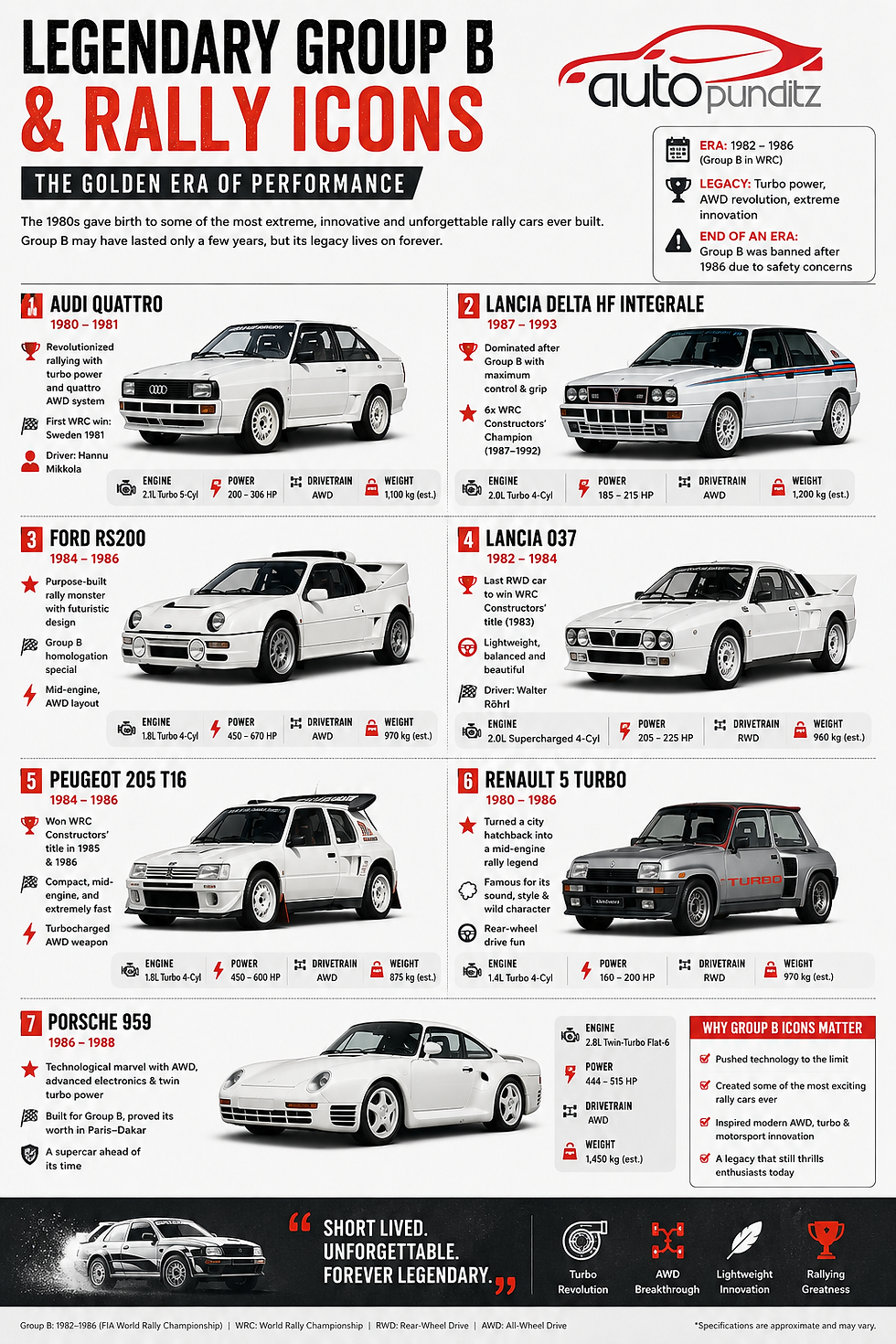
Audi Quattro: The Car That Changed Rallying Forever
The Audi Quattro was the revolution. Before it, rallying was largely dominated by rear-wheel-drive cars. Audi proved that turbocharging and permanent all-wheel drive could rewrite the rulebook.
The Quattro took its first World Rally Championship win in Sweden in 1981 with Hannu Mikkola, while Michèle Mouton’s San Remo victory the same year became a landmark moment for women in motorsport.
Its biggest legacy was not just trophies, but technology. Today, all-wheel drive is common in performance cars and SUVs, and the Quattro played a major role in making that image desirable.
Lancia 037: The Last Rear-Wheel-Drive Hero
The Lancia 037 is remembered as one of the most beautiful and dramatic rally cars ever made. Mid-engined and rear-wheel drive, it fought against the rising all-wheel-drive revolution with balance, traction skill and Italian engineering brilliance.
Its greatest achievement came in 1983, when Lancia won the manufacturers’ title, making the 037 the last rear-wheel-drive car to win the WRC constructors’ championship.
Peugeot 205 T16: The Compact Monster
The Peugeot 205 T16 showed how serious Group B had become. Though it carried the 205 name, the rally car was a purpose-built mid-engined, turbocharged, all-wheel-drive machine.
It won the WRC manufacturers’ title in 1985 and 1986, becoming one of the most successful cars of the Group B era. Its small size, brutal acceleration and advanced layout made it one of the category’s defining machines.
Ford RS200: Too Late, But Unforgettable
The Ford RS200 arrived late in the Group B timeline, but it became one of the most famous homologation specials ever made. Unlike modified road cars, it was designed almost from scratch for rallying.
Its mid-engine layout, all-wheel drive and lightweight construction gave it huge potential. But by the time Ford was ready to exploit it fully, Group B was already nearing its end. Today, the RS200 is among the most collectible rally-bred Fords.
Renault 5 Turbo: The Wild City Car
The Renault 5 Turbo turned a humble hatchback into a mid-engined rally weapon. With swollen arches, a turbocharged engine placed behind the driver and rear-wheel drive, it became one of the most visually striking rally cars of the 1980s.
It was not as dominant as Audi or Peugeot, but its character, sound and extreme packaging made it a cult icon.
Lancia Delta HF Integrale: The Group A King
Strictly speaking, the Lancia Delta HF Integrale was not a Group B car. It became famous after Group B was banned, under Group A regulations. But its achievements were extraordinary.
The Delta HF 4WD debuted at the 1987 Monte Carlo Rally, and Lancia’s Delta-based rally cars won six consecutive WRC constructors’ titles from 1987 to 1992.
It proved that even after Group B’s death, rallying could still produce legends.
Porsche 959: The Supercar With Rally DNA
The Porsche 959 was not a full-time WRC star like the Quattro or 205 T16, but it was deeply connected to the Group B mindset. It was developed as a technological showcase with all-wheel drive, advanced electronics and supercar-level performance.
Its rally fame came mainly through events like the Paris-Dakar, where Porsche demonstrated that high technology could survive extreme endurance conditions.
Why These Cars Still Matter
Group B lasted only a few years, but its impact remains massive. It accelerated the use of turbocharging, all-wheel drive, composite materials and extreme homologation specials. More importantly, it created cars that felt larger than life.
For enthusiasts, these machines are not just old rally cars. They represent a time when manufacturers were willing to build almost anything to win.


