


The Next Generation of Performance Sedans Is Almost Here
BMW M, Ferrari and Mercedes-AMG Are Redefining Speed for the Electric Era
For decades, the performance-sedan formula revolved around large engines, rear-wheel drive and increasingly sophisticated turbocharging. That formula is now undergoing its biggest transformation yet.
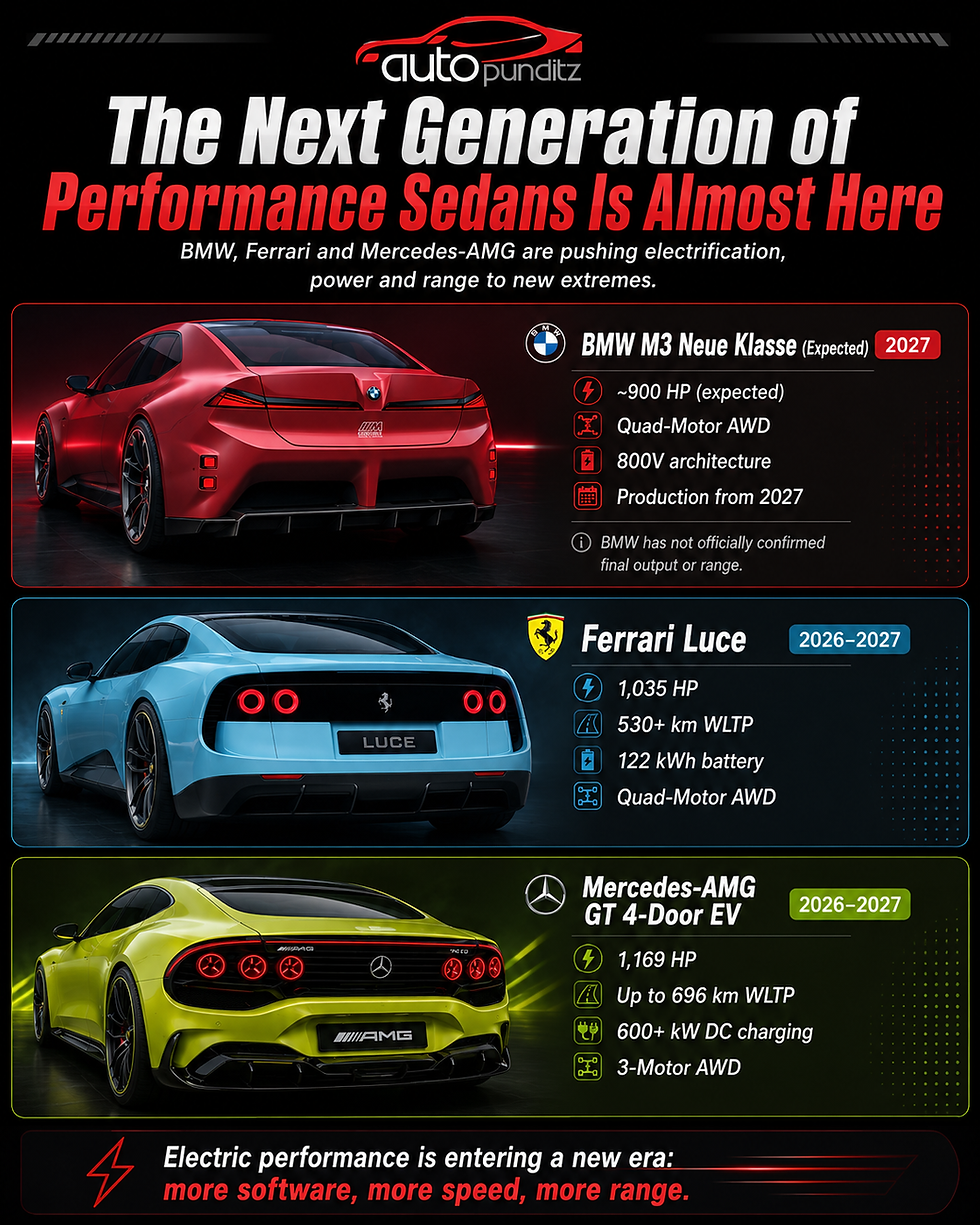
BMW M is developing its first purpose-built electric high-performance model on the Neue Klasse platform. Ferrari has entered the battery-electric segment with the four-door Luce, while Mercedes-AMG has revealed an electric GT 4-Door Coupé producing as much as 1,169 hp.
These cars are not simply conventional performance sedans fitted with electric motors. They introduce multi-motor drivetrains, individually controlled wheels, advanced battery cooling, exceptionally high charging speeds and software capable of coordinating the complete vehicle in real time.
The next generation of performance cars may be quieter, but it certainly will not be slower.
BMW M Neue Klasse: The Electric M3 Takes Shape
BMW has confirmed that its first fully electric next-generation M models will arrive from 2027, based on the company’s Neue Klasse technology.
Although enthusiasts commonly refer to the upcoming sports sedan as the electric M3 or iM3, BMW has not yet confirmed its final production name. What the company has disclosed, however, suggests that this will be far more than a higher-powered version of the forthcoming electric BMW i3 sedan.
The defining feature of the new BMW M eDrive system will be its four-motor configuration, with one electric motor powering each wheel. BMW’s M Dynamic Performance Control will be able to vary torque independently at every corner, giving engineers unprecedented control over traction, cornering balance, energy recuperation and vehicle stability.
The front axle can also be completely disconnected. This would allow the car to operate as a rear-wheel-drive model in certain situations, preserving the handling character associated with BMW M while potentially improving efficiency during motorway driving.
What BMW Has Officially Confirmed
The forthcoming electric BMW M architecture will feature:
Four electric motors, one for each wheel
BMW M Dynamic Performance Control
An 800-volt electrical platform
More than 100 kWh of usable battery capacity
Performance-oriented Gen6 cylindrical battery cells
Advanced battery cooling and energy recuperation
Simulated gearshifts and a newly developed soundscape
Structural integration of the battery with the vehicle body
BMW describes these as the most powerful electric drive units ever developed by its M division. However, it has not disclosed a final combined output or certified driving range.
Consequently, reports suggesting approximately 900 hp and 800 km of WLTP range should currently be treated as estimates rather than confirmed production specifications.
The real significance of the electric M3 successor may not be its headline horsepower figure. With four independently controlled motors and BMW’s centralised “Heart of Joy” vehicle computer, the car could distribute power and regenerative braking in ways that would be impossible with a conventional mechanical differential.
For BMW M, software will increasingly become as important as suspension geometry or engine tuning.
Ferrari Luce: Maranello’s First Electric Car
Ferrari’s entry into the electric-car segment has arrived in the form of the Ferrari Luce, a four-door, five-seat electric grand tourer.
It represents a major departure from Ferrari’s traditional mid-engined and front-engined sports cars. Yet Maranello has attempted to retain its established principles through an in-house-developed electric drivetrain, rear-biased power delivery and a strong focus on driver interaction.
The Luce uses four electric motors, one for each wheel, developing a combined 1,050 cv, equivalent to approximately 1,035 bhp. Ferrari claims a 0–100 km/h time of 2.5 seconds and a top speed of 310 km/h.
Ferrari Luce: Key Specifications
Specification | Ferrari Luce |
Power | 1,050 cv / around 1,035 bhp |
Drivetrain | Quad-motor all-wheel drive |
Battery capacity | 122 kWh |
WLTP range | Over 530 km |
Maximum DC charging | 350 kW |
0–100 km/h | 2.5 seconds |
Top speed | 310 km/h |
Seating | Five |
Doors | Four |
The 122 kWh battery and electric hardware were engineered around a dedicated high-voltage platform. Ferrari claims a WLTP range exceeding 530 km, while maximum DC charging capability stands at 350 kW.
Unlike an electric reinterpretation of an existing Ferrari, the Luce introduces new packaging possibilities. Its four-door layout and five-seat cabin make it the brand’s most spacious and versatile production model. Ferrari says electrification allowed its designers to develop a radically different architecture without abandoning performance.
The Luce’s cabin was developed in collaboration with LoveFrom, the design collective founded by Jony Ive and Marc Newson. Interestingly, it combines digital displays with physical controls rather than relying entirely on touch-sensitive interfaces. European deliveries are expected to begin in late 2026, while its arrival in some markets, including the United States, extends into 2027.
Mercedes-AMG GT 4-Door Coupé: 1,169 HP Becomes Reality
While BMW’s final figures remain under development, Mercedes-AMG has already revealed the production version of its new fully electric GT 4-Door Coupé.
It is the first series-production model based on the dedicated AMG.EA high-performance electric architecture and will be offered in GT 55 and GT 63 forms.
The flagship Mercedes-AMG GT 63 4MATIC+ uses three axial-flux electric motors—two at the rear and one at the front. Peak output reaches 860 kW or 1,169 hp when Launch Control is activated and the battery has sufficient charge. Mercedes-AMG claims:
0–100 km/h in 2.1 seconds
0–200 km/h in 6.4 seconds
A 300 km/h top speed with the optional AMG Driver’s Package
Up to 696 km of WLTP range
More than 600 kW of peak DC charging capability
The less powerful GT 55 still develops 600 kW, or 816 hp, and offers a slightly longer claimed WLTP range of up to 700 km.
Charging Becomes a Performance Metric
One of the AMG’s most remarkable figures is not related to acceleration.
Mercedes claims the battery can accept more than 600 kW of charging power under suitable conditions. It says approximately 460 km of WLTP range can be added in ten minutes, while a 10–80 percent charge can take around 11 minutes.
That level of charging performance requires more than a powerful charger. The battery uses direct cooling to manage cell temperatures and maintain high power during acceleration, repeated hard driving and rapid charging.
This is becoming one of the defining differences between ordinary electric cars and serious performance EVs. Peak horsepower may attract attention, but thermal management determines how frequently that performance can actually be used.
The Specification Comparison
Model | Power | Motors | Claimed range | Launch timing |
BMW M Neue Klasse | Not officially disclosed | Four | Not officially disclosed | From 2027 |
Ferrari Luce | 1,050 cv / around 1,035 bhp | Four | Over 530 km WLTP | Late 2026 onwards |
Mercedes-AMG GT 63 4-Door | 1,169 hp | Three | Up to 696 km WLTP | 2026 onwards |
The comparison also demonstrates how quickly the industry is evolving. Outputs close to or above 1,000 hp are no longer limited to low-volume two-seat hypercars. They are appearing in vehicles with four doors, usable rear seats and substantial driving ranges.
More Than a Horsepower War
It would be easy to view these cars simply as participants in an escalating power contest. However, their engineering suggests that the real transformation is happening beneath the headline numbers.
1. Individual-wheel control
BMW and Ferrari’s quad-motor systems can control torque at each wheel without waiting for a mechanical differential to react. This can improve rotation into a corner, traction on exit and stability under braking.
2. Axial-flux motors
Mercedes-AMG’s axial-flux motors are smaller and lighter relative to their output than many conventional radial-flux units. Their compact dimensions allow AMG to install three motors while preserving the proportions and packaging of a low performance car.
3. Structural batteries
Battery packs are increasingly becoming part of the vehicle’s structure. This can raise body rigidity and help compensate for the weight associated with large-capacity batteries.
4. Thermal performance
Cooling systems must support repeated acceleration, sustained high-speed driving and rapid charging. A car capable of producing enormous power once is less useful than one capable of repeating it consistently.
5. Software-defined handling
Central vehicle computers now coordinate the motors, suspension, steering, brakes and stability systems. The character of a performance car is increasingly being shaped through software calibration as much as through mechanical hardware.
Can Electric Performance Cars Still Feel Emotional?
The central challenge facing BMW M, Ferrari and Mercedes-AMG is not generating speed. Electric motors already provide more than enough acceleration.
The more difficult task is creating involvement.
BMW plans to use simulated gear changes, selectable driving modes and a purpose-developed sound profile. Mercedes-AMG has introduced AMGFORCE S+, which recreates the sensation of gearshifts and a V8-inspired sound experience. Ferrari has developed a system that captures genuine mechanical vibrations from the electric drivetrain instead of merely playing a synthetic soundtrack.
These solutions may divide traditional enthusiasts. Nevertheless, they acknowledge that performance is not solely measured in acceleration times. Rhythm, sound, response and the process of extracting performance are equally important.
What It Means for the Performance-Sedan Segment
The BMW M3, Mercedes-AMG GT 4-Door and Ferrari’s grand touring models have traditionally occupied different parts of the market. Electrification is bringing their engineering philosophies closer together.
All three manufacturers are pursuing:
Outputs approaching or exceeding 1,000 hp
All-wheel drive using multiple electric motors
High-capacity batteries suitable for long-distance use
Extremely rapid DC charging
Advanced torque-vectoring software
Four-door practicality combined with supercar acceleration
The result is a new class of electric performance car that attempts to combine hypercar speed, luxury-car comfort and everyday usability.
There will still be room for combustion-engined and hybrid performance cars. BMW, Ferrari and Mercedes-AMG are not abandoning those powertrains immediately. However, their flagship electric programmes make it clear that battery-powered models are no longer peripheral experiments. They are becoming core performance products.
Conclusion
The next generation of performance sedans and four-door grand tourers is arriving with specifications that would have appeared unrealistic only a few years ago.
BMW M’s Neue Klasse promises a four-motor chassis built around individual-wheel control and racetrack capability. Ferrari’s 1,035 bhp Luce combines its first fully electric drivetrain with four doors and five seats. Mercedes-AMG has raised the benchmark further with a 1,169 hp GT 63 capable of nearly 700 km of claimed WLTP range and charging at more than 600 kW.
Their success will not be determined by horsepower alone. The decisive question is whether these manufacturers can make electric performance feel distinctive, repeatable and emotionally engaging.
The engines may be disappearing, but the performance war is only becoming more intense.


