


Top 10 Global Car Companies By Revenue: Why Volkswagen, Toyota, GM And Ford Still Dominate The Auto Business
- Team Autopunditz
- May 31
- 4 min read
Revenue is one of the clearest ways to understand the true scale of an automobile company. While sales volumes show how many vehicles a company sells, revenue tells a wider story — vehicle pricing, premium positioning, financing operations, parts, services, commercial vehicles, motorcycles and global market spread.
Based on the latest available annual financial results from global automakers, the ranking highlights a list of automobile companies or groups — not individual car badges.
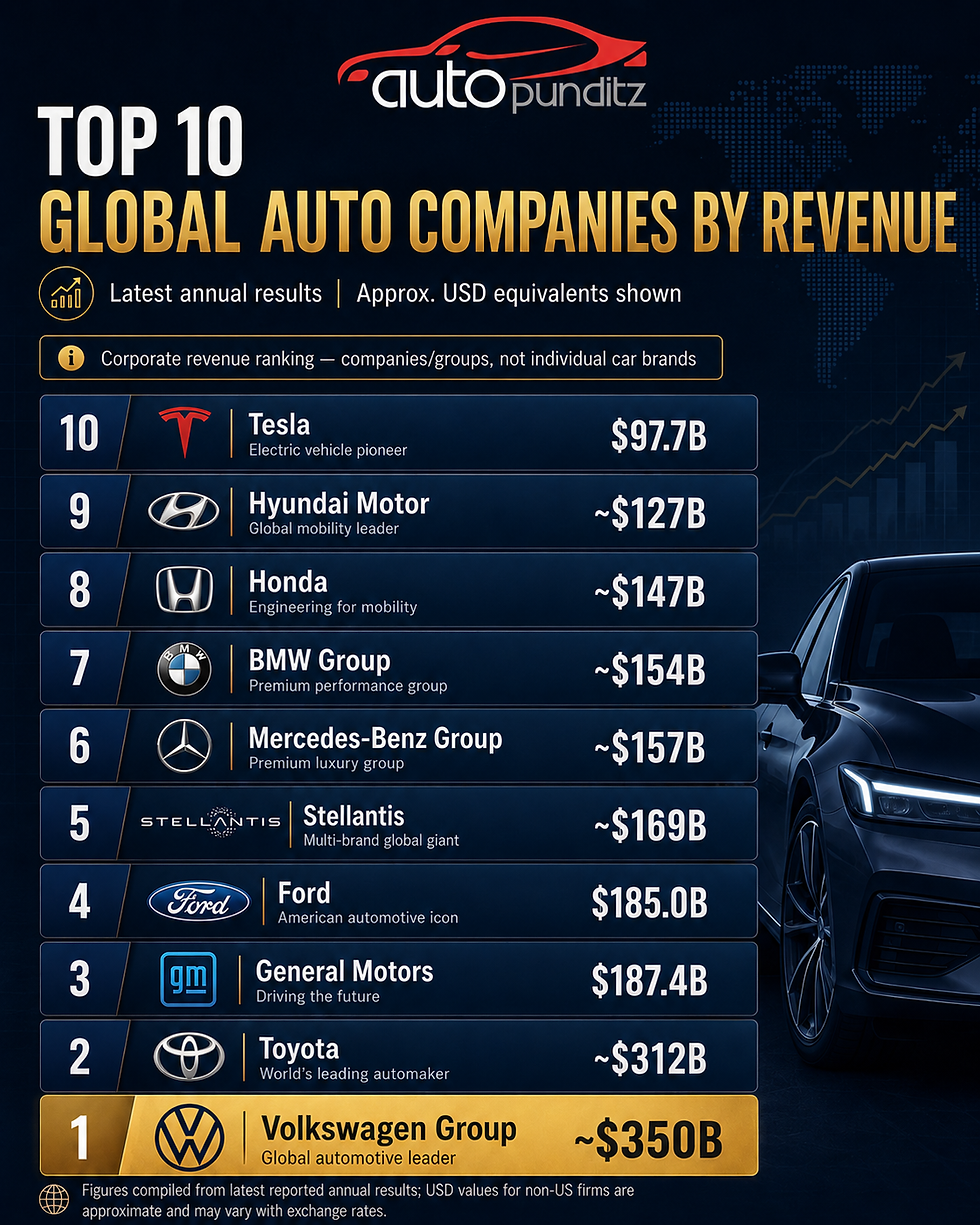
Top 10 Global Auto Companies By Revenue
Rank | Company / Group | Latest reported annual revenue | Approx. USD equivalent* | Notes |
1 | Volkswagen Group | €324.7 billion | ~$350 billion | Includes Volkswagen, Audi, Skoda, Porsche, SEAT/Cupra, Lamborghini, Bentley and commercial vehicle brands |
2 | Toyota Motor Corporation | ¥48.04 trillion | ~$310–315 billion | Toyota remains one of the world’s largest automakers by both volume and revenue |
3 | General Motors | $187.4 billion | $187.4 billion | Chevrolet should be counted under GM, not separately |
4 | Ford Motor Company | ~$185 billion | ~$185 billion | Strong North American truck and commercial vehicle business supports revenue |
5 | Stellantis | €156.9 billion | ~$165–170 billion | Parent of Jeep, Peugeot, Citroen, Fiat, Opel, Ram, Dodge and others |
6 | Mercedes-Benz Group | €145.6 billion | ~$155–160 billion | Premium pricing keeps revenue high despite lower volumes than mass-market giants |
7 | BMW Group | €142.4 billion | ~$150–155 billion | Strong luxury-car and motorcycle portfolio |
8 | Honda Motor Co. | ¥21.69 trillion | ~$145–150 billion | Includes cars, motorcycles, power products and financial services |
9 | Hyundai Motor Company | KRW 175.2 trillion | ~$125–130 billion | Hyundai alone; Kia is listed separately as a separate listed company |
10 | Tesla | $97.69 billion | $97.69 billion | Still smaller by revenue than legacy giants, but larger than many traditional brands on a standalone basis |
*USD values are approximate because companies report in different currencies and fiscal years. The ranking can change slightly depending on the exchange rate used.
Volkswagen Group: The Revenue Leader
Volkswagen Group remains the largest automotive corporate entity by revenue. Its scale comes from a wide brand portfolio spread across mass-market, premium, luxury and performance segments. Volkswagen, Skoda and SEAT/Cupra cover the mainstream market, while Audi, Porsche, Bentley and Lamborghini add premium pricing power.
This is why Volkswagen’s revenue base is much larger than that of a single-brand company. Even if the Volkswagen passenger-car brand faces pressure in China and Europe, the group’s overall structure gives it a massive revenue advantage.
Toyota: The Volume Giant With Massive Revenue Muscle
Toyota is often the world’s largest automaker by vehicle sales volume, but depending on currency conversion, it can rank slightly behind Volkswagen on revenue. Toyota’s revenue strength comes from its global scale, hybrid leadership, strong presence in North America and Asia, Lexus premium vehicles, commercial models and financial services.
The key point is that Toyota and Volkswagen are in a different league from most other automakers. Both generate annual revenue of more than $300 billion equivalent, making them the two biggest forces in the global car business.
GM And Ford: Detroit Still Has Enormous Scale
General Motors and Ford continue to remain among the world’s highest-revenue automakers. GM’s revenue is supported by its strong North American pickup, SUV and full-size vehicle business. Ford’s revenue base is also heavily supported by the F-Series, commercial vehicles, SUVs and its Ford Pro business. Both companies may not match Toyota or Volkswagen globally in volume diversity, but their North American vehicle mix gives them very high revenue per vehicle.
Stellantis: Big Group, Difficult Year
Stellantis remains one of the world’s largest auto groups by revenue because of its huge brand portfolio. It owns Jeep, Ram, Dodge, Chrysler, Fiat, Peugeot, Citroen, Opel, Vauxhall, Alfa Romeo and Maserati, among others.
However, Stellantis’ latest revenue was down sharply year-on-year due to weaker shipments, inventory correction and transition challenges in key markets. The group remains large, but its 2024 performance showed that having many brands does not automatically guarantee momentum.
Mercedes-Benz And BMW: Premium Pricing Power
Mercedes-Benz and BMW rank below the mass-market giants in overall revenue, but both punch far above their volume because of premium pricing. Their business models are not based on chasing the highest number of cars sold. Instead, they generate revenue through luxury cars, performance models, SUVs, financing, aftersales and high-value technology packages. This also explains why premium automakers can rank so high in revenue despite selling far fewer vehicles than Toyota, Volkswagen, Hyundai or Honda.
Honda: More Than Just Cars
Honda’s revenue is often misunderstood because the company is not only a carmaker. It is also one of the world’s largest motorcycle manufacturers and has a large power products and financial services business. This gives Honda a broader revenue base than many car-only comparisons suggest. In automobiles, Honda has faced pressure in China, but its hybrid-heavy strategy in markets like the US has helped support business performance.
Hyundai: A Global Mainstream Powerhouse
Hyundai Motor Company has grown into one of the world’s most important standalone automakers. Its revenue base reflects its strong global presence across SUVs, sedans, EVs, hybrids and emerging-market products. It is important to note that Hyundai and Kia are separate listed companies, even though both are part of the broader Hyundai Motor Group ecosystem. If Hyundai and Kia are combined conceptually as a group, the Korean auto powerhouse would rank much higher globally.
Tesla: High Valuation, But Lower Revenue Than Legacy Giants
Tesla is one of the most valuable auto companies in the world by market capitalisation, but revenue tells a different story. On annual revenue, Tesla is still smaller than Toyota, Volkswagen, GM, Ford, Stellantis, Mercedes-Benz, BMW, Honda and Hyundai. That does not reduce Tesla’s importance. Tesla’s influence on EV adoption, software, charging infrastructure and industry valuation remains enormous. But in a revenue ranking, legacy automakers still dominate because of their scale, brand spread, financing operations and global manufacturing footprint.
Auto Punditz Take
The global auto industry is still dominated by legacy giants when measured by revenue. Volkswagen and Toyota remain in a league of their own, followed by American majors GM and Ford, multi-brand giant Stellantis, and premium German players Mercedes-Benz and BMW.
Tesla’s presence in the top 10 shows how quickly the EV disruptor has scaled, but the company is still far behind the biggest traditional automakers on annual revenue. The bigger lesson is simple: brand popularity, market capitalisation, profitability and revenue are four very different rankings. A company can be highly valuable without being the largest by revenue, and a premium brand can be extremely profitable without being among the biggest revenue generators.


