


2027 Hyundai i20 Leaks Ahead Of Debut: Is Hyundai Turning Its Premium Hatchback Into A Mini Crossover?
- Team Autopunditz
- Jun 12
- 4 min read
The next-generation Hyundai i20 has leaked ahead of its global debut, and the images point to one of the biggest design shifts in the model’s history. The 2027 i20 appears to be moving away from the traditional low-slung premium hatchback formula and adopting a more upright, rugged and crossover-inspired personality.
This is not just a design experiment. It looks like a calculated response to changing buyer preferences, especially in markets like India where premium hatchbacks are increasingly under pressure from sub-4-metre SUVs.
The current i20 remains one of the most aspirational hatchbacks in India, but the market around it has changed dramatically. Buyers who once upgraded from entry hatchbacks to premium hatchbacks are now considering compact SUVs for their road presence, seating position and perceived value. Hyundai seems to have recognised this shift and is preparing the new i20 with a bolder, more SUV-like identity.
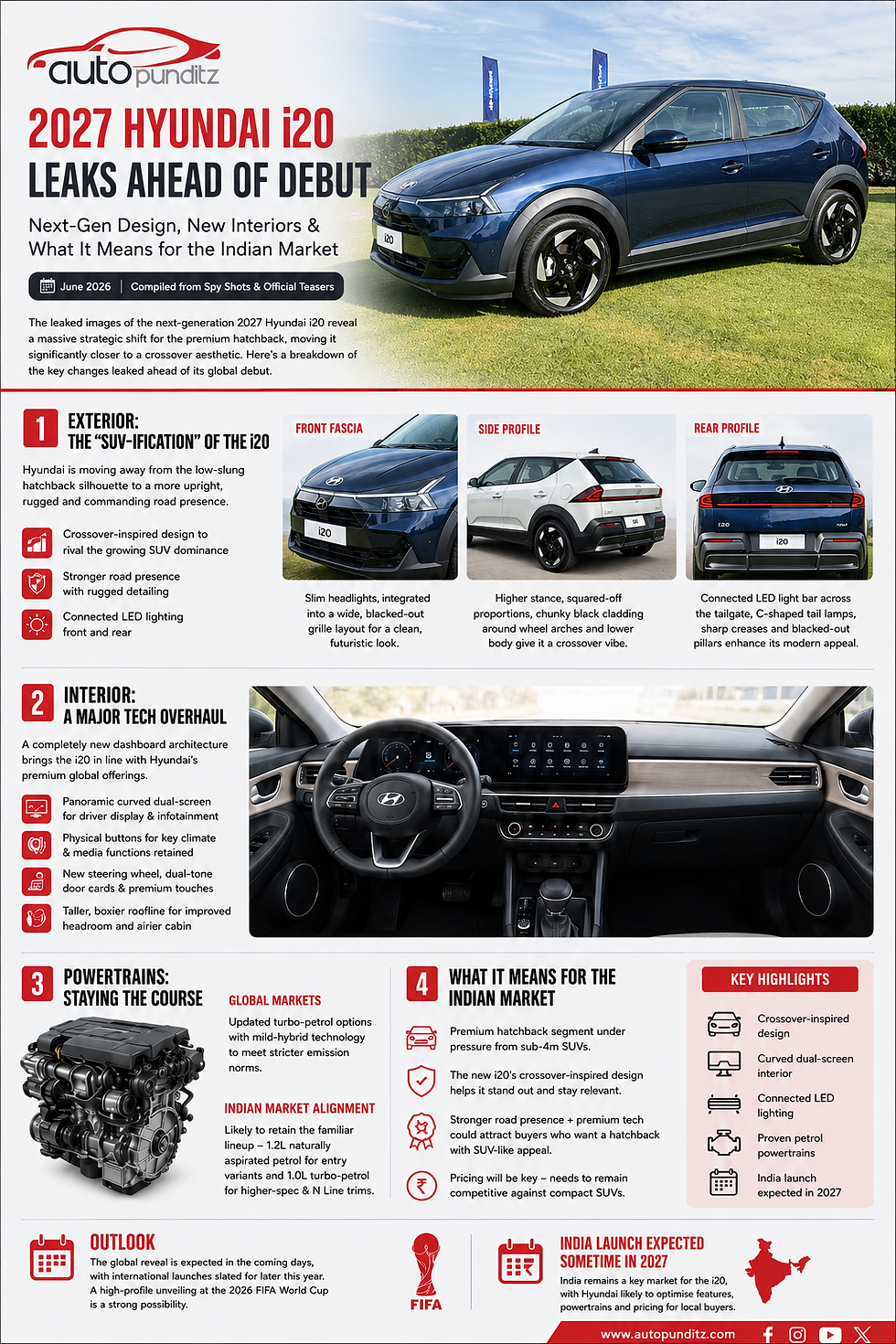
Exterior: The SUV-ification Of The Hyundai i20
The most striking change in the leaked images is the stance. The next-generation i20 looks taller, boxier and more muscular than the outgoing model. While it remains a hatchback at its core, the visual treatment clearly moves it closer to a crossover.
The front fascia adopts a cleaner and more futuristic layout. Slim lighting elements, a wide blacked-out grille area and sharper surfacing give the car a more premium and global look. Hyundai’s recent teasers have also confirmed connected LED lighting elements, which are fast becoming a key design signature across modern Hyundai models.
The side profile appears more upright, with chunky black cladding around the wheel arches and lower body. This gives the car a tougher visual character and helps it stand apart from conventional hatchbacks. The blacked-out pillars, sharper creases and larger-looking wheels further add to its crossover-like appeal.
At the rear, the new i20 gets a full-width connected LED light bar, C-shaped tail-lamp elements and a more sculpted tailgate. This rear treatment brings it closer to Hyundai’s latest global design language and should give the hatchback a much stronger road presence.
Interior: A Big Technology Leap
The cabin is expected to receive an equally significant overhaul. Spy shots and teasers suggest that the new i20 will feature a modern curved dual-screen layout, combining the digital instrument cluster and infotainment touchscreen into a single integrated display housing.
This setup is similar in approach to Hyundai’s newer global models and the latest Venue-style dashboard architecture. It should make the i20 feel far more premium than before, especially in the higher trims.
Hyundai also appears to have retained physical controls for key climate and media functions, which is a practical move. While many carmakers are shifting aggressively towards touch-based controls, physical buttons remain easier to use while driving.
Other expected cabin highlights include a redesigned steering wheel, new dual-tone door pads, circular speaker elements, revised grab handles and a cleaner centre console layout. The taller roofline and boxier proportions could also improve headroom and make the cabin feel airier than the current model.
For India, this interior upgrade will be critical. Premium hatchback buyers now expect features that were once limited to SUVs — large screens, connected tech, premium upholstery, rear AC vents, multiple charging ports and advanced safety equipment. The new i20 seems designed to address exactly that expectation.
Powertrains: Evolution, Not Revolution
While Hyundai has not officially revealed the full powertrain details, the next-generation i20 is expected to continue with petrol-led engine options. In global markets, updated turbo-petrol engines with mild-hybrid assistance could be offered to meet stricter emission norms.
For India, Hyundai is likely to take a more familiar route. The current 1.2-litre naturally aspirated petrol engine could continue for the mainstream variants, while the 1.0-litre turbo-petrol may remain reserved for higher trims or the N Line version.
This would be a sensible strategy. The i20’s biggest strength in India has always been its premium positioning, refinement and feature package rather than radical mechanical experimentation. Retaining proven engines would help Hyundai manage costs while focusing on design, features and cabin experience.
What It Means For The Indian Market
The next-generation i20 could be very important for Hyundai India. The premium hatchback segment has lost some of its earlier momentum as compact SUVs have become more aspirational and better packaged. Cars like the Hyundai Venue, Tata Nexon, Maruti Brezza, Kia Sonet and Mahindra XUV 3XO have pulled buyers away from traditional hatchbacks.
This is where the new i20’s crossover-inspired design becomes strategically relevant. Hyundai does not appear to be abandoning the hatchback formula; instead, it is trying to make the hatchback feel more SUV-like without fully turning it into one.
If priced correctly, the new i20 could appeal to buyers who want the premium feel and ease of use of a hatchback but also desire a stronger road presence. It could also help Hyundai protect the i20 brand from being squeezed between affordable hatchbacks and compact SUVs.
However, pricing will be the key challenge. If the new i20 becomes too expensive, buyers may simply move to compact SUVs. Hyundai will need to offer a clear value ladder, with well-equipped mid variants and feature-loaded top trims that justify the premium.
India Launch Timeline
The global debut of the next-generation Hyundai i20 is expected soon, with international launches likely to begin later. An India launch is expected sometime in 2027, though Hyundai has not officially confirmed the exact timeline.
Given India’s importance for the i20 nameplate, the model is highly likely to be considered for our market. However, the India-spec version may differ slightly in terms of features, powertrains and variant positioning.
The 2027 Hyundai i20 looks like a major strategic repositioning of the premium hatchback. Instead of fighting compact SUVs with a conventional hatchback design, Hyundai seems to be giving the i20 a tougher, taller and more technology-rich personality.
This could be the right move for India. The premium hatchback segment still has buyers, but they now want more than just style and features. They want presence, practicality and a sense of modernity. The new i20 appears to address all three.
If Hyundai can bring the next-generation i20 to India with aggressive pricing and the right feature mix, it could help revive interest in the premium hatchback space. More importantly, it could prove that hatchbacks still have a future — provided they evolve with the market.


