


BYD Targets Toyota’s Global Sales Crown: Can China’s EV Giant Become the World’s Largest Automaker?
For decades, Toyota has represented the benchmark for global automotive success. Its reputation for reliability, manufacturing excellence, hybrid leadership, and worldwide scale has kept it at the top of the global sales charts.
Now, one company believes it can change that.
Chinese automotive giant BYD has publicly declared its ambition to overtake Toyota and become the world’s largest automaker within the next five years. While the target may initially sound ambitious, BYD’s extraordinary growth trajectory suggests it deserves to be taken seriously.
The bigger question isn’t whether BYD is growing rapidly—it clearly is. The real question is whether the company can double its sales while expanding across Europe, Southeast Asia, Latin America, Australia and other global markets without relying on the United States.
A Bold Target
BYD founder Wang Chuanfu recently set an internal goal of becoming the world’s largest carmaker within five years. Reinforcing that ambition, Stella Li, Executive Vice President and head of BYD’s global operations, stated that the company can achieve this milestone through organic growth, without acquisitions and even without entering the U.S. passenger vehicle market.
Considering Toyota currently sells more than twice as many vehicles annually as BYD, the challenge is enormous.
However, BYD is no longer just another Chinese EV manufacturer.
BYD’s Growth Has Been Unprecedented
A decade ago, BYD was primarily known as a battery manufacturer.
Today it is one of the world’s largest producers of battery electric vehicles (BEVs) and plug-in hybrid electric vehicles (PHEVs), with an increasingly diversified global portfolio spanning affordable city cars, premium SUVs, luxury sedans, buses and commercial vehicles.
Its rise has been driven by several competitive advantages:
Industry-leading battery technology, including Blade Battery
Strong vertical integration, manufacturing batteries, semiconductors and power electronics in-house
Aggressive pricing enabled by manufacturing scale
Rapid product development cycles
Leadership in both BEVs and plug-in hybrids
Unlike several EV startups that rely heavily on external suppliers, BYD controls much of its value chain, giving it significant cost and supply-chain advantages.
Why BYD Believes It Can Catch Toyota
1. Explosive Overseas Expansion
China is becoming an increasingly competitive automotive market, prompting BYD to accelerate international expansion.
The company is rapidly strengthening its presence in:
Europe
Southeast Asia
Australia
Latin America
Middle East
Africa
It is also investing heavily in overseas manufacturing facilities to reduce tariff exposure and improve regional competitiveness.
2. Technology as the Differentiator
Rather than competing purely on price, BYD wants to win through technology.
Recent developments include:
Ultra-fast charging systems
Advanced driver assistance technologies
High-efficiency hybrid powertrains
Next-generation battery innovations
Premium Denza models targeting German luxury brands
The company plans to install thousands of ultra-fast chargers across Europe to strengthen its premium ecosystem.
3. Strong Presence Across Multiple Segments
Unlike many EV specialists, BYD is not betting solely on battery electric vehicles.
Its portfolio includes:
Compact EVs
Premium EVs
Plug-in hybrids
Luxury vehicles
Commercial vehicles
Pickup trucks
MPVs
This broad product mix allows the company to address markets where charging infrastructure is still developing.
Can BYD Really Beat Toyota?
The numbers highlight the scale of the challenge.
Toyota continues to benefit from:
Manufacturing operations in over 25 countries
Strong customer trust built over decades
Dominance in hybrids
Extensive dealer and service networks
Consistent profitability
BYD, meanwhile, still faces several hurdles:
Limited brand recognition in many mature markets
Political and trade barriers in North America and Europe
Rising competition from Tesla, Geely, Hyundai, Volkswagen and others
Pressure from China’s ongoing price war
Recent domestic demand has softened amid subsidy changes and intense pricing competition, making overseas growth increasingly critical for BYD’s long-term strategy.
The Irony: BYD Already Works With Toyota
Interestingly, the two companies are not just competitors.
Toyota and BYD have collaborated on electric vehicle development for the Chinese market, with several Toyota EVs using BYD-developed technologies and batteries. This partnership illustrates how even established global manufacturers increasingly rely on Chinese EV expertise for local competitiveness.
What This Means for India
Although BYD’s passenger vehicle business in India remains relatively small, its global ambitions could have significant implications.
Faster Technology Adoption
As BYD scales globally, expect faster deployment of:
High-density batteries
Faster charging
Software-defined vehicles
Advanced hybrid systems
Increased Competitive Pressure
Toyota, Hyundai, Tata Motors, Mahindra, JSW MG Motor, Maruti Suzuki and other manufacturers may need to accelerate electrification and technology investments to stay competitive.
More Affordable EVs
Global competition typically drives innovation while reducing costs, potentially benefiting Indian consumers through better-equipped vehicles and more competitive pricing.
Supply Chain Opportunities
India’s growing automotive manufacturing ecosystem could benefit as global OEMs diversify production and component sourcing outside China.
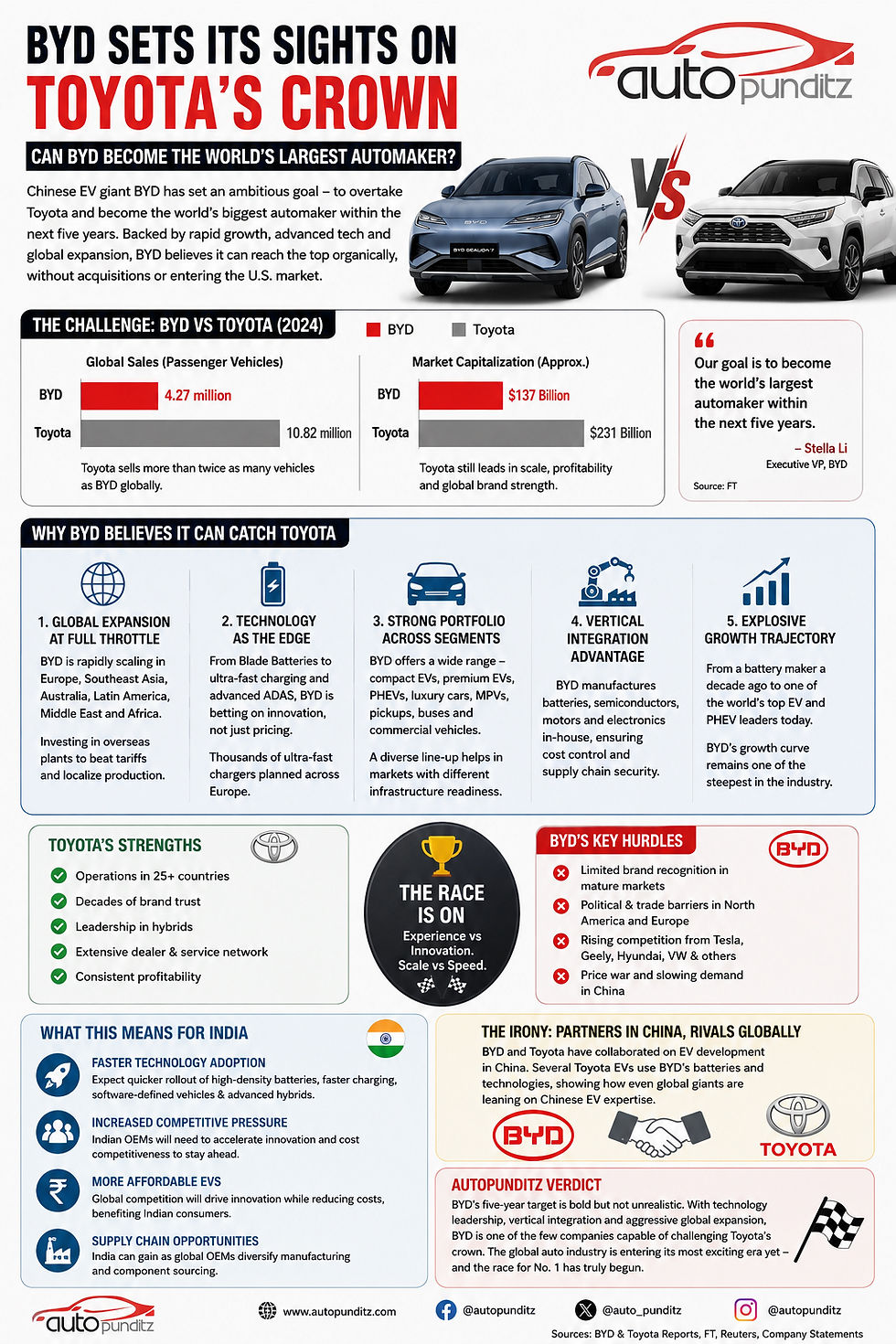
Auto Punditz Verdict
Five years ago, the idea of BYD challenging Toyota for the global sales crown would have sounded unrealistic.
Today, it appears far more plausible.
Toyota still enjoys unmatched scale, customer loyalty and manufacturing excellence. Yet BYD has emerged as one of the fastest-growing automotive companies in history, backed by battery leadership, vertical integration, competitive pricing and an aggressive international expansion strategy.
Whether BYD ultimately surpasses Toyota remains uncertain, but one thing is already clear:
The global automotive industry is no longer being reshaped solely by Detroit, Stuttgart or Tokyo. Increasingly, the future of mobility is being defined in Shenzhen.
And every established automaker is paying close attention.


