


H1 2026 Luxury Car Sales: Mercedes-Benz Leads India Again
India's luxury car market continued its upward trajectory in the first half of 2026, recording a healthy 4% year-on-year growth despite macroeconomic uncertainties. Mercedes-Benz successfully defended its leadership position, while BMW posted the fastest growth among the top luxury manufacturers, highlighting the increasing appetite for premium vehicles among affluent Indian buyers.
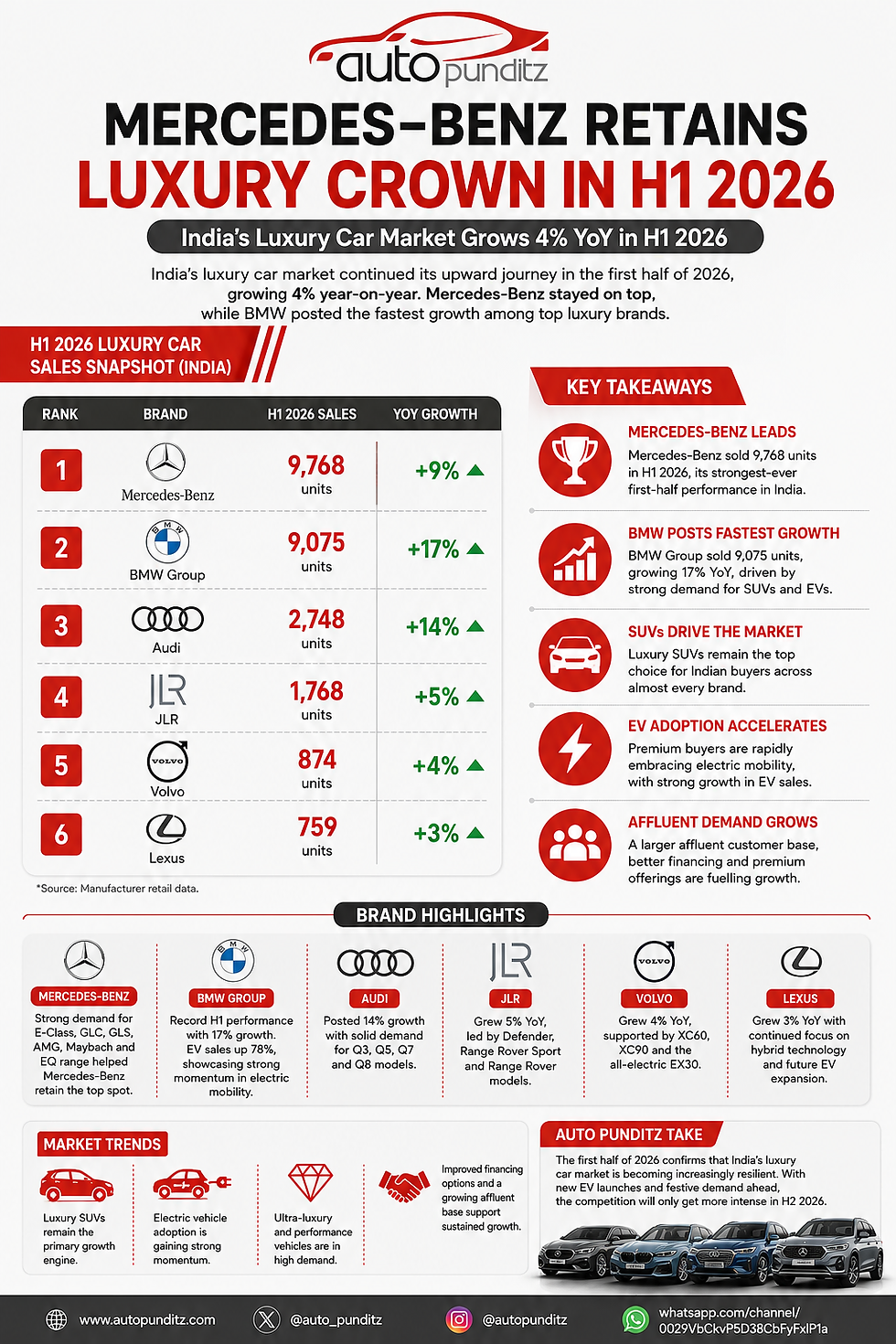
H1 2026 Luxury Car Sales (India)
Rank | Brand | H1 2026 Sales | YoY Growth |
1 | Mercedes-Benz | 9,768 | +9% |
2 | BMW Group | 9,075 | +17% |
3 | Audi | 2,748 | +14% |
4 | JLR | 1,768 | +5% |
5 | Volvo | 874 | +4% |
6 | Lexus | 759 | +3% |
Mercedes-Benz Leads the Pack
Mercedes-Benz India retained its position as the country's best-selling luxury carmaker by retailing 9,768 units between January and June 2026, representing a 9% year-on-year growth and marking the brand's strongest-ever first-half performance in India. The company continued to benefit from strong demand across its core portfolio, including the E-Class, GLC, GLS and its expanding electric vehicle range.
The German luxury marque has also witnessed increasing demand for its high-end AMG, Maybach and EQ models, reflecting a shift in customer preference towards premium and performance-oriented offerings.
BMW Closes the Gap with Record Growth
BMW Group India delivered a record 9,075 cars during H1 2026, registering an impressive 17% growth, making it the fastest-growing luxury brand among the top players. The performance was driven by strong demand for SUVs, premium sedans and a rapidly expanding electric vehicle portfolio.
The company's EV sales surged by 78%, underlining the growing acceptance of luxury electric mobility in India.
Audi Strengthens Recovery
Audi India maintained its third position in the luxury market with 2,748 units, registering a healthy 14% year-on-year increase. The brand's growth was supported by sustained demand for models such as the Q3, Q5, Q7 and Q8, along with improved product availability.
Although it trails the two German giants by a considerable margin, Audi continues to rebuild momentum in the Indian market.
JLR Continues Premium SUV Momentum
Jaguar Land Rover (JLR) recorded 1,768 units, growing 5% over H1 2025. The Land Rover Defender, Range Rover Sport and Range Rover remained the key volume contributors, reinforcing India's growing preference for luxury SUVs.
The company's focus on locally assembled models and premium SUVs continues to resonate with buyers seeking exclusivity and capability.
Volvo and Lexus Maintain Steady Growth
Volvo India retailed 874 units, reflecting 4% growth compared to the same period last year. Updated XC60 and XC90 SUVs, along with the EX30 electric SUV, contributed positively to volumes. The company is expected to further strengthen its EV portfolio with the upcoming EX90 and ES90.
Lexus India followed with 759 units, posting 3% growth. The Japanese luxury brand continues to focus on hybrid technology while preparing to expand its electrified product range in India.
Auto Punditz Take
The first half of 2026 confirms that India's luxury car market is becoming increasingly resilient. Mercedes-Benz continues to dominate through its diversified portfolio and strong brand equity, but BMW is narrowing the gap with aggressive product launches and rapid EV adoption.
Luxury buyers today are no longer purchasing solely for brand prestige—they are prioritising technology, electrification, performance and personalised ownership experiences. This evolving customer mindset is expected to intensify competition over the coming months as Audi, Volvo, JLR and Lexus introduce new electric and hybrid offerings.
With the festive season approaching and several high-profile launches lined up, H2 2026 is likely to witness an even stronger battle in India's premium automotive segment.


