


Hero Launches Flex-Fuel Splendor & HF Deluxe: India’s Commuter Motorcycle Segment Gets Its Ethanol Moment
- Team Autopunditz
- Jun 3
- 5 min read
Hero MotoCorp has taken a significant step in India’s alternative-fuel journey by launching flex-fuel versions of two of its most important commuter motorcycles — the Splendor+ and HF Deluxe. The move is important not just because it introduces ethanol-ready technology in the two-wheeler space, but because Hero has chosen its highest-volume mass-market nameplates to begin the transition.
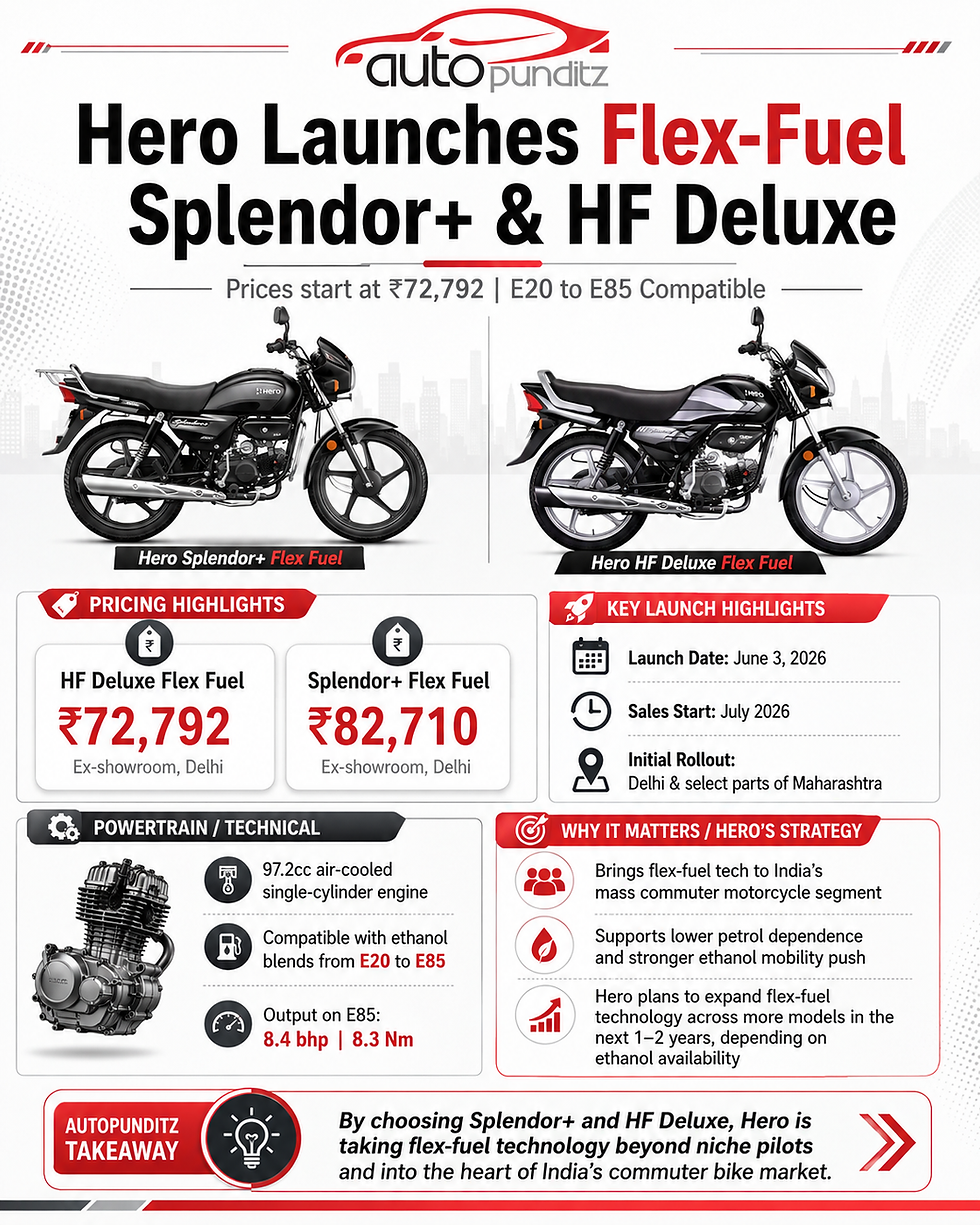
The Hero Splendor+ Flex Fuel has been priced at ₹82,710, while the Hero HF Deluxe Flex Fuel is priced at ₹72,792. Both prices are ex-showroom, Delhi. The motorcycles are compatible with ethanol blends ranging from E20 to E85 and are expected to go on sale from July 2026, initially in Delhi and select regions of Maharashtra, followed by a wider rollout later.
Hero Flex-Fuel Motorcycle Prices
Model | Price, ex-showroom Delhi | Fuel Compatibility |
Hero HF Deluxe Flex Fuel | ₹72,792 | E20 to E85 |
Hero Splendor+ Flex Fuel | ₹82,710 | E20 to E85 |
Why the Pricing Matters
The pricing shows that Hero is trying to keep flex-fuel technology within reach of India’s commuter motorcycle buyers. The HF Deluxe Flex Fuel starts at ₹72,792, making it the more accessible of the two ethanol-compatible models, while the Splendor+ Flex Fuel sits at ₹82,710.
This is important because both motorcycles operate in a highly price-sensitive segment where even a small premium can influence buying decisions. Hero’s strategy appears to be focused on making flex-fuel technology commercially viable in the mass commuter category rather than positioning it as a niche or premium experiment.
The HF Deluxe Flex Fuel is particularly notable because its price places it close to some of Hero’s higher-spec regular HF Deluxe variants. This could help reduce customer hesitation if ethanol fuel availability improves in the coming months.
Why Hero Chose Splendor and HF Deluxe First
Hero could have introduced flex-fuel technology on a niche product or a premium motorcycle, but the company instead selected Splendor and HF Deluxe — two of its strongest volume drivers. That choice is strategically important.
Hero says the Splendor and HF families together account for roughly one in every three motorcycles on Indian roads, making them among the most influential commuter motorcycle nameplates in the country. By introducing flex-fuel technology on these platforms, Hero is attempting to take alternative fuel adoption beyond pilot projects and into the hands of everyday Indian commuters.
What Is a Flex-Fuel Motorcycle?
A flex-fuel vehicle is designed to run on petrol as well as higher ethanol-petrol blends. Ethanol is an alcohol-based fuel generally produced from agricultural feedstock such as sugarcane, maize and other biomass sources.
In India, petrol with 20% ethanol blending, known as E20, has already become a major policy focus. Flex-fuel vehicles go a step further by being capable of handling much higher ethanol content, depending on engine calibration, material compatibility and fuel system design.
The new Hero Splendor+ Flex Fuel and HF Deluxe Flex Fuel can run on blends from E20 to E85, which means they are engineered to handle fuel containing up to 85% ethanol. This requires changes in areas such as fuel lines, seals, filtration, ECU calibration and combustion management.
What Changes Has Hero Made?
To make the motorcycles compatible with higher ethanol blends, Hero has reportedly changed multiple components compared to the regular petrol variants. These include changes to the fuel system, filtration and engine control mapping to support operation on E85 fuel.
This is important because ethanol behaves differently from petrol. It has different combustion properties and can affect components if the vehicle is not engineered for higher ethanol content. Flex-fuel compatibility therefore requires more than simply filling ethanol-blended fuel into a regular motorcycle.
Performance on E85 Fuel
According to reports, both bikes continue to use Hero’s familiar 97.2cc air-cooled, single-cylinder engine. When running on E85 fuel, the motorcycles are claimed to produce 8.4 bhp and 8.3 Nm of torque, which is slightly higher than the regular petrol versions.
This means Hero has managed to introduce ethanol compatibility without diluting the core commuter-bike proposition. The focus remains on affordability, reliability and everyday usability.
Why This Launch Matters for India
India imports a large share of its crude oil requirement, making the country vulnerable to global crude price volatility and supply disruptions. Ethanol blending has therefore become a key part of India’s broader energy security strategy.
For the government, ethanol offers multiple benefits. It can reduce crude oil imports, support domestic agriculture, create demand for ethanol producers and lower certain tailpipe emissions. For automakers, it provides a bridge technology between traditional petrol vehicles and full electrification.
For two-wheelers, the opportunity is especially large. India is one of the world’s biggest two-wheeler markets, and motorcycles remain the primary mobility solution for millions of households. Even a small improvement in fuel diversification across this segment can have a meaningful impact at national scale.
Hero’s decision to bring flex-fuel technology to its commuter range aligns well with this policy direction.
Ethanol vs EVs: Not a Replacement, But a Parallel Route
Hero’s flex-fuel move should not be seen as a shift away from electric mobility. Instead, it reflects a more diversified approach to cleaner mobility. India’s two-wheeler market is too large and varied for a single technology solution. Electric scooters and motorcycles will continue to grow, especially in urban usage patterns. However, for long-distance rural users, price-sensitive buyers and regions with slower charging infrastructure development, internal combustion motorcycles are likely to remain relevant for several years.
This is where ethanol can play a role. Flex-fuel motorcycles can allow existing ICE architecture to become cleaner and less dependent on pure petrol, while retaining the affordability, range and refuelling convenience that commuter buyers expect.
The Big Challenge: Fuel Availability
The success of Hero’s flex-fuel motorcycles will depend heavily on fuel availability. Launching ethanol-compatible motorcycles is only one part of the equation. For customers to benefit, higher ethanol blends must be available at fuel stations in a reliable and widespread manner.
At present, India’s ethanol blending programme has progressed rapidly, especially around E20 petrol. However, higher ethanol blends such as E85 would require deeper coordination between oil marketing companies, fuel retailers, automakers and regulators. Without sufficient availability of higher ethanol blends, flex-fuel motorcycles may remain technologically ready but commercially limited.
What It Means for Customers
For regular commuter motorcycle buyers, the key questions will be simple: Will the bike cost more? Will mileage be affected? Will maintenance change? Will ethanol fuel be cheaper or more easily available?
These questions will determine real-world adoption. Ethanol has lower energy density than petrol, which can affect fuel efficiency depending on the blend and engine calibration. At the same time, ethanol can support cleaner combustion and reduce dependence on fossil petrol. For customers, the value proposition will depend on the price difference between fuels, running cost, availability and long-term reliability.
Hero will need to communicate these benefits clearly, especially because Splendor and HF Deluxe buyers are highly value-conscious. In this segment, even small changes in running cost or maintenance perception can influence purchase decisions.
Auto Punditz Take
Hero’s flex-fuel Splendor+ and HF Deluxe launch is one of the most significant alternative-fuel moves in India’s two-wheeler market because it targets scale from day one.
The pricing is equally important. At ₹72,792 for the HF Deluxe Flex Fuel and ₹82,710 for the Splendor+ Flex Fuel, Hero has kept the technology within the mass commuter space instead of pushing it into a premium niche. Instead of treating ethanol as an experimental technology, Hero has placed it directly into the commuter motorcycle segment — the heart of Indian two-wheeler mobility. This makes the development strategically important for both Hero and India’s ethanol mobility roadmap.
That said, the success of this move will depend less on the motorcycles themselves and more on the ecosystem around them. Fuel availability, price advantage, customer education and real-world mileage will decide whether flex-fuel motorcycles become mainstream or remain a policy-aligned niche.
For now, Hero has made the first major move. If ethanol distribution catches up, India’s best-selling commuter motorcycles could become the first real mass-market bridge between petrol mobility and cleaner domestic fuel alternatives.


