Honda’s India Strategy Reset: Tata Technologies Partnership Could Shape Its Next Growth Phase
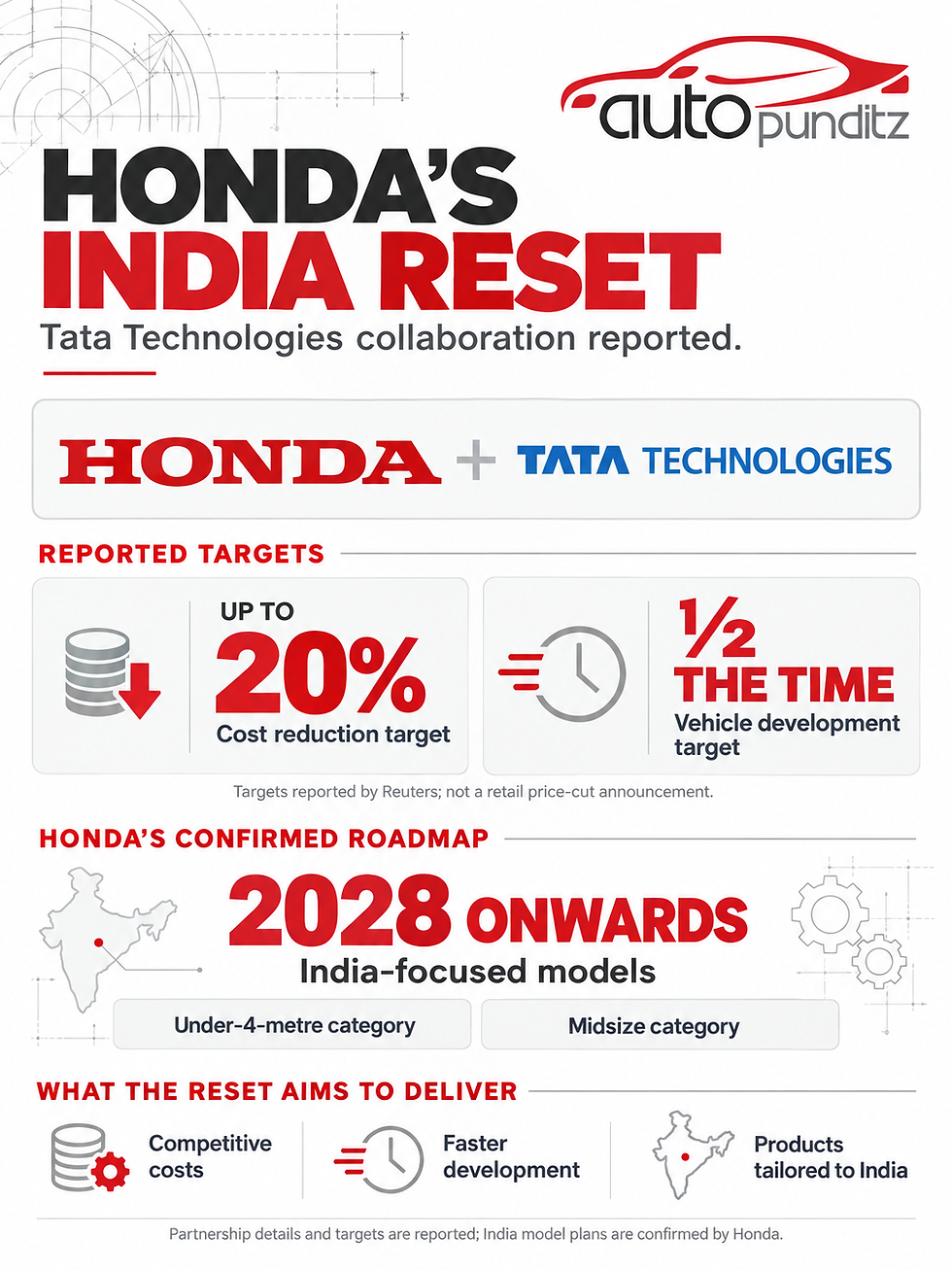
Honda’s next phase in India could involve a significant change in how it develops cars. According to Reuters, the Japanese manufacturer has partnered with Tata Technologies for India-focused vehicle development, targeting cost reductions of up to 20% and development timelines roughly half their current length. A sub-four-metre SUV is reportedly targeted for 2028. These details are attributed to unnamed sources. Honda denied the report’s account of internal disagreements over supplier selection.
For Honda, the potential importance of this arrangement goes beyond outsourcing engineering work. It could help the company build products around Indian customers’ budgets and expectations earlier in the development process.
Honda’s official roadmap provides the broader context. At its May 2026 business briefing, the company named India, Japan and North America as priority markets. It confirmed that India-specific strategic models would begin arriving in 2028, covering vehicles below four metres in length and the midsize category. Honda also outlined greater use of external resources and local cost advantages as part of its global restructuring.
Affordability begins at the development stage
The biggest potential benefit lies in how early cost decisions are made.
A vehicle’s eventual showroom positioning depends on choices taken well before production starts. Component selection, engineering requirements, manufacturing complexity and the number of variants all influence what a manufacturer can offer at a particular price.
Bringing local engineering expertise into this process could give Honda more flexibility to balance equipment, quality and affordability. Savings could support more competitive pricing, additional features or healthier margins that help sustain future investment.
However, the reported cost-reduction target should not be read as an equivalent reduction in vehicle prices. Development savings and customer-facing prices are different measures, and Honda has not announced pricing for these future products.
A faster response to buyers
Shorter development cycles could also help Honda respond more quickly to changing customer preferences. Features and cabin technology selected at the start of a lengthy programme can lose their competitive advantage before a vehicle reaches showrooms.
Honda’s global strategy already includes an ambition to halve development costs, workload and timelines against its 2025 baseline. The company has outlined different implementation schedules for minor updates and full model changes, making this a broader organisational effort.
The practical challenge will be maintaining product consistency while speeding up decisions. Faster engineering only creates lasting value if the finished vehicle meets expectations through everyday ownership.
The opportunity extends to first-time car buyers
Honda has also identified customers moving from motorcycles into cars as an opportunity in India. Its official plans include digital initiatives and a captive finance operation to support business growth.
For this audience, affordability extends beyond the purchase price. Monthly instalments, fuel expenditure, maintenance costs and family practicality all matter. An India-focused product strategy therefore needs to address the complete ownership experience.
Auto Punditz Perspective
The reported collaboration is a meaningful development because it could change the economics behind Honda’s future products. Its success will ultimately be measured through competitive launch prices, sensible variants, timely introductions and sustained demand.
The 2028 product cycle will be an important test: can Honda turn a revised development approach into cars that more Indian buyers want—and can comfortably afford?