5th-Gen Hyundai Tucson Hybrid Details Revealed – 245 PS, 17.4 km/l and Next-Gen Hybrid Tech
Hyundai Motor has released detailed technical specifications for the fifth-generation Tucson, revealing a significantly upgraded hybrid powertrain, larger dimensions and a technology-heavy cabin for its global best-selling SUV.
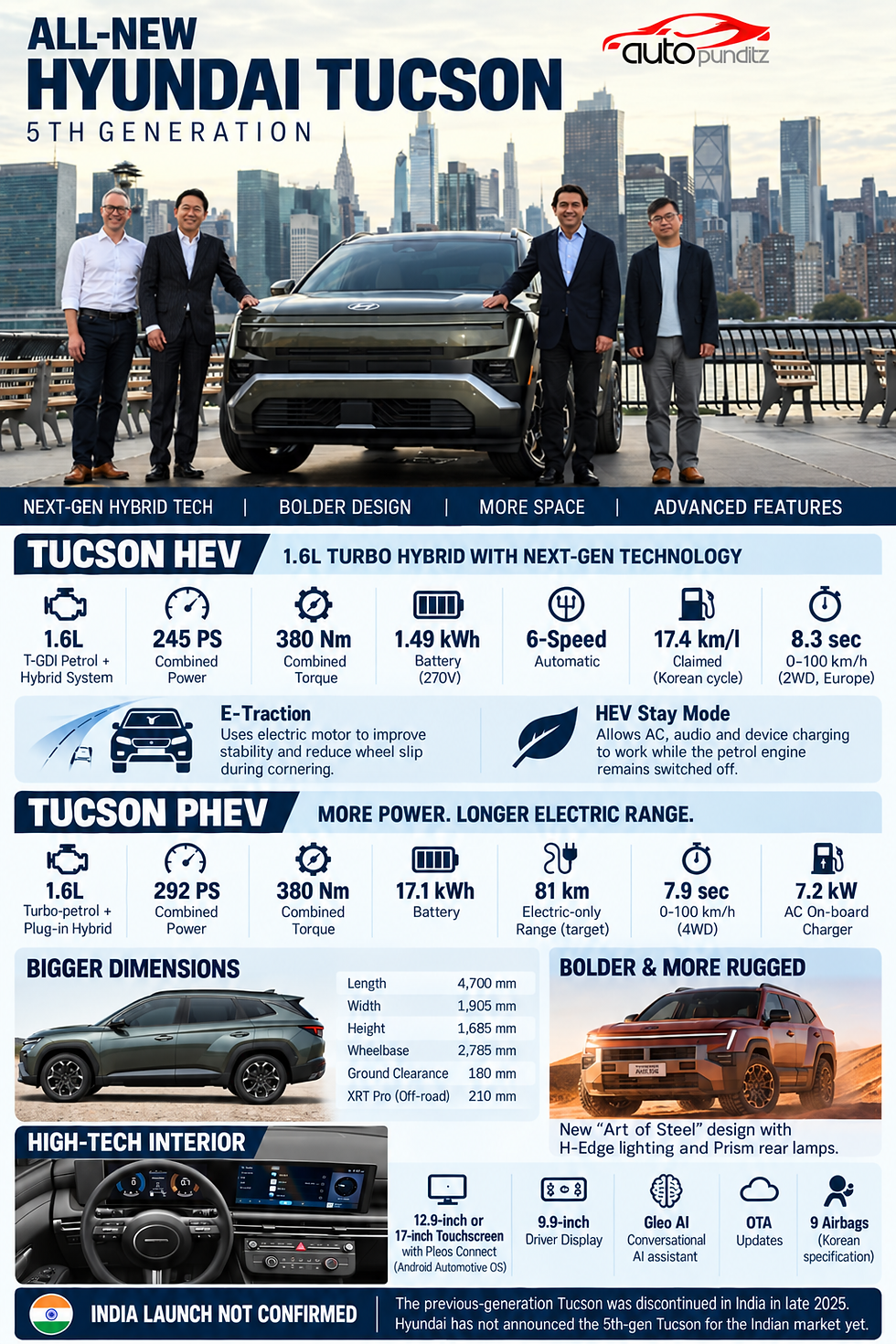
The headline addition is Hyundai's next-generation hybrid system. In European specification, the new Tucson HEV combines a 1.6-litre T-GDI turbo-petrol engine with an electric hybrid system to produce 245 PS and 380 Nm. Power is transmitted through a 6-speed automatic transmission, while a compact 1.49 kWh, 270V battery supports the electric side of the powertrain.
Hyundai claims fuel efficiency of up to 17.4 km/l in the Korean test cycle, while the European 2WD version can accelerate from 0–100 km/h in 8.3 seconds. Specifications will vary between markets.
Hyundai Tucson HEV: Key Specifications
Specification | 5th-Gen Tucson HEV |
Engine | 1.6-litre T-GDI petrol + hybrid system |
Combined Power | Up to 245 PS |
Combined Torque | 380 Nm |
Battery | 1.49 kWh / 270V |
Transmission | 6-speed automatic |
0–100 km/h | 8.3 seconds (2WD, Europe) |
Fuel Efficiency | Up to 17.4 km/l (Korean cycle) |
Drivetrain | 2WD / 4WD, market dependent |
Hyundai's new hybrid technology is designed to deliver more than just improved fuel efficiency. The Tucson HEV receives E-Traction, which uses the electric motor to manage drive torque and improve stability by reducing wheel slip during cornering.
Another interesting feature is HEV Stay Mode. It allows functions such as climate control, audio and device charging to continue operating while the combustion engine remains switched off, giving occupants an EV-like experience when the vehicle is stationary.
Tucson PHEV Gets 292 PS and 81 km EV Range
Alongside the conventional hybrid, Hyundai has detailed a substantially more powerful plug-in-hybrid version.
The Tucson PHEV also uses a 1.6-litre turbo-petrol engine but combines it with a more powerful electric system to produce 292 PS and 380 Nm.
It gets a much larger 17.1 kWh battery, with Hyundai targeting an electric-only driving range of up to 81 km. A 7.2 kW onboard charger is provided for AC charging.
The PHEV can accelerate from 0–100 km/h in 7.9 seconds in 4WD specification.
Bigger Than the Previous Tucson
The fifth-generation Tucson has also grown in size.
The long-wheelbase version measures 4,700 mm in length, 1,905 mm in width and 1,685 mm in height, while the wheelbase stretches to 2,785 mm.
Compared with its predecessor, it is 60 mm longer and 40 mm wider, while the wheelbase has increased by 30 mm. Hyundai says the additional dimensions have been used to improve passenger and luggage space.
Dimension | New Tucson LWB |
Length | 4,700 mm |
Width | 1,905 mm |
Height | 1,685 mm |
Wheelbase | 2,785 mm |
Ground Clearance | 180 mm |
XRT Pro Ground Clearance | 210 mm |
New 'Art of Steel' Design
The new Tucson represents another major change in Hyundai's SUV design direction.
Hyundai calls its latest design philosophy “Art of Steel”, with the Tucson featuring more upright and muscular proportions, pronounced wheel arches and cleaner body surfaces.
The front incorporates Hyundai's new H-Edge lighting signature, while the rear gets distinctive Prism Rear Lamps.
Hyundai has also developed the more rugged Tucson XRT Pro, which gets additional body protection, all-terrain tyres and 210 mm ground clearance, 30 mm more than the standard SUV.
17-inch Infotainment Screen and Gleo AI
The interior represents an equally significant technological step.
The new Tucson introduces Hyundai's Pleos Connect infotainment architecture based on Android Automotive OS.
Depending on specification, it combines a 17-inch or 12.9-inch central touchscreen with a slim 9.9-inch driver display.
Pleos Connect supports an integrated app ecosystem, entertainment services and over-the-air updates rather than relying solely on smartphone mirroring.
Hyundai has also integrated its Gleo AI assistant. The system is designed to understand natural conversation and context, allowing occupants to make follow-up requests rather than repeatedly issuing complete commands.
More Focus on Ride, Refinement and Aerodynamics
Hyundai has also made substantial changes underneath the new Tucson.
The suspension mounting points and rear underbody structure have been strengthened, while a revised suspension valve is intended to better control body movement and road impacts.
Additional sound insulation, revised engine mounts and thicker door glass have been introduced to reduce engine, wind and road noise.
Aerodynamic efficiency has improved as well. The drag coefficient of both petrol and hybrid versions has reportedly dropped from 0.33 to 0.30, aided by active air flaps, aerodynamic wheel designs and revised spoilers.
Will the New Hyundai Tucson Hybrid Come to India?
This remains the biggest question for Indian buyers.
The previous-generation Tucson was discontinued in India in late 2025, and Hyundai has not announced the fifth-generation Tucson for the Indian market so far.
However, the new Tucson's hybrid-focused powertrain strategy makes the SUV particularly interesting from an Indian-market perspective.
Hyundai is preparing a broader electrified product offensive, and hybrids are expected to play a growing role in its Indian portfolio. If the Tucson eventually returns, the 245 PS strong-hybrid powertrain could potentially provide a more differentiated proposition than the petrol and diesel engines offered with the outgoing Indian model.
That said, any India launch, localisation strategy, powertrain selection or pricing remains unconfirmed at this stage.
Auto Punditz Take
The fifth-generation Tucson is much more than a styling overhaul.
Hyundai has combined a larger SUV body with a 245 PS next-generation hybrid system, 17.4 km/l claimed efficiency, E-Traction, Stay Mode, Pleos Connect and Gleo AI, effectively repositioning the Tucson as a technology showcase for the company's next generation of electrified SUVs.
For India, the most interesting aspect isn't simply whether the Tucson returns—it is whether Hyundai chooses the strong-hybrid powertrain for that comeback.
With Indian manufacturers increasingly looking at hybrids alongside EVs, the Tucson HEV could potentially give Hyundai a premium hybrid SUV positioned between mainstream midsize SUVs and luxury models.
For now, however, the fifth-generation Tucson remains unconfirmed for India. Hyundai will introduce the model in Korea first, with North America, Europe and other global markets following in 2027.