Suzuki Asks Indian Suppliers to Adopt Six-Day Production Schedule as Maruti Targets 4 Million Capacity
Suzuki Motor Corporation has reportedly asked its Indian component suppliers to reserve one day every week for equipment maintenance, marking an important change in production planning as Maruti Suzuki prepares for a major expansion of its manufacturing footprint in India.
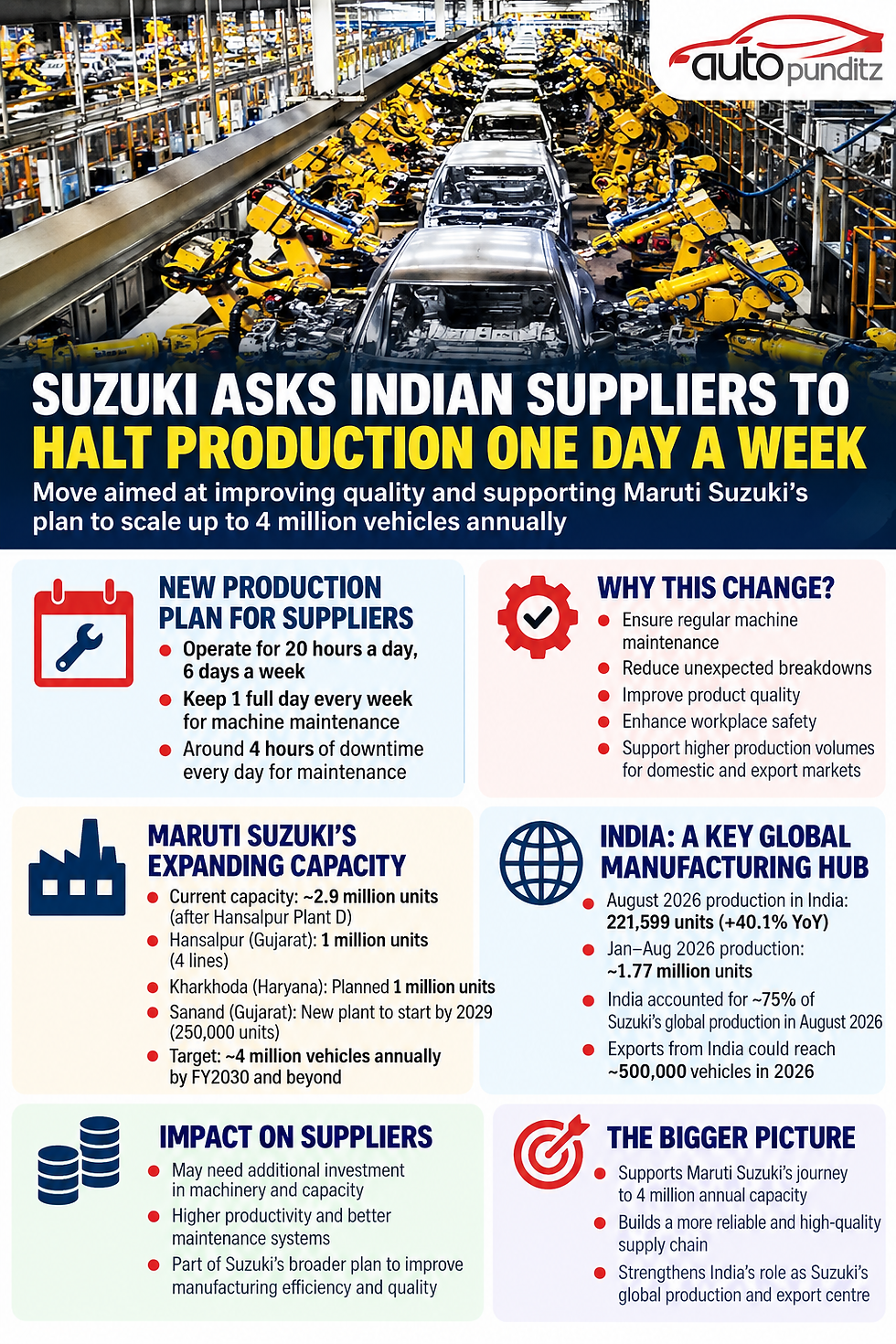
Suzuki wants suppliers to eventually operate their component production lines for 20 hours a day and six days a week, rather than keeping machinery running continuously across all seven days. The revised production system is targeted for implementation by September 2027. The underlying objective is not to reduce component output. Instead, Suzuki appears to be creating more structured maintenance windows as production volumes increase substantially over the coming years.
One Full Day Reserved for Machine Maintenance
Under the proposed operating model, suppliers would run production for around 20 hours each day, leaving roughly four hours of downtime every night. One complete day each week would additionally be reserved for machine inspection and maintenance.
It is reported that Suzuki Motor President Toshihiro Suzuki met Indian suppliers in August 2026 and asked them to plan future manufacturing capacity around a six-day production schedule. Maruti Suzuki has subsequently reportedly asked suppliers to provide declarations by the end of 2026 confirming that production lines supplying the company will not operate continuously throughout all seven days of the week. The policy is reportedly being introduced to Suzuki's Indian supplier network for the first time.
Why Suzuki Wants More Maintenance Downtime
Automotive component manufacturing relies heavily on highly automated machinery working at very high utilisation levels. While continuous production can maximise output from existing equipment, it also reduces the available window for preventive maintenance.
As Maruti Suzuki significantly increases production, Suzuki reportedly wants to minimise the risks associated with:
Unexpected machinery breakdowns
Production-line stoppages
Manufacturing defects and quality issues
Workplace safety incidents
Disruptions to vehicle assembly schedules
Regular preventive maintenance could therefore become increasingly important as Maruti's supply chain moves toward much higher volumes.
Maruti Suzuki's Capacity Expansion Is Driving the Change
The supplier initiative needs to be viewed alongside Suzuki's much larger manufacturing strategy for India. Suzuki officially announced in September 2026 that it intends to strengthen India as both a manufacturing and global export hub, targeting annual production capacity of approximately 4 million vehicles in fiscal 2030 and beyond.
That represents a major increase from Suzuki's existing production footprint.
In July 2026, Suzuki confirmed that the fourth production line at its Hansalpur facility had started commercial production. The new line added 250,000 units of annual capacity, taking Hansalpur alone to 1 million units annually.
F
ollowing the expansion, Suzuki stated that its total annual vehicle production capacity in India had reached approximately 2.9 million units. Further expansion is already planned. The Kharkhoda manufacturing facility in Haryana is designed to eventually reach around 1 million units annually, while a new manufacturing facility at Sanand in Gujarat is planned to begin operations by 2029 with an initial annual capacity of around 250,000 vehicles.
India Becoming Suzuki's Global Production Centre
India's importance within Suzuki's global operations has steadily increased.
Suzuki's latest production data illustrates the scale of that dependence. In August 2026, Suzuki produced 221,599 vehicles in India, representing a year-on-year increase of 40.1%. During January-August 2026, India production reached approximately 1.77 million vehicles.
For comparison, Suzuki's total global production during August stood at 295,249 units.
That means India accounted for roughly three-fourths of Suzuki's worldwide vehicle production during the month. India is therefore no longer simply Maruti Suzuki's domestic manufacturing base. It is becoming one of Suzuki's most important global sourcing and export centres.
Exports Add Another Layer of Production Pressure
Suzuki is simultaneously expanding exports from India to overseas markets including Japan, Europe and the Middle East. Maruti Suzuki's overseas shipments could approach 500,000 vehicles during 2026. Higher domestic demand combined with rising exports means component suppliers will have to support considerably larger production volumes without compromising quality or reliability. That appears to be one of the major reasons Suzuki is focusing on preventive maintenance before production capacity expands further.
Suppliers May Need Additional Investment
The change could nevertheless create challenges for the Indian component ecosystem.
Many automotive component manufacturers traditionally maximise machine utilisation by operating production equipment continuously. Taking one production day offline every week reduces the amount of available manufacturing time from existing equipment.
Suppliers could therefore have to:
Increase machine productivity
Add additional manufacturing equipment
Expand existing production lines
Build additional capacity
Improve automation and preventive-maintenance systems
Additional investment in manufacturing plants and machinery may consequently be required for some suppliers. This could become particularly significant for suppliers whose facilities are already operating close to maximum utilisation.
Part of Suzuki's Broader Manufacturing Transformation
The supplier strategy also fits closely with Suzuki Motor Corporation's recently announced Technology Strategy 2026 for 10 Years Ahead.
Suzuki says that by 2030 it wants to:
Cut new-vehicle development lead time by 50%
Improve development efficiency by 30%
Improve manufacturing efficiency by 50%
The automaker plans to achieve this through greater use of digital engineering, modularisation and closer integration between product development and manufacturing. The increased emphasis on planned maintenance across the supplier network can therefore be viewed as part of a broader move toward improving manufacturing efficiency and production stability.
The Bigger Picture
Maruti Suzuki's journey toward approximately 4 million units of annual manufacturing capacity will require considerably more than new vehicle assembly lines. Its component ecosystem will also have to expand at a similar pace.
Suzuki's proposed six-day production schedule indicates that the company is attempting to build preventive maintenance and quality control into the expansion process rather than relying purely on higher machinery utilisation.
While the strategy could require additional investments from suppliers, the longer-term objective appears clear: create a production system capable of supporting substantially higher domestic sales and exports while reducing the risk of breakdowns, quality issues and unexpected production interruptions. For India's automotive component industry, Maruti Suzuki's expansion toward 4 million vehicles annually could consequently trigger another significant phase of capacity investment across the supplier ecosystem.