


India EV Sales Feb 2026: Maruti Suzuki eVitara Clocks 870 Units in Debut Month
India’s electric passenger vehicle (PV) market continued its strong growth momentum in February 2026, with total dispatches reaching 20,616 units, marking a healthy 25.3% month-on-month (MoM) growth over January’s 16,456 units. The market is increasingly consolidating among a few key players, while new entrants and fresh models are reshaping the competitive landscape.

OEM Performance: M&M Closes Gap on Tata
Tata Motors retained its leadership with 7,982 units, though volumes declined 7.4% MoM, bringing its market share to 38.7%.
Mahindra & Mahindra emerged as the biggest gainer, nearly doubling volumes to 7,168 units (+95.8% MoM), significantly closing the gap with Tata and capturing 34.8% share.
MG Motor India held the third position with 3,642 units (-2.4% MoM) and a 17.7% share.

Key Takeaways:
The top 3 OEMs together command over 91% of the EV market, highlighting strong concentration.
M&M’s aggressive push with new-generation EVs is clearly reshaping market dynamics.
Tata’s temporary dip suggests rising competitive pressure rather than structural weakness.
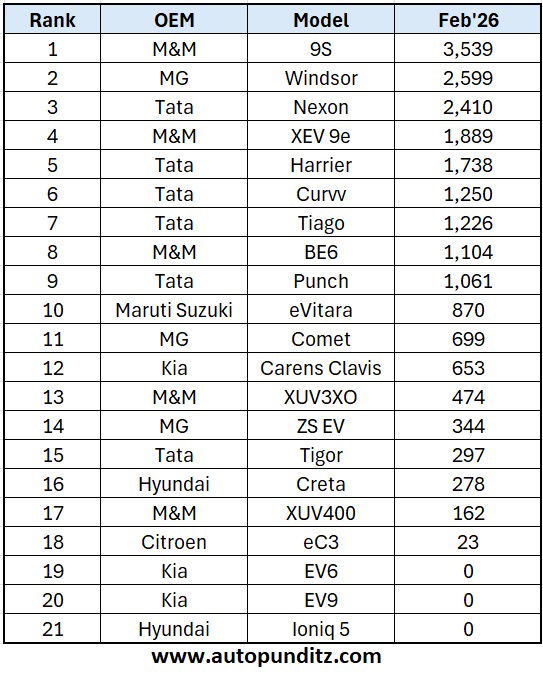
Maruti Suzuki entered the EV space meaningfully with the eVitara, clocking 870 units in its first full month (4.2% share).
Kia India saw explosive growth (+266.9% MoM) to 653 units, driven by the Carens Clavis EV.
Hyundai Motor India posted modest growth at 278 units (+12.6%), while
Citroën India remained niche with 23 units.
Model-Wise Performance: New Leaders Emerge
Top 10 Best-Selling EVs – February 2026

M&M dominates the top ranks with two models in the top 4, led by the 9S.
MG’s Windsor EV continues to be a strong volume driver.
Tata still has the widest portfolio strength, with multiple models (Nexon, Harrier, Curvv, Tiago, Punch) contributing meaningfully.
Modelwise EV Sales chart for February 2026:
Market Insights & Trends
1. Two-Horse Race Emerging
The Indian EV market is rapidly evolving into a Tata vs Mahindra battleground, with M&M gaining momentum quickly.
2. Product Strategy Driving Growth
M&M’s success is clearly product-led, with fresh, tech-heavy EVs.
Tata’s strength remains its broad portfolio and early-mover advantage.
3. New Entrants Gaining Early Traction
Maruti Suzuki and Kia are showing strong initial acceptance, which could intensify competition in coming months.
4. Volume Growth vs Premium Stagnation
Mass-market EVs continue to drive growth, while premium EV adoption remains inconsistent and supply-led.
February 2026 marks a turning point in India’s EV market, with:
Strong overall growth
Intensifying competition at the top
Successful new product launches reshaping rankings
If M&M sustains this momentum and Tata counters with updates or pricing strategies, the coming months could see a leadership shift for the first time in India’s EV era.


