Mahindra Plans 16 New SUVs by 2031: The Biggest Product Offensive in Its History
- Team Autopunditz
- Jun 13
- 8 min read
Mahindra & Mahindra is preparing one of the most aggressive product expansion programmes ever undertaken by an Indian passenger-vehicle manufacturer. The company plans to introduce 16 SUVs between April 2026 and 2031, covering conventional petrol and diesel vehicles as well as a growing range of purpose-built electric SUVs.
The roadmap underlines Mahindra’s ambition to defend its leadership in the utility-vehicle market while expanding into segments where its presence has historically been limited. Rather than depending almost entirely on models such as the Scorpio, Thar, Bolero and XUV range, Mahindra is now building a much wider portfolio spanning compact urban SUVs, lifestyle off-roaders, family vehicles, premium electric models and potentially global-market products.

Ten ICE SUVs and Six Electric SUVs Planned
Mahindra’s revised product plan includes 10 internal-combustion SUVs and six battery-electric vehicles by 2031. This is an expansion of the roadmap announced in May 2024, when the company had initially targeted nine ICE models and seven electric SUVs by 2030.
By the end of FY2025-26, Mahindra had already counted five ICE products and four electric products under its earlier programme. These included the XUV 3XO, Thar Roxx, XUV 7XO and updates to the Bolero family on the combustion side, along with the BE 6, XEV 9e, XEV 9S and BE 6 Formula E Edition in the electric portfolio.
The refreshed strategy therefore does not mean that 16 completely unknown vehicles will suddenly enter the market. It represents Mahindra’s new launch aspiration from April 2026 onward and includes a combination of new nameplates, production versions of previously displayed concepts and at least one major mid-cycle product enhancement.
Mahindra has indicated that the 10-model ICE programme will consist of nine new SUV nameplates and one mid-cycle enhancement. The six-EV roadmap is expected to include different body styles and price points rather than merely electric conversions of every existing Mahindra SUV.
NU_IQ Platform Will Drive the Next Phase
A major part of Mahindra’s future strategy will be built around the new NU_IQ modular architecture. The platform has been developed to support multiple energy options and both right-hand-drive and left-hand-drive markets.
Mahindra has already previewed four concepts based on this architecture: Vision.S, Vision.X, Vision.T and Vision.SXT. Production vehicles inspired by these concepts are expected to begin arriving from 2027.
The platform is important because it allows Mahindra to address gaps in its current portfolio. The company is extremely strong in rugged SUVs and larger utility vehicles but has fewer offerings in high-volume urban crossover categories. NU_IQ could help Mahindra compete more directly in segments currently dominated by models such as the Hyundai Creta, Kia Seltos, Maruti Suzuki Brezza, Tata Nexon and other monocoque SUVs.
It should be noted that the Vision models remain concepts at present. Their final names, specifications, seating layouts and powertrain combinations have not been officially announced.
Vision.S Could Become a More Accessible Rugged SUV
The Vision.S appears to be one of the most commercially significant products in Mahindra’s future portfolio. Its upright proportions and squared-off design suggest a compact SUV with visual links to the Scorpio family.
Media reports have frequently described it as a “baby Scorpio”, although Mahindra has not confirmed that positioning. A production version could potentially give the company a more rugged alternative in the compact-SUV category, positioned below the Scorpio-N and possibly alongside or above the XUV 3XO. Such a model would allow Mahindra to use its strongest brand attributes—road presence, toughness and SUV character—in a more affordable and higher-volume segment.
Vision.X May Target the Urban SUV Buyer
The Vision.X concept follows a more athletic and contemporary crossover design. It appears less focused on traditional off-road styling than the Vision.S and could be aimed at urban families seeking a premium compact or midsize SUV.
This would be a crucial segment for Mahindra. The company currently has strong products at the sub-four-metre and larger SUV ends of the market, but a direct rival to the Creta, Seltos, Grand Vitara and Hyryder could significantly increase its addressable customer base.
Depending on its eventual dimensions, the Vision.X-derived model could sit between the XUV 3XO and XUV 7XO. Petrol, diesel, hybrid or electric possibilities cannot be ruled out because the NU_IQ platform has been conceived as a multi-energy architecture.
Vision.T Points Towards the Future of the Thar Family
The Vision.T concept carries several design cues associated with the Thar, including an upright body, short overhangs and a lifestyle-oriented off-road stance. It is widely expected to preview a future electric or next-generation lifestyle SUV.
Mahindra had earlier displayed the Thar.e concept, demonstrating its intention to eventually electrify its most recognisable lifestyle nameplate. The Vision.T could represent a more evolved design direction for that programme.
However, it remains unclear whether the final production model will be sold as the Thar.e, Vision.T or under another name. The production vehicle may also differ substantially from the concept once packaging, regulations, pricing and manufacturing requirements are considered.
Vision.SXT Could Expand Mahindra’s Lifestyle Portfolio
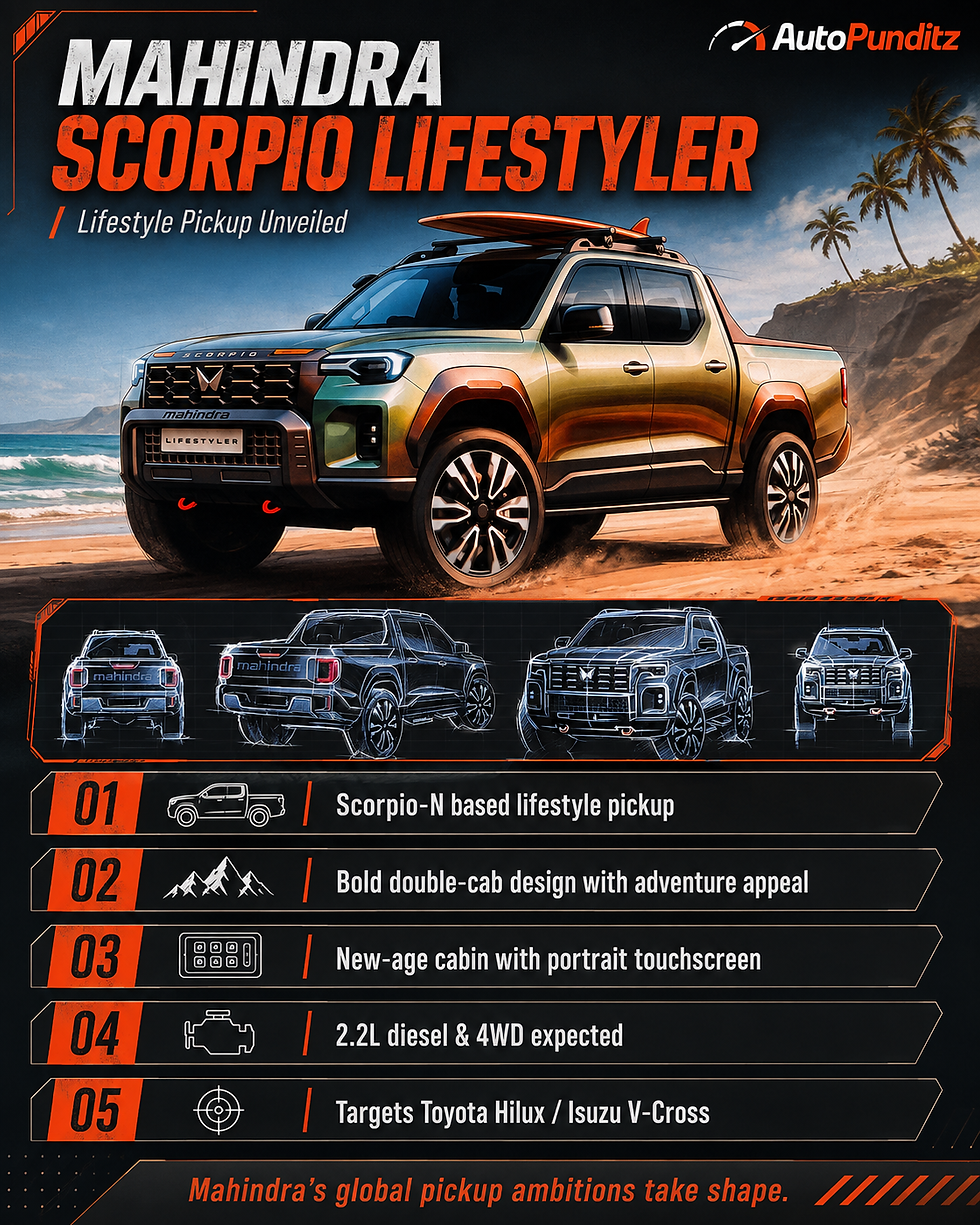
The Vision.SXT is among the most distinctive concepts in Mahindra’s future range. Its pickup-inspired rear section combines lifestyle-SUV styling with added utility.
A production model could help Mahindra participate in the premium lifestyle pickup market, which remains relatively small in India but has meaningful potential in international markets. It could also complement the Global Pik Up concept that Mahindra previously showcased.
The business case for such a model may depend heavily on exports. Pickup-based lifestyle vehicles have much larger customer bases in markets such as South Africa, Australia, Southeast Asia and Latin America than in India.
BE.07 Expected to Broaden the Electric Range
Mahindra’s current electric-origin range is led by the BE 6, XEV 9e and XEV 9S. The next logical addition is expected to be a production model based on the BE.07 concept.
The BE.07 was originally conceived as a family-oriented electric SUV with more conventional proportions than the coupe-styled BE 6 and XEV 9e. It could therefore become an important volume product, particularly for customers who want a spacious electric SUV without a dramatically styled exterior.
The eventual vehicle is expected to use Mahindra’s INGLO electric architecture and could share battery, motor and electronic systems with the company’s existing electric-origin SUVs. Mahindra has not yet confirmed the production model’s specifications or final launch date.
A More Rugged Version of the BE 6 Is Also Possible
Mahindra has previously showcased the BE Rall-E, a rugged interpretation of the vehicle that eventually entered production as the BE 6. The concept featured off-road-inspired styling, additional body protection and a more adventure-focused appearance.
A production derivative could serve as a halo variant for the BE brand and reinforce Mahindra’s traditional association with capable SUVs. Nevertheless, its inclusion in the six-EV programme has not been officially confirmed.
The company could alternatively use special editions and performance variants to create additional differentiation without launching an entirely separate model.
Scorpio-N and Thar Updates Remain Likely
Alongside the all-new nameplates, Mahindra is expected to continue updating its most successful existing SUVs. Test vehicles believed to be related to the Scorpio-N facelift have already appeared on Indian roads, suggesting that development work is underway.
The Scorpio-N could receive changes to its exterior design, cabin technology, infotainment system and feature list. Its current petrol and diesel engines are likely to continue, although Mahindra may improve efficiency, refinement and emissions compliance.
The three-door Thar is also expected to receive periodic upgrades. With the Thar Roxx offering a more family-oriented five-door package, the three-door version may increasingly focus on enthusiasts and lifestyle buyers. These updates will be important because new products alone cannot sustain growth. Mahindra will need to keep its established models competitive as rival manufacturers add more technology, safety features and electrified powertrains.
Bolero Family Could Enter a New Generation
The Bolero remains one of Mahindra’s most enduring nameplates, particularly in rural and semi-urban markets. Although it does not attract the same attention as the Thar or Scorpio, it continues to deliver consistent volumes and strengthens Mahindra’s presence outside major metropolitan areas.
A future Bolero-family product could retain the nameplate’s durability and practicality while adopting a more modern platform, improved safety, greater comfort and updated technology.
Mahindra must manage this transition carefully. Moving the Bolero too far upmarket could weaken its value proposition, while retaining an ageing architecture indefinitely would make it difficult to meet future customer and regulatory expectations.
Why Mahindra Needs Such a Large Pipeline
Mahindra’s SUV business has expanded rapidly over the past few years, supported by the Scorpio-N, Thar, Thar Roxx, XUV 3XO, XUV700 and its new electric-origin products. The company has also increased manufacturing capacity to reduce waiting periods and support future launches.
However, the Indian SUV market is becoming increasingly competitive. Maruti Suzuki, Hyundai, Tata Motors, Toyota, Kia, Skoda, Volkswagen, MG and several emerging electric brands are all widening their portfolios.
Mahindra’s 16-SUV plan is therefore not simply about increasing the number of products in showrooms. It is intended to ensure that the company has credible offerings across almost every major SUV category. The strategy should also reduce its dependence on a handful of blockbuster models. A larger portfolio can help balance demand cycles, reach new customer groups and improve the utilisation of Mahindra’s manufacturing and technology investments.
Electric SUVs Will Become Central to Mahindra’s Growth
Mahindra’s electric strategy has changed significantly following the introduction of the BE 6 and XEV 9e. Instead of treating electric vehicles as modified versions of combustion-engine products, the company is now developing dedicated electric SUVs with distinctive styling, large battery packs and advanced electronic architectures.
The XEV 9S has expanded the range into the three-row family-SUV market, while future products are expected to cover more accessible and lifestyle-oriented categories. The challenge will be to maintain pricing discipline while scaling volumes. Electric SUVs still cost more than comparable petrol and diesel vehicles, and charging access remains uneven across India. Mahindra will therefore continue to rely heavily on ICE SUVs even as the electric share of its portfolio rises.
The 10-ICE and six-EV split reflects this practical approach. Mahindra is preparing for electrification without abandoning the diesel and petrol vehicles that currently generate the majority of its volumes and profits.
Launch Timelines Should Be Treated With Caution
Although several future Mahindra products have been spotted testing or previewed as concepts, exact launch schedules remain subject to change.
Vehicle-development timelines can be affected by market conditions, component availability, regulations, manufacturing capacity and changes in consumer demand. Concept names may also not be carried forward to production.
The confirmed part of Mahindra’s plan is the overall number of introductions and the ICE-EV split. The exact identity of every model will become clearer as the company moves closer to production and begins official testing and homologation.
Auto Punditz Take
Mahindra’s 16-SUV programme represents a transition from being a strong domestic utility-vehicle manufacturer to becoming a broader, technology-led global SUV company. The most important part of the strategy may not be the number 16 itself. Its success will depend on whether Mahindra can maintain the qualities that built its reputation—strong road presence, capable powertrains and authentic SUV character—while improving reliability, quality consistency, software performance and after-sales support.
The company already has considerable momentum in India’s SUV market. The coming five years will determine whether Mahindra can turn that momentum into long-term leadership across combustion, electric and global SUV categories.
For customers, the outcome is clear: Mahindra’s future showrooms are likely to become considerably more diverse, with products ranging from compact urban crossovers and rugged lifestyle vehicles to large family SUVs and dedicated electric models.