


Exclusive Interview: Pranav Bansal on India's Steel Wire Revolution, EVs & Import Substitution
By Auto Punditz Editorial Team
As India's automotive industry accelerates towards electrification, localisation and advanced manufacturing, the role of specialty material suppliers is becoming increasingly critical. Steel wire may not always make headlines, but it forms the backbone of tyres, suspension systems, seating, power transmission, construction and numerous safety-critical automotive applications.
One company that is aggressively expanding into these high-value segments is Bansal Wire Industries Ltd. (BWIL). Having recently scaled its manufacturing capacity, entered Steel Tyre Cord production and strengthened its specialty wire portfolio, BWIL is positioning itself to benefit from India's next phase of manufacturing-led growth.
In this exclusive interaction with Auto Punditz, Mr. Pranav Bansal, Managing Director & CEO, Bansal Wire Industries Ltd., discusses the company's growth journey, localisation opportunities, EV trends, infrastructure demand, exports and the future of Indian manufacturing.
Company & Growth Journey
Q: Bansal Wire Industries has evolved into one of India's largest steel wire manufacturers. Could you briefly take us through the key milestones that have shaped the company's growth journey?
A: Our journey goes back to 1938, when we started as a wire trading business, and we moved into manufacturing in 1985. For close to four decades since, the focus has been consistent: build scale, but never at the cost of quality or customer trust.
The more recent milestones tell the story of how fast that scale has compounded. We listed on the BSE and NSE in 2024, which gave us the capital discipline and visibility to plan much bigger investments. FY26 was a genuinely transformational year for us. We closed it with consolidated revenue of around ₹4,160 crore, up 19% year-on-year, net profit of about ₹161 crore, and sales volumes of 4,58,054 metric tonnes, a 33% jump over the previous year.
Alongside that, we commissioned a major capacity expansion at our Dadri facility, taking our installed capacity to roughly 6.8 lakh tonnes, and we have also become the first Indian company to enter steel cord manufacturing for tyres, which until now has been almost entirely import-dependent. Each of these has been a deliberate step in the same direction, from being a volume-led commodity producer to becoming a specialty, application-led solutions provider.
Q: What have been the major factors behind BWIL's expansion across multiple sectors, including automotive, infrastructure, engineering, agriculture, and industrial applications?
A: The honest answer is that our diversification has always been customer-led rather than opportunistic. As our customers' end-use needs evolved, we built the capability to follow them, rather than waiting and reacting. That is what led to the Dadri facility and our move into Induction Hardened & Tempered (IHT) Wires, Steel Tyre Cord, Brass Coated Hose Wire and LRPC strands.
The other big factor is the structural shift in the Indian economy itself. Infrastructure spending on roads, metros, railways and energy; the government's manufacturing and import-substitution push under Make in India; and the rapid growth of automotive, especially EVs, have all created genuine, durable demand for wire that simply did not exist at this scale a decade ago. Our job has been to make sure our product mix and manufacturing footprint are ready before that demand fully materialises, not after.
Q: How has the recently expanded manufacturing footprint strengthened your ability to serve both domestic and global customers?
A: Scale has been the bigger lever for us recently. With Dadri's latest phase complete, our installed capacity now stands at around 6.8 lakh tonnes, up from 2.4 lakh tonnes just a couple of years ago, and we are planning a further expansion at Dadri in FY27 to take us towards 8 lakh tonnes. That kind of scale gives our automotive and industrial customers real confidence in our ability to support volume growth without supply constraints, while our diversified end-market exposure across regions helps smooth out demand swings in any single sector or geography.
It also gives us flexibility. Our product mix and plant capabilities allow us to shift or add production lines from one sector to another depending on where demand is strongest in a given quarter, whether that is automotive, power transmission or construction. For our export customers, the larger footprint, combined with our IATF 16949 and ISO certifications, gives them the assurance of consistent supply even as volumes scale up.
Auto Punditz Insight
BWIL's evolution reflects a broader trend across Indian manufacturing. Rather than competing purely on production volumes, component manufacturers are increasingly investing in technology, R&D and specialised products that command higher value and create stronger entry barriers.
Automotive Industry & Mobility Trends
Q: The automotive industry is undergoing rapid transformation driven by electrification, localization, and new mobility solutions. How is BWIL adapting its product portfolio to meet these changing requirements?
A: We are moving up the value chain quite deliberately. Where we were once a supplier of largely standard-grade wire, we are now investing heavily across our full automotive portfolio: Steel Tyre Cord, Tyre Bead Wire, Spring Wires, Auto Control Cable Wires, Profile Wires, Stainless Steel Wires, and Mild Steel Galvanised Wires for automotive components. Each of these goes into demanding automotive applications where precision, fatigue resistance, and consistent quality are non-negotiable.
The clearest recent proof point is our entry into Steel Tyre Cord manufacturing, where we have set up a 20,000-tonne pilot facility at Dadri as the first phase of a planned 2 lakh tonne capacity build-out, and we have already secured a trial purchase order from a leading tyre manufacturer after successful evaluation of our samples. That is a real, tangible sign that the shift towards higher-value automotive wire is gathering pace, not just a plan on paper.
Q: What role do specialty wire products such as Steel Tyre Cord, Tyre Bead Wire, Spring Wire, and Profile Wire play in modern vehicle manufacturing?
A: These are not commodity products, they are precision-engineered components that go directly into vehicle safety and performance. Steel Tyre Cord reinforces the tyre carcass and determines its strength, durability and ride stability. Tyre Bead Wire anchors the tyre to the wheel rim and has to hold up under constant mechanical stress. Spring wire goes into suspension systems, where fatigue resistance over hundreds of thousands of cycles is non-negotiable. Profile wire is used in seat structures and other shaped components where dimensional precision is critical. Auto control cable wires are essential in vehicle control systems and actuation mechanisms. Stainless steel wires go into high-corrosion-resistance applications across exhaust, sensor and structural components, while Mild Steel Galvanised Wires serve a range of automotive assembly and component manufacturing needs.
What unites all of these is that they demand far tighter metallurgical control, surface finish and consistency than general-purpose wire. That is exactly why we have built dedicated R&D capability and invested in advanced heat treatment and surface engineering processes, because OEM qualification cycles for these products are long and unforgiving, and there is very little room for variability.
Q: How do you see demand evolving across passenger vehicles, commercial vehicles, two-wheelers, and electric vehicles over the next five years?
A: Passenger vehicles and two-wheelers will continue to be large, steady volume drivers for wire demand, particularly as premiumisation continues and vehicles carry more safety and comfort features that rely on wire-based components. Commercial vehicles track infrastructure and freight cycles closely, so as India's logistics and construction activity scales up, we expect steady, healthy growth there too.
EVs are the segment we are watching most closely, because the demand profile is structurally different. EVs need lightweight, high-strength components to offset battery weight, and that plays directly to our specialty wire capabilities. We expect EV-linked demand for high-tensile and lightweight wire products to grow meaningfully faster than the broader automotive wire market over the next five years, even as overall EV penetration in India is still in its early stages relative to more mature markets.
Q: Are EVs creating new opportunities for specialty steel wire manufacturers? If yes, which product categories are expected to benefit the most?
A: Yes, and this is one of the more exciting parts of our portfolio strategy. EVs are inherently heavier than internal combustion vehicles because of battery packs, which makes every other component a candidate for weight reduction without compromising strength. That plays directly to several categories across our existing portfolio.
Tyre Bead Wire and Steel Tyre Cord enable the high-performance tyres that improve durability, safety, load-carrying capacity and energy efficiency, all of which feed into maximising EV range. Auto control cable wires go into vehicle control systems, parking brake mechanisms, charging port release systems and various actuation applications that remain essential even in an EV architecture. Profile wires are used in wiper arms, oil level gauges, seat structures, circlips and other precision parts that need customised shapes and high strength.
Spring wires find use in battery pack assemblies, electrical connectors, charging systems, suspension components and several precision mechanisms within EVs. Circlips and spring washer wires support fastening and retention components in electric motors, battery systems, gear assemblies and drivetrains, where reliability and operational safety cannot be compromised. And our Induction Hardened & Tempered (IHT) Wires enable high-strength fasteners and suspension parts that improve durability while supporting lightweight design. As Indian EV volumes scale up, we expect this entire basket of products, not any single category in isolation, to be the real beneficiary.
Q: What are some of the key material and engineering trends shaping the future of automotive components and supply chains?
A: Lightweighting without compromising strength is the single biggest engineering trend, and it cuts across every material category, not just wire. Alongside that, we are seeing rising demand for traceability and consistent metallurgical quality, since OEMs now want documented, repeatable performance across every batch, not just a good sample.
On the supply chain side, the trend is towards localisation and de-risking. Global disruptions, whether tariff-related or geopolitical, have made OEMs and Tier-1 suppliers much more deliberate about building resilient, India-based sourcing options for components that were historically imported. That shift is structural, not cyclical, and it is one of the strongest tailwinds for a domestic specialty wire manufacturer like us.
Auto Punditz Insight
The discussion highlights how electrification is reshaping demand beyond batteries and electric motors. Lightweight, high-strength speciality materials are becoming equally important as OEMs pursue better efficiency, safety and durability.
Localization & Import Substitution
Q: India has been focusing aggressively on localization and reducing import dependence. How significant is the opportunity for domestic manufacturers in specialty wire segments?
A: It is genuinely significant, and the Steel Tyre Cord segment is the clearest example. Nearly 60% of India's Steel Tyre Cord requirement is still met through imports, largely from China, Thailand and Malaysia. That is a substantial, structural gap in a country that is one of the world's top tyre manufacturing bases. We are the first Indian company to enter this segment in a serious way, specifically because we see that gap as a long-term opportunity rather than a short-term import-substitution headline.
More broadly, India's Make in India push, supported by import restrictions and tariff measures, is giving organised domestic manufacturers a genuine competitive edge. For specialty wire categories where global suppliers have historically dominated on technology, we think the next five years will see meaningful share shift towards capable Indian players who can match that technical bar.
Q: Which categories currently present the biggest import-substitution opportunities for Indian manufacturers?
A: Steel Tyre Cord is the standout, given the scale of import dependence I just mentioned. Beyond that, aramid and hybrid reinforcement cords for premium and EV tyre applications are almost entirely imported into India today, and that is a category where very few domestic players have the technical depth to compete yet.
We also see opportunity in higher grades of Induction Hardened & Tempered (IHT) Wires for automotive springs and fasteners, and in specialised galvanised and coated wires for power transmission and renewable energy applications, where global suppliers have traditionally had an edge on consistency and certification.
Q: What challenges must Indian manufacturers overcome to compete with global suppliers in highly specialized applications?
A: The biggest challenge is qualification, not manufacturing. OEM approval cycles for specialty automotive components are long, rigorous and unforgiving of inconsistency, and that is true whether you are an Indian manufacturer or a global one. Building the testing infrastructure, traceability systems and process discipline to clear those cycles takes real time and capital, and it cannot be shortcut.
There is also a talent dimension. Specialised wire drawing and heat treatment expertise has historically concentrated in legacy European and East Asian facilities, so building that depth of metallurgical and process engineering talent in India is a genuine, ongoing effort. And finally, raw material availability matters; India's long steel product capacity needs to keep pace with downstream wire demand, or expansion plans across the industry could be constrained by input availability rather than market opportunity.
Q: How is BWIL contributing to strengthening India's automotive and industrial supply chain ecosystem?
A: Our Steel Tyre Cord investment is the most direct example, since we are building a category in India that has simply not existed domestically at scale before. Beyond that, our Dadri R&D centre is focused specifically on developing high-performance wires, including Induction Hardened & Tempered (IHT) Wires, LRPC and brass-coated hose wires, for automotive, construction, agriculture and power sectors, so that Indian OEMs have a credible domestic alternative to imported specialty wire.
We are also investing in the certifications and traceability systems, IATF 16949 among them, that let Indian and global OEMs qualify us with the same confidence they would extend to an established international supplier. That is what genuine import substitution looks like in practice, not just substituting on price, but matching on technical reliability.
Auto Punditz Insight
India's dependence on imported Steel Tyre Cord and other specialised wire products represents one of the country's most significant component localisation opportunities. Domestic manufacturing in these segments could strengthen both automotive and tyre supply chains over the coming decade.
Infrastructure & Industrial Growth
Q: India's infrastructure push continues to gather momentum. How is this translating into demand for steel wire and related products?
A: Infrastructure has been one of the clearest and most consistent demand drivers for our industry. Large-scale projects, highways, metro rail, logistics hubs, industrial corridors and smart cities, all require steel wire for reinforcement, structural applications, fencing, fasteners and general engineering use. Our Low Relaxation Prestressed Concrete (LRPC) Strands capacity, for instance, is specifically built to serve the kind of high-specification pre-stressed concrete applications that large infrastructure programmes demand, which positions us well as those programmes scale up.
We are seeing this demand show up in our own numbers too. Our FY26 volume growth of 33% was driven not just by automotive but by this broader structural pull from infrastructure and industrial capex across the country.
Q: Which sectors do you expect to drive the strongest growth for BWIL over the next three to five years?
A: Automotive and EV-linked specialty wire will be the fastest-growing segment for us in percentage terms, given how early we still are in that journey. Power transmission is another area we expect to be a genuine high-growth pillar, supported by India's grid expansion and renewable energy buildout, where our galvanised and cable armouring wires are well placed.
Infrastructure and general engineering will likely remain our largest segments by absolute volume, simply because the scale of national infrastructure spending is so large and Steel Tyre Cord, once it scales beyond the pilot stage, has the potential to become a meaningful new growth vertical in its own right over this period.
Q: How do you assess the outlook for steel demand in India amid continued investments in roads, railways, energy, housing, and industrial development?
A: The outlook is structurally positive, but availability of the right kind of steel matters as much as overall demand growth. Most recent capacity investments in the steel industry have gone into flat products, while the wire industry, and downstream sectors like ours, depend on long products. If meaningful long-product capacity additions do not materialise, India could see a tightness in long steel availability by around 2027, which would be a real constraint on expansion plans across the wire industry, including our own.
That is why we watch raw material availability, quality and price as closely as we watch end-demand. Demand visibility from infrastructure and industrial investment is strong and durable, but translating that into volume growth depends on the upstream steel ecosystem keeping pace.
Auto Punditz Insight
Infrastructure continues to be a major demand driver for steel wire products. Roads, metro systems, railways, renewable energy and transmission projects are expected to sustain demand even as automotive applications grow rapidly.
Manufacturing Excellence & Technology
Q: What role does technology, automation, and process innovation play in maintaining quality and competitiveness in steel wire manufacturing?
A: It plays a defining role, especially as we move further into specialty products where tolerances are tight and consistency cannot be compromised. At our Dadri facility, we are investing in advanced automation and process engineering, including plans for IoT-based digital monitoring systems for real-time production visibility and paperless operations, which will give us significantly tighter control over process variability as we scale.
Automation and precision process control also help us manage cost pressures without compromising reliability. Rather than reacting to input cost volatility with price hikes, our approach is to extract more value from every tonne of raw material through better yield, less rework and more consistent process control. That operational discipline is what ultimately protects both margins and customer trust.
Q: How important are R&D and product development in helping BWIL enter higher-value applications?
A: R&D is central to everything we are trying to do strategically. Moving from a volume-driven commodity manufacturer to an application-led specialty player is not possible without dedicated product development, because every specialty wire category, whether Induction Hardened & Tempered (IHT) Wires, Steel Tyre Cord or LRPC, requires its own metallurgical and process recipe, developed and refined specifically for that end application.
Our R&D centre at Dadri is fully equipped for exactly this purpose, and it is where products like our Steel Tyre Cord and brass-coated reinforced wires have been developed and refined ahead of commercial scale-up. The faster-than-expected commercialisation we have seen with some of our newer specialty products in FY26 is really a credit to that R&D groundwork done well before launch.
Q: Could you share some examples of advanced manufacturing practices or innovations implemented at BWIL's facilities?
A: Our Dadri facility is probably the best showcase. It integrates sustainability features like rainwater harvesting, solar power generation and an acid-free wire rod cleaning process, which is both more environmentally responsible and produces a better surface finish on the wire itself. We are also building towards IoT-based digital monitoring and paperless production systems as part of the next phase of technology investment, which will further sharpen our process control as we scale up specialty production.
We have also brought in advanced galvanising and surface engineering technology to improve corrosion resistance and tensile performance for power transmission applications, and our focus on IATF 16949 and ISO certification frameworks ensures that these process improvements are auditable and repeatable, which is what global customers increasingly demand.
Auto Punditz Insight
Automation, IoT-enabled manufacturing, advanced metallurgy and process consistency are emerging as key differentiators for companies supplying global automotive OEMs.
Exports & Global Competitiveness
Q: BWIL exports to over 50 countries. What factors have enabled the company to establish a global presence?
A: Consistency has been the foundation of that global reach. Our exports have grown at a CAGR of over 47% across the last three fiscal years prior to listing, and that kind of growth does not happen without OEM-grade quality and reliability that customers can depend on shipment after shipment. We back that with global certifications, IATF 16949 and ISO among them, and a network of representatives across markets spanning around 40 countries, including the US, Europe, the Middle East, Southeast Asia and parts of Africa.
Around 10 to 15% of our sales today come from exports, with a large share going to the US and European markets, and exporting has become a deliberate pillar of our growth strategy rather than a residual outlet for surplus capacity. We are not just expanding reach for its own sake, we are building long-term relationships in markets where performance and compliance standards are exacting.
Q: How do you view India's potential as a global manufacturing hub for specialty steel products?
A: I think India's positioning has genuinely shifted, from being seen primarily as a cost-driven manufacturing base to being recognised as a technology-led, application-focused one. That message is exactly what we plan to take to WIRE Düsseldorf 2026, where we will showcase our roadmap towards 8 lakh tonnes of capacity and our capabilities in advanced galvanising, surface engineering and precision process control.
India's combination of expanding industrial infrastructure, improving logistics connectivity, a deep domestic raw-material ecosystem and a supportive export policy environment makes it a genuinely resilient and competitive base for global customers. We see Europe, the Middle East, Southeast Asia and select African markets as our key growth regions, and each of them is increasingly looking at India as a serious long-term supply partner, not just a low-cost option.
Q: What are the key opportunities and challenges for Indian manufacturers looking to expand internationally?
A: The opportunity is in scale combined with engineering depth. Global customers today want suppliers who can deliver consistent quality at volume, and increasingly, Indian manufacturers can do both, which was not always the case a decade ago. Platforms like WIRE Düsseldorf are valuable precisely because they let us move beyond purely transactional relationships and build strategic, long-term partnerships with OEMs, EPC players and distributors evaluating new supply chains.
The challenges are real too. Compliance and traceability requirements for export markets are demanding and constantly evolving, and mechanisms like the EU's Carbon Border Adjustment Mechanism, which entered its payment phase in January 2026, mean customers are now factoring carbon costs directly into pricing decisions. Indian manufacturers will need to build genuine sustainability credentials, not just cost competitiveness, to compete for global accounts over the next decade.
Auto Punditz Insight
With global manufacturers diversifying supply chains, Indian component manufacturers have an opportunity to evolve from cost-based suppliers into technology-led global partners. Compliance, sustainability and traceability will increasingly define competitiveness.
Leadership & Future Outlook
Q: As a leader of one of India's fastest-growing manufacturing companies, what are the biggest opportunities you see for the country's manufacturing sector over the next decade?
A: I think India is at a genuine inflection point. The combination of large-scale infrastructure investment, a maturing EV and automotive ecosystem, and a deliberate national push towards import substitution and self-reliance is creating durable, structural demand across manufacturing, not a short-lived cyclical bump.
The biggest opportunity is for organised, technology-capable manufacturers to move up the value chain into specialty and high-precision products that India has historically imported. That shift favours companies willing to invest in R&D, automation and quality systems well ahead of demand, rather than those competing purely on price. If Indian manufacturing can make that shift at scale, the next decade could meaningfully change the country's position in global supply chains.
Q: What are your growth priorities for BWIL over the next three to five years?
A: Our priorities are clear. Scaling up our Steel Tyre Cord vertical is the biggest single investment priority, with a planned capacity of 2 lakh tonnes at Dadri. Alongside that, we are adding a further 1.2 lakh tonnes of wire capacity at Dadri in FY27, taking us towards 8 lakh tonnes overall, while continuing to grow our specialty wire segments — Induction Hardened & Tempered (IHT) Wires and the broader automotive portfolio — as a share of the overall revenue mix.
Beyond capacity, our priority is improving revenue quality, growing the share of high-value specialty products like Induction Hardened & Tempered (IHT) Wires and Steel Tyre Cord in our overall mix, deepening engagement with key customers, and maintaining the operational discipline that has already delivered ₹333 crore of operating cash flow in FY26, ahead of our own target, on the way to a cumulative ₹600 crore by FY27. Growth that does not also strengthen the balance sheet is not the kind of growth we are chasing.
Q: Looking ahead, which emerging trends in automotive, infrastructure, industrial manufacturing and mobility do you believe industry stakeholders should watch closely?
A: Three trends stand out to me. First, the steady shift of import-dependent automotive components, Steel Tyre Cord being the clearest example, towards domestic manufacturing, which will reshape sourcing strategies for OEMs and tyre makers over the next few years. Second, the weight-reduction imperative in EVs, which is going to keep driving demand for high-tensile, lightweight specialty wire across seating, suspension and battery architecture.
Third, and this one is often underappreciated, the growing weight of sustainability and carbon compliance in export competitiveness. With frameworks like CBAM now in their payment phase, the manufacturers who invest early in cleaner processes and credible certification will have a real edge in global markets, well beyond just cost.
Q: Finally, what message would you like to share with India's automotive and manufacturing ecosystem as the country aims to become a global industrial powerhouse?
A: My message would be that the opportunity in front of Indian manufacturing right now is real, but it has to be earned through engineering depth, not just scale or cost advantage. The world is actively looking for resilient, high-quality supply chain partners, and India has every structural advantage to be that partner, skilled talent, a deep raw material base and improving infrastructure.
What will determine who captures that opportunity is the willingness to invest ahead of demand, in R&D, in certifications, in sustainable processes, and in long-term customer relationships rather than transactional ones. At Bansal Wire, that is exactly the bet we have made, and we believe it is the right one for where Indian manufacturing is headed over the next decade.
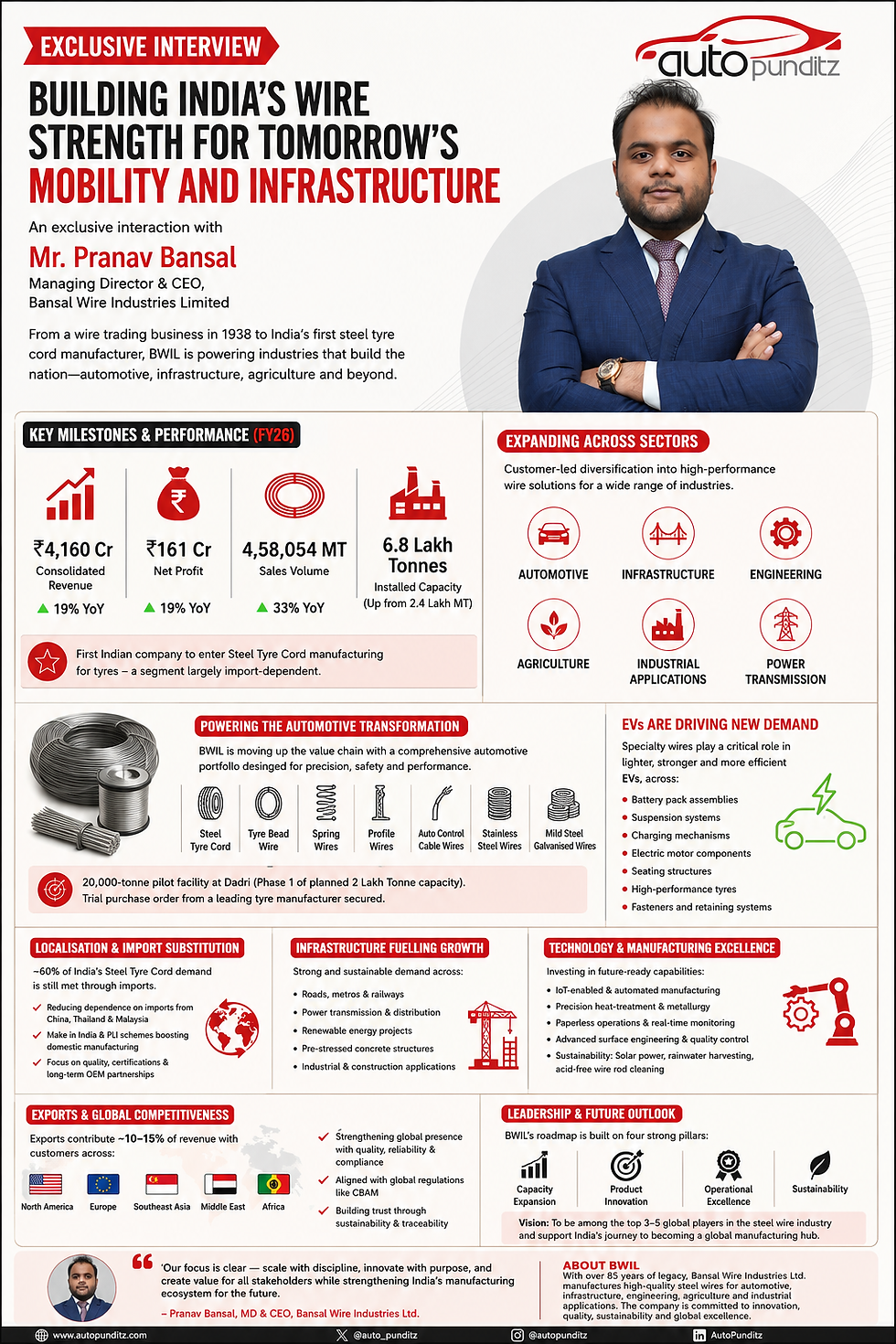
Auto Punditz Take
India's ambition to become a global automotive and manufacturing hub will depend not only on vehicle production but also on strengthening the domestic component ecosystem. As OEMs increasingly seek resilient, localised and technologically capable suppliers, speciality manufacturers such as Bansal Wire Industries are positioning themselves to play a larger role in both domestic and international supply chains.
From Steel Tyre Cord manufacturing to advanced speciality wires for EVs and infrastructure, the company's investment roadmap reflects broader trends shaping India's industrial future. The coming decade is likely to reward manufacturers that combine engineering capability, research, sustainability and operational discipline with scale.


