Škoda Overtakes Porsche in H1 2026 Operating Profit as Volkswagen Group’s Profit Dynamics Shift
For years, Porsche was widely regarded as one of the Volkswagen Group’s strongest profit generators, combining relatively modest volumes with exceptionally high margins. In the first half of 2026, however, an unusual reversal emerged inside the Group: Škoda generated slightly more operating profit than Porsche.
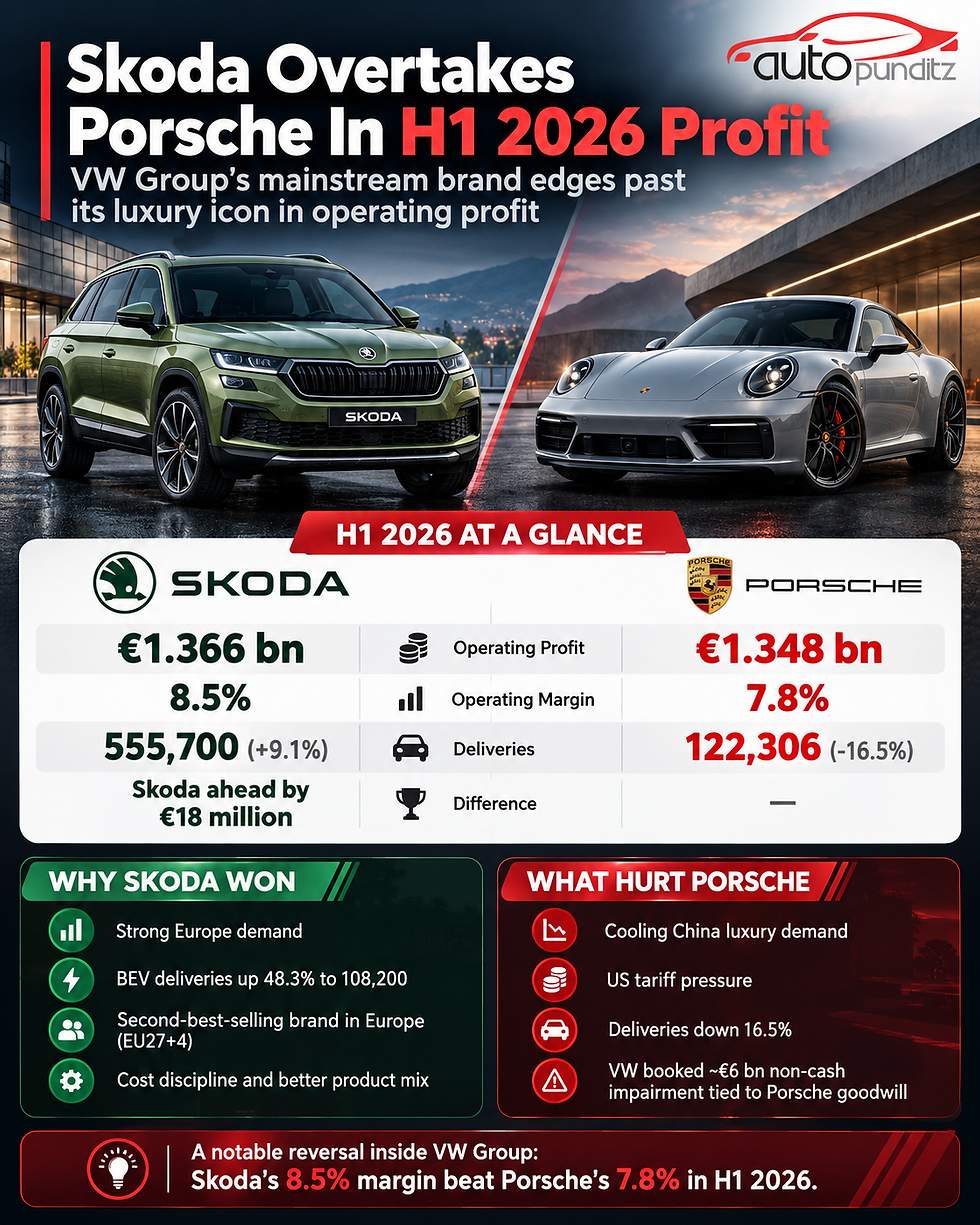
Škoda Auto reported an operating profit of €1.366 billion in H1 2026, while Porsche AG reported €1.348 billion over the same period. The difference is only around €18 million, but the symbolism is significant given the two brands’ very different market positions.
Škoda vs Porsche: H1 2026 at a glance
Metric | Škoda | Porsche |
Operating Profit | €1.366 bn | €1.348 bn |
Revenue | €16.015 bn | €17.229 bn |
Operating Margin | 8.5% | 7.8% |
Customer Deliveries | 555,700 | 122,306 |
Delivery Growth | +9.1% | -16.5% |
Škoda’s operating profit increased 6.3% year-on-year, while revenue rose by the same percentage to €16.0 billion. Its operating margin remained steady at 8.5%. Volkswagen Group attributed the performance to higher volumes, improved product mix, strict cost discipline and greater use of Group-wide synergies.
Porsche, meanwhile, actually improved its H1 operating profit from €1.007 billion to €1.348 billion, a rise of 33.9%, and lifted its margin from 5.5% to 7.8%. But the brand remains well below the profitability levels it enjoyed only a few years ago.
Why Škoda is gaining ground
Škoda’s performance is being supported primarily by strong demand in Europe.
Worldwide deliveries rose 9.1% to 555,700 units during the first six months of 2026. In the EU27+4 region, the Czech manufacturer remained Europe’s second-best-selling car brand during H1. Electric vehicles have become another important growth engine. Škoda’s battery-electric vehicle deliveries climbed 48.3% to 108,200 units, driven largely by the Enyaq and Elroq. Plug-in hybrid deliveries also increased 11.8% to 24,100 units.
Germany was particularly strong for Škoda, with deliveries increasing 19.6% to 120,400 units. The brand also recorded growth in several other important European markets as well as India. In other words, Škoda is benefiting from a combination of volume growth, relatively affordable models and increasing EV penetration without sacrificing profitability.
Porsche faces a very different environment
Porsche delivered 122,306 vehicles globally in H1 2026, down from 146,391 units in the corresponding period of 2025 — a decline of 16.5%. China represents one of the biggest challenges. Porsche deliveries there dropped from 21,302 units to 14,501 vehicles, a decline of roughly 32%. Porsche has cited difficult conditions in the luxury market and intense competition in China as key pressures on the business.
North American deliveries also fell from 43,577 to 37,712 vehicles, while deliveries across Europe excluding Germany declined from 35,381 to 30,278 units. Some of the decline is also product-related. Porsche has pointed to the end of production of the combustion-engined 718, the unusually strong launch-period demand for the electric Macan a year earlier and changes to EV and hybrid incentives in the United States.
From 18% margins to 7.8%
The comparison becomes more striking when viewed against Porsche’s recent history.
Porsche was generating operating margins close to 18% during 2022 and 2023, placing it among the most profitable large automotive manufacturers globally. By H1 2026, Porsche’s operating return on sales stood at 7.8%.
Škoda, by comparison, generated an 8.5% operating margin despite operating in a much more price-sensitive part of the automotive market. The comparison illustrates how quickly profitability can shift when product cycles, geographic exposure and competitive conditions change.
Volkswagen takes a €6 billion Porsche impairment
The deterioration in Porsche’s longer-term outlook also resulted in a significant accounting adjustment at Volkswagen. In September 2026, Volkswagen announced a non-cash impairment of approximately €6 billion related to goodwill allocated to its Porsche business segment.
The impairment will negatively affect Volkswagen Group’s operating profit in the third quarter of 2026. Importantly, this is an accounting impairment rather than a €6 billion cash outflow. The development reflects Volkswagen’s reassessment of Porsche’s medium- and long-term earnings prospects.
Porsche is still financially strong
The H1 comparison should not be interpreted as suggesting Porsche has suddenly become financially weak. Porsche still generated €17.23 billion in revenue during the first half of the year and reported automotive net cash flow of €1.02 billion, up sharply from €394 million a year earlier.
The company also ended H1 with automotive net liquidity of around €7.3 billion. Porsche has begun a broader strategic realignment under its “Sportwagenschmiede 35” programme aimed at improving profitability, cash generation and organisational efficiency. The company expects a full-year 2026 operating return on sales of 5.5% to 7.5%, with revenue of €35-36 billion.
A significant shift inside Volkswagen Group
The ₹— or rather euro — numbers involved are less important than what they reveal about the changing economics of the automotive industry. Porsche historically demonstrated how a premium manufacturer could generate extraordinary profits from relatively small volumes.
Škoda is showing another route: larger volumes, disciplined costs, competitive mainstream products and increasingly successful electric vehicles.
During H1 2026, those different strategies produced an unusual result:
Škoda operating profit: €1.366 billionPorsche operating profit: €1.348 billion
The gap may be only €18 million, but it marks a notable moment within the Volkswagen Group. For one half-year at least, Volkswagen’s mainstream Czech brand generated more operating profit than Porsche.
And perhaps the most striking statistic is not the absolute profit figure at all. It is that Škoda achieved an 8.5% margin while Porsche delivered 7.8% — something that would have looked extremely unlikely when Porsche was producing 18% margins just a few years ago.