


Tata EV Bookings Triple in 6 Months as Production Capacity Emerges as the Next Big Challenge
Tata Motors’ electric vehicle business is witnessing a sharp acceleration in customer demand, with EV bookings increasing nearly three-fold over the past six months. However, the company now faces an unusual challenge: demand appears to be growing faster than its ability to produce and deliver electric cars.
Tata Passenger Electric Mobility Chief Commercial Officer Vivek Srivatsa has indicated that the company has been gaining electric vehicle market share over recent months and that its lead over the second-largest EV manufacturer has widened.
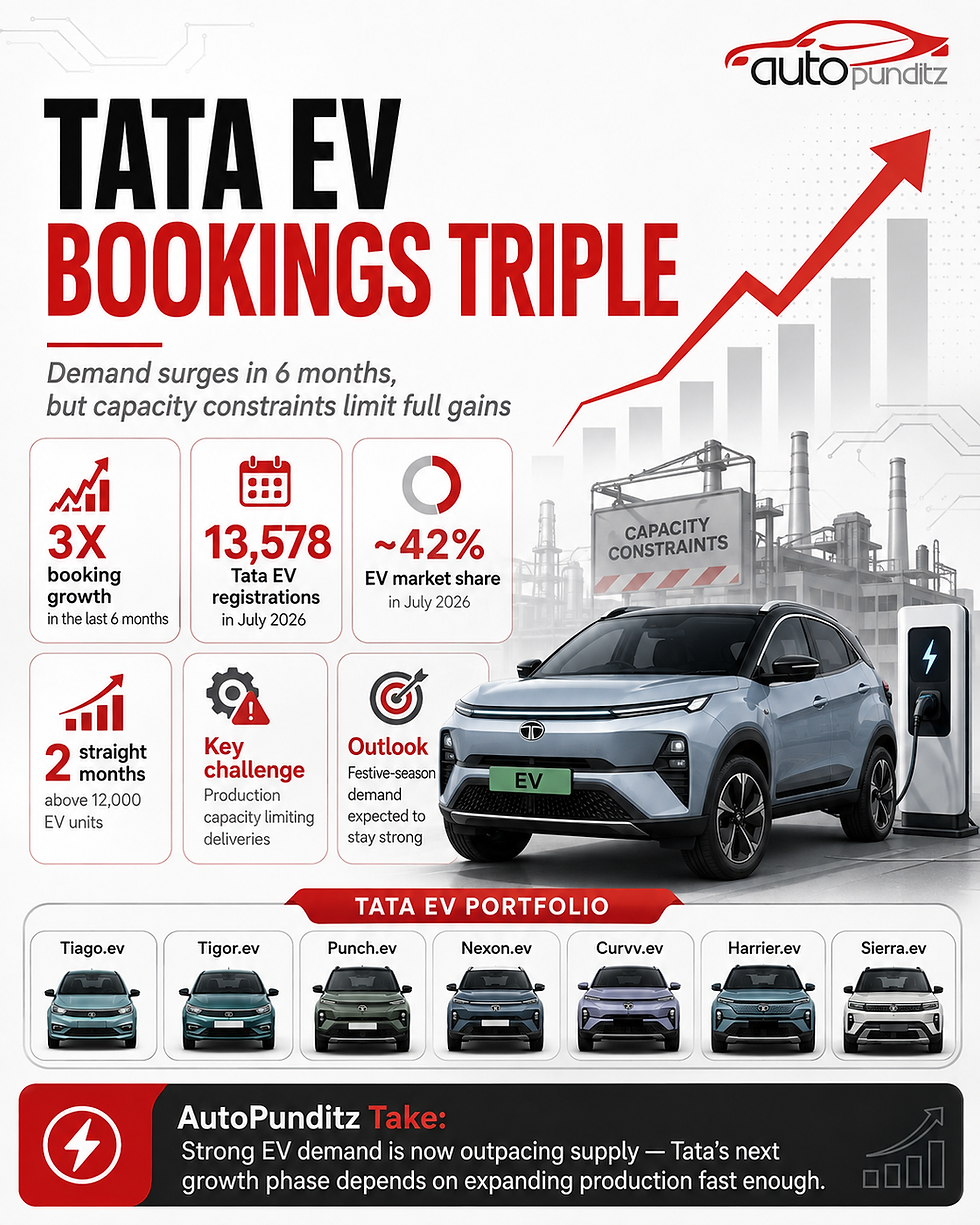
More importantly, Tata says its electric vehicle bookings have grown around 3X over the last six months, while production capability is currently preventing the company from fully converting that demand into retail sales.
Tata EV Demand Accelerates Sharply
The latest booking momentum comes at a particularly important time for Tata Motors.
India’s passenger electric vehicle market has entered a new phase of growth during 2026, helped by a wider choice of products, stronger consumer confidence in EV technology and greater acceptance of electric cars beyond the traditional urban commuter segment.
Tata Motors itself recorded its highest-ever monthly electric passenger vehicle retail volume in July 2026, with 13,578 registrations.
That represented more than 100% year-on-year growth and gave Tata approximately 42% of the electric passenger vehicle market during the month.
July was also the second consecutive month in which Tata crossed the 12,000-unit EV retail mark.
Tata EV Indicator | Latest Position |
EV booking growth | Around 3X in six months |
July 2026 EV registrations | 13,578 units |
July 2026 EV market share | ~42% |
July YoY growth | ~102% |
Main constraint | Production capacity |
The numbers suggest that Tata’s recent recovery in EV market share is being backed by actual consumer demand rather than simply higher dealer dispatches.
Tata Now Has an EV for Almost Every Major Price Segment
One of Tata’s biggest advantages is its unusually broad electric vehicle portfolio.
Its current passenger EV range includes:
Tiago.evTigor.evPunch.evNexon.evCurvv.evHarrier.evSierra.ev
This gives Tata products spanning affordable electric hatchbacks to premium electric SUVs.
That portfolio depth has become particularly important as India’s EV buyer profile changes.
Earlier, electric cars were primarily purchased by customers looking for an economical second car or a vehicle for urban commuting.
The market now increasingly includes buyers considering an EV as their primary family vehicle.
Products such as the Harrier.ev and Sierra.ev have consequently allowed Tata to participate in categories where higher range, performance, cabin space and highway usability matter just as much as running costs.
At the other end, models such as the Tiago.ev and Punch.ev continue to provide relatively accessible entry points into electric mobility.
Production Capacity Could Now Become Tata EV’s Biggest Bottleneck
The interesting part of Tata’s latest statement is the acknowledgement that production capability is restricting sales.
Normally, automakers face the opposite problem — manufacturing capacity exists, but adequate consumer demand does not.
Tata appears to be entering a phase where at least part of the EV business has the demand but needs greater production throughput to fulfil it.
That has several implications.
Longer waiting periods
If bookings continue to grow faster than production, customers could encounter longer waiting periods on popular EV variants.
Lost sales opportunities
Electric vehicle buyers now have considerably more alternatives than they did even two years ago.
Mahindra, MG, Maruti Suzuki, Hyundai, Kia and several other manufacturers are rapidly expanding their EV portfolios.
A customer unwilling to wait several months for a vehicle may simply migrate to a competing model.
Market-share opportunity
Conversely, if Tata manages to increase production sufficiently quickly, the additional capacity could translate almost directly into higher deliveries because a strong order pipeline already appears to exist.
That makes manufacturing capacity increasingly important to Tata’s competitive position.
India’s EV Market Is Expanding Much Faster Than the Overall Car Market
Tata’s booking growth is occurring against the backdrop of rapid expansion in India’s electric passenger vehicle industry.
According to industry data cited by the company, passenger vehicle sales grew close to 46% year-on-year during the first quarter, while electric vehicles expanded approximately 77%.
The momentum continued into July.
India registered more than 32,000 electric passenger vehicles during the month, making it the second consecutive month in which EV retail volumes exceeded the 30,000-unit mark.
This is significant.
Electric cars are gradually moving from being a relatively small alternative-powertrain category towards becoming a meaningful part of India’s passenger vehicle market.
Why Are EV Sales Growing So Quickly?
Several factors appear to be working simultaneously.
1. Greater vehicle choice
Indian buyers can now choose electric cars across substantially more segments and price points.
The market includes hatchbacks, compact SUVs, midsize SUVs, premium SUVs and increasingly larger family vehicles.
2. Better usable range
New-generation EVs increasingly offer real-world ranges suitable not just for urban commuting but also intercity travel.
For example, Tata’s current portfolio stretches from relatively small-battery urban vehicles to models such as the Harrier.ev and Sierra.ev with significantly larger battery packs and longer driving ranges.
3. Charging confidence
India’s charging network continues to expand, while faster DC charging capability has reduced the inconvenience associated with long-distance EV travel.
4. Running-cost considerations
Changes in conventional fuel prices can make the operating-cost advantage of electric vehicles increasingly attractive, especially for high-mileage consumers.
5. Greater battery confidence
Longer battery warranties and increased familiarity with EV ownership are reducing concerns surrounding long-term battery durability.
Tata itself has increasingly used battery warranty coverage as an important part of its EV ownership proposition.
Festive Season Could Deliver Another EV Sales Record
Tata expects the September-December 2026 festive period to remain particularly strong.
Srivatsa has indicated that current demand trends could make it one of the largest quarters ever for the passenger vehicle industry.
There is an important statistical caveat.
Year-on-year percentage growth may begin moderating as the industry moves into a stronger comparative base from late September onwards.
That does not necessarily mean demand will weaken.
Absolute vehicle sales could remain at historically high levels even if the percentage growth rate declines.
Tata EV Prices Set to Increase
Another factor to watch is pricing.
Tata Passenger Electric Mobility is expected to implement a price increase from September 2026.
The company believes the immediate increase is unlikely to materially affect festive-season demand.
However, the post-festive period will provide a better indication of how sensitive EV
consumers have become to higher acquisition prices.
For the industry, pricing remains critical.
EV adoption may be accelerating, but purchase-price parity with equivalent combustion-engine cars remains an important consideration for many mainstream consumers.
Competition Is Getting Much Stronger
Tata remains the largest electric passenger vehicle manufacturer in India, but its position is being challenged from several directions.
Mahindra has expanded aggressively with its new-generation electric SUVs.
Maruti Suzuki is entering the EV market with considerably greater scale.
MG continues expanding its electric portfolio.
Hyundai and Kia are introducing EVs across additional price segments.
Premium manufacturers are also increasing their electric offerings.
This makes Tata’s current production constraint particularly important.
Having strong demand is valuable, but in a rapidly expanding market, the manufacturer capable of delivering vehicles quickly can gain disproportionate market share.
Auto Punditz Take
Tata Motors’ three-fold increase in EV bookings may be more significant than the headline sales numbers themselves.
For much of India’s early electric-car era, the central question was whether enough consumers were willing to buy EVs.
That question is gradually changing.
For Tata, the problem increasingly appears to be how quickly it can manufacture enough EVs to satisfy the demand already being generated.
Its product strategy is clearly helping. Few manufacturers currently cover as much of the Indian EV market as Tata, ranging from the Tiago.ev and Punch.ev to the Nexon.ev, Curvv.ev, Harrier.ev and Sierra.ev.
But this advantage will matter only if supply keeps pace.
India’s EV market has become far more competitive, and customers now have alternatives. Excessively long waiting periods could therefore turn Tata’s production bottleneck into an opportunity for Mahindra, MG, Maruti Suzuki and other rivals.
On the other hand, if Tata can expand production while preserving product quality and delivery timelines, its current booking pipeline could provide the foundation for another major step-up in EV volumes.
The next phase of India's electric-car battle may therefore be determined not just by who can generate demand — but by who can actually build and deliver enough cars.


