


Tata Kuno Electric SUV Under Development – New MG Windsor EV Rival Expected in 2027–28
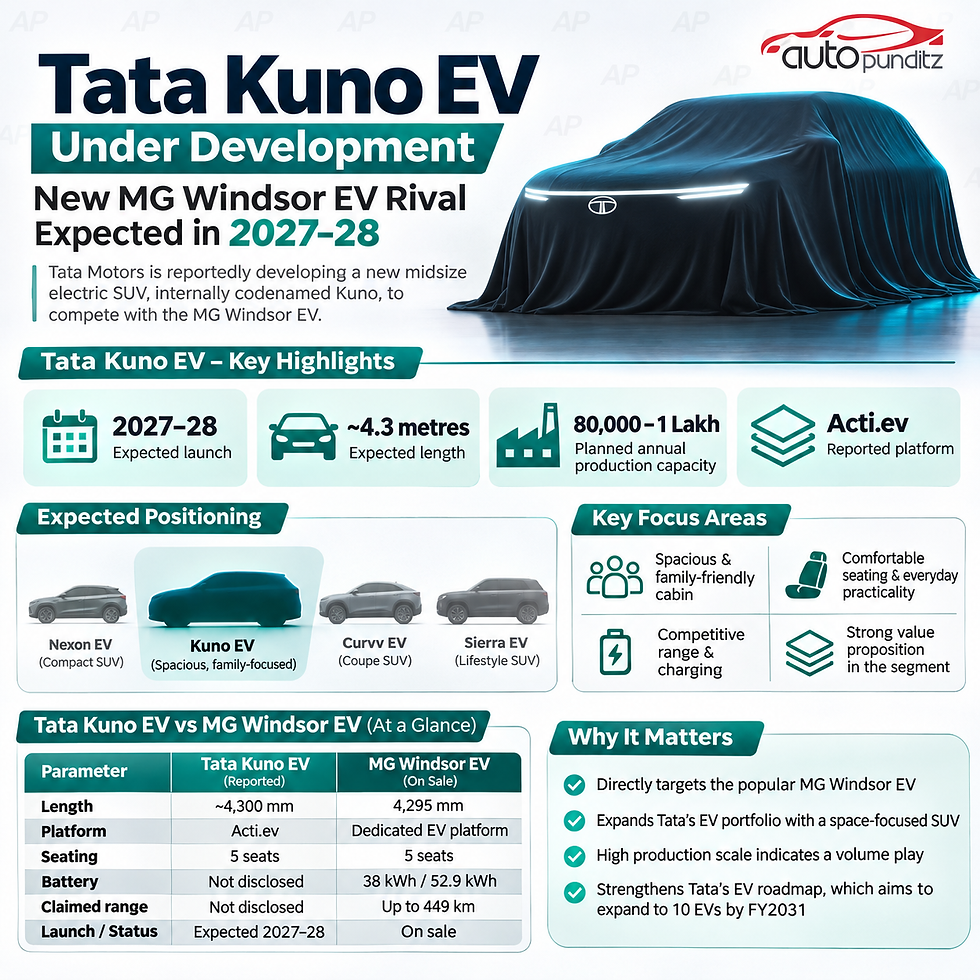
The upcoming Tata Kuno is expected to be a spacious, family-focused electric SUV built on the Acti.ev platform, with an estimated annual production capacity of up to 1 lakh units.
Tata Motors is reportedly developing an all-new midsize electric SUV, internally codenamed Kuno, to compete directly with the popular MG Windsor EV. Expected to arrive in India during 2027–28, the upcoming model could play an important role in Tata Motors' strategy to strengthen its presence in the growing electric passenger vehicle market.
Tata Kuno is expected to measure approximately 4.3 metres in length and will be positioned above the next-generation Nexon EV and below the Sierra EV in Tata's expanding electric vehicle portfolio.
Unlike the more design-focused Curvv EV, the Kuno is expected to prioritise cabin space, passenger comfort and practicality — attributes that have helped establish the MG Windsor EV as a compelling family electric vehicle. Tata Motors has not officially confirmed the project, its production specifications or its launch timeline.
1. Tata Kuno EV to Target the MG Windsor's Family-Buyer Appeal
The Kuno is expected to occupy a relatively distinct position in Tata Motors' electric SUV lineup. While the Nexon EV targets compact SUV buyers, the Curvv EV offers coupe-inspired styling and the Sierra EV focuses on a more premium, lifestyle-oriented proposition, the Kuno could become Tata's dedicated family-focused midsize electric SUV.
The vehicle's approximately 4.3-metre length would put it close to the MG Windsor EV, which measures 4,295mm. Rather than relying primarily on aggressive SUV styling, Tata could emphasise practical features such as generous rear-seat accommodation, easy cabin access, a spacious luggage compartment and a comfortable driving experience.
This approach could help the company reach customers transitioning from conventional family cars and SUVs to electric vehicles.
2. Dedicated Acti.ev Platform to Improve Cabin Packaging
The upcoming Tata Kuno is reportedly being developed on Tata Motors' Acti.ev architecture, designed specifically for electric vehicles. Unlike platforms that must accommodate conventional internal combustion engines, a dedicated electric architecture provides greater flexibility for battery placement, interior design and drivetrain configuration.
The Acti.ev architecture supports front-wheel-drive, rear-wheel-drive and all-wheel-drive layouts, although the Kuno's final configuration has not been disclosed. A relatively flat floor and optimised battery packaging could allow Tata Motors to improve passenger space within the vehicle's compact exterior dimensions. The use of an existing EV architecture could also provide opportunities for component sharing and manufacturing efficiencies across Tata's electric portfolio.
3. Battery, Range and Powertrain – What Can We Expect?
Tata Motors has not disclosed battery capacity, motor specifications, charging performance or certified driving range for the Kuno. However, considering its positioning alongside the Curvv EV and Sierra EV, the upcoming electric SUV could benefit from the company's existing battery and powertrain technologies.
For reference, the Tata Curvv EV's 55kWh version offers a claimed driving range of 502km and produces 167hp and 215Nm of torque. The Sierra EV, meanwhile, offers larger 65kWh and 75kWh battery options, with reported claimed driving ranges of up to 535km and 665km, respectively.
For a family-oriented EV targeting the Windsor, battery efficiency, charging convenience and real-world driving range may ultimately matter more than outright performance.
Importantly, none of the Curvv EV or Sierra EV specifications should be interpreted as confirmed figures for the Kuno.
4. Sanand Manufacturing and Production Plans
Another significant aspect of the Kuno project is its reported production scale. Tata Motors is considering manufacturing the upcoming electric SUV at its Sanand facility in Gujarat, with a planned annual production capacity of approximately 80,000 to 1,00,000 vehicles.
If realised, this would translate into a nominal monthly production capacity of approximately 6,700–8,300 units at full annual utilisation. The proposed scale suggests Tata Motors may be positioning the Kuno as a potentially important volume contributor rather than a niche EV offering. However, planned production capacity is not equivalent to expected sales. Actual output will depend on market demand, manufacturing readiness and the pace of production ramp-up.
5. Tata Kuno vs MG Windsor EV – How Could They Compare?
MG Windsor EV
A spacious electric crossover with a 2,700mm wheelbase, reclining rear seats, and 38kWh or 52.9kWh battery options.
Parameter | Tata Kuno EV (reported) | MG Windsor EV |
Length | Approximately 4,300mm | 4,295mm |
Architecture | Acti.ev | Dedicated electric architecture |
Seating | Expected 5 seats | 5 seats |
Battery | Not disclosed | 38kWh / 52.9kWh |
Claimed range | Not disclosed | Up to 449km |
Positioning | Family-focused midsize SUV | Family-focused electric crossover |
Launch | Expected 2027–28 | On sale |
MG Windsor EV specifications are based on manufacturer information. Tata Kuno details remain preliminary. The MG Windsor EV has differentiated itself with its spacious interior, reclining rear seats and comfort-focused design. Its Battery-as-a-Service (BaaS) ownership option also provides an alternative to conventional upfront battery purchase.
For the Kuno to compete effectively, Tata Motors may need to deliver a similarly comfortable cabin while remaining competitive on driving range, charging convenience, technology and total ownership costs.
6. Expected Tata Kuno EV Price in India
Official pricing information is not available. Given the model's expected positioning, the Kuno could overlap with Tata's existing midsize electric SUVs and the MG Windsor EV. The Windsor EV was recently reported to have received a ₹15,000 price increase across its regular variants, taking its ex-showroom price range to approximately ₹14.85 lakh–₹19.15 lakh as of October 30, 2026.
For the Kuno, a price positioning in the mid-to-upper teens could make strategic sense if Tata intends to challenge the Windsor directly. However, this is an Auto Punditz assessment rather than a reported price target. Final pricing will depend on battery size, equipment, manufacturing costs and market conditions closer to launch.
7. Tata Motors' Broader EV Expansion Strategy
The Kuno project also fits into Tata Motors' longer-term electric vehicle roadmap. During its June 2026 Investor Day, Tata outlined plans to expand its EV portfolio from six models to ten by FY2031. The proposed Kuno would help broaden the company's reach across different customer requirements and price segments.
An important consideration is differentiation within Tata's own portfolio. With the Nexon EV, Curvv EV and Sierra EV already addressing overlapping price bands, the Kuno will need a clearly defined proposition. A more conventional, spacious family SUV body style could provide that distinction.
Auto Punditz Take – Why the Kuno Could Be Strategically Important
The proposed Tata Kuno appears to be more than another addition to the company's expanding EV portfolio. It could represent a shift toward greater emphasis on family-oriented electric mobility.
The MG Windsor has demonstrated the appeal of prioritising cabin space, comfort and convenience rather than conventional SUV design alone. Tata's existing electric portfolio covers several vehicle formats, but the Kuno could provide a more direct alternative to the Windsor's space-focused proposition.
Three factors could determine the success of this strategy.
First, product differentiation. Tata will need to distinguish the Kuno from the Curvv EV and Sierra EV to avoid unnecessary overlap within its own lineup.
Second, competitive pricing. A compelling entry price and attractive battery options could be essential, particularly against the Windsor's flexible ownership model.
Third, manufacturing scale. The reported annual capacity of up to 1 lakh units suggests a potentially significant commitment. If market demand develops as expected, the Kuno could become an important contributor to Tata's electric vehicle volumes.
However, the launch timeline of 2027–28 also means Tata will be competing against an evolving MG Windsor lineup and potentially several other electric SUVs. Ultimately, the Kuno's success may depend less on headline performance figures and more on how effectively Tata combines space, range, value and everyday usability.


