


Tata Motors CV Sales Rise 42.7% in Q2 FY27 to 1.35 Lakh Units; September Volumes Up 42.4%
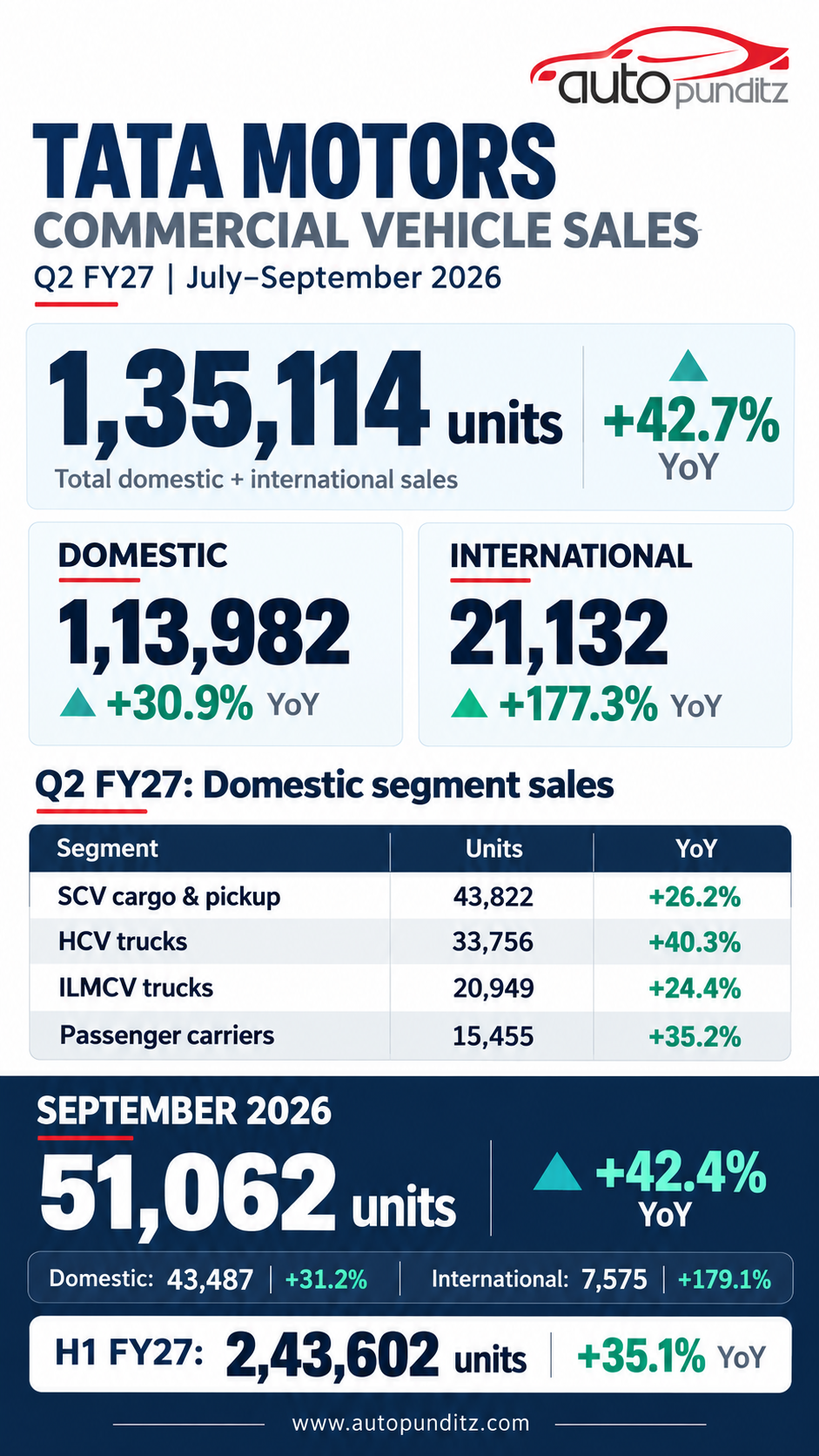
Tata Motors reported commercial vehicle sales of 1,35,114 units in Q2 FY27, registering 42.7% year-on-year growth over 94,681 units in the corresponding quarter last year. Growth was supported by higher domestic volumes across all reported vehicle categories and a sharp increase in international business.
For September 2026, total commercial vehicle sales reached 51,062 units, up 42.4% from 35,862 units in September 2025. First-half FY27 volumes stood at 2,43,602 units, an increase of 35.1% year-on-year.
These figures cover Tata Motors’ commercial vehicle business, including trucks, buses, small commercial vehicles and pickups.
September 2026: Domestic CV Sales Grow 31.2%
Domestic commercial vehicle sales rose to 43,487 units in September, compared with 33,148 units a year earlier. International business contributed another 7,575 units, growing 179.1% year-on-year.
The domestic categories below are arranged in descending order of September sales.
Category | September 2026 | September 2025 | YoY change |
SCV cargo and pickup | 16,510 | 14,110 | +17.0% |
HCV trucks | 14,171 | 9,870 | +43.6% |
ILMCV trucks | 7,990 | 6,066 | +31.7% |
Passenger carriers | 4,816 | 3,102 | +55.3% |
Total domestic CV sales | 43,487 | 33,148 | +31.2% |
International business | 7,575 | 2,714 | +179.1% |
Total CV sales | 51,062 | 35,862 | +42.4% |
Small commercial vehicle cargo and pickups remained the largest domestic category by volume. However, HCV trucks generated the biggest absolute increase among domestic categories, adding 4,301 units over September 2025.
Passenger carriers recorded the fastest percentage growth among the domestic categories at 55.3%, although from a smaller volume base.
Q2 FY27: Growth Across Every Domestic Category
For the July–September quarter, domestic commercial vehicle sales increased 30.9% to 1,13,982 units. International business volumes climbed 177.3% to 21,132 units.
Category | Q2 FY27 | Q2 FY26 | YoY change |
SCV cargo and pickup | 43,822 | 34,732 | +26.2% |
HCV trucks | 33,756 | 24,056 | +40.3% |
ILMCV trucks | 20,949 | 16,845 | +24.4% |
Passenger carriers | 15,455 | 11,428 | +35.2% |
Total domestic CV sales | 1,13,982 | 87,061 | +30.9% |
International business | 21,132 | 7,620 | +177.3% |
Total CV sales | 1,35,114 | 94,681 | +42.7% |
HCV trucks led domestic quarterly growth in percentage terms, followed by passenger carriers. SCV cargo and pickups retained the largest share of domestic volumes.
International Business Gains Weight
International operations played a significant role in the quarterly increase. Volumes rose by 13,512 units, accounting for approximately one-third of Tata Motors’ total incremental CV sales over Q2 FY26.
Based on the reported figures, international business represented approximately 15.6% of total Q2 FY27 sales, compared with 8.0% a year earlier. Domestic operations still accounted for most volumes, but the international contribution expanded substantially.
What Supported Demand?
According to Tata Motors, infrastructure, construction and mining activity supported heavy commercial vehicle demand during the quarter.
Intermediate, light and medium commercial vehicle demand benefited from e-commerce, consumer goods, consumer durables and two-wheeler logistics. Consumption-related freight movement supported small commercial vehicles and pickups.
Passenger transportation demand was supported by last-mile mobility, government orders and intercity travel. The company also reported stable fleet utilisation, indicating continued underlying freight activity.
Electric CV Volumes Reach 2.4 Times Last Year’s Level
Tata Motors said its electric commercial vehicle volumes reached 2.4 times the year-earlier level in Q2 FY27, equivalent to approximately 140% growth.
The release did not disclose absolute EV sales or a model-wise breakdown, so the contribution of electric vehicles to overall CV volumes cannot be calculated from this update.
Auto Punditz Take
The strength of Tata Motors’ Q2 performance lies in the breadth of growth. Every reported domestic category expanded by more than 24%, while international business supplied roughly one-third of the overall volume increase. This indicates that the quarter’s gains were spread across multiple parts of the business.
The next test will be sustaining demand against a higher comparison base in the second half. Tata Motors expects government capital expenditure, post-monsoon construction and mining activity, e-commerce and festive demand to support transportation requirements. It has also flagged commodity costs, diesel prices, potential interest rate hikes and global uncertainty as factors to watch.
For now, the sales figures show strong volume momentum. Whether that translates into stronger profitability will depend on costs, product mix and financial performance, which this sales release does not cover.


