


Tata Nano Could Make a Comeback as an EV, India Design Head Hints
The Tata Nano may have disappeared from showrooms years ago, but the idea behind India’s most ambitious affordable car continues to generate interest. Now, fresh comments from a senior Tata Motors design executive have reignited speculation that the Nano nameplate could one day return — potentially as an electric car.
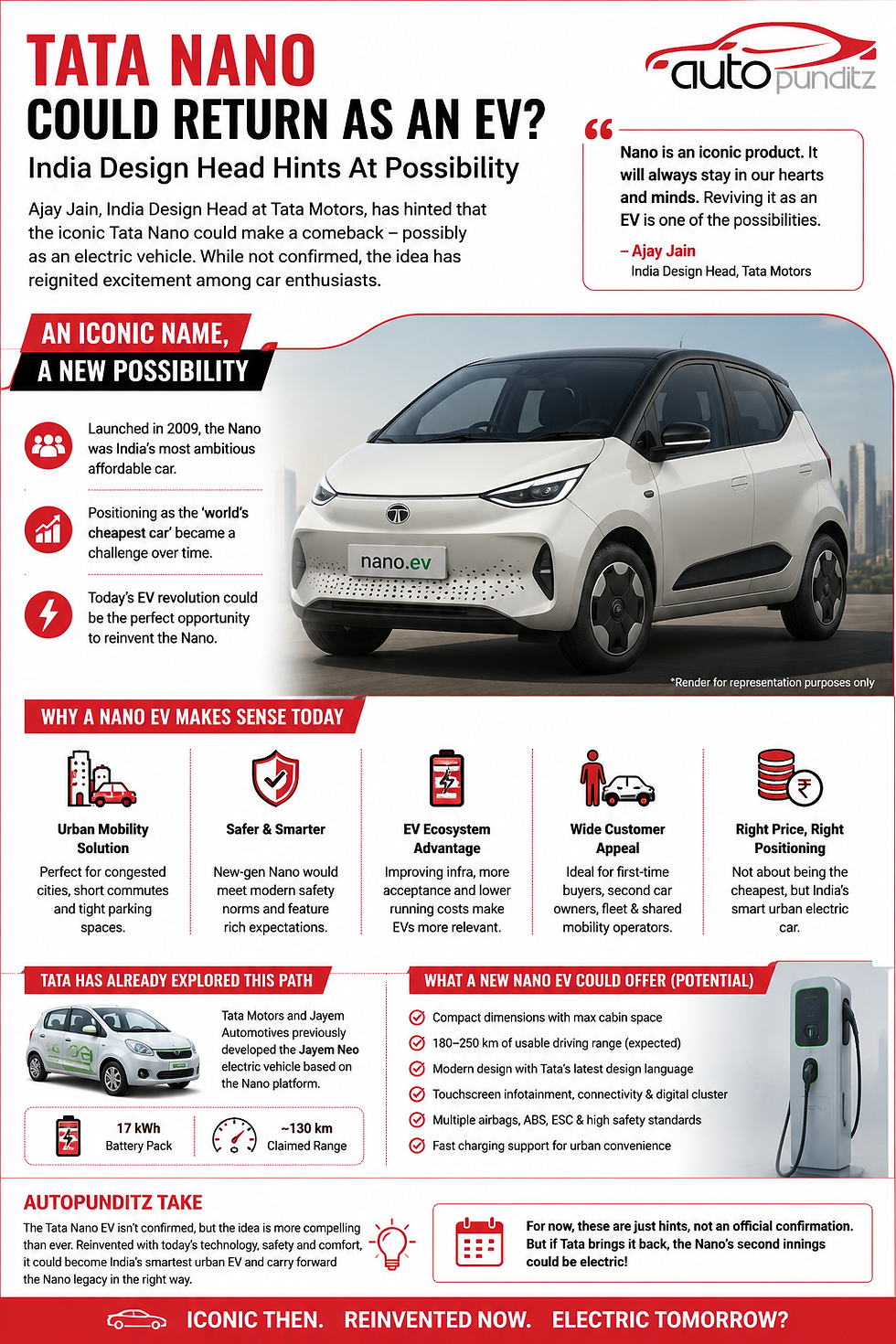
Ajay Jain, India Design Head at Tata Motors, recently spoke about the Nano during an interaction with ABP Auto Live. When asked about the possibility of bringing the iconic small car back, Jain responded positively and suggested that an electric avatar could be one way of reinventing the Nano for a new generation.
Importantly, Tata Motors has not officially confirmed a new Nano or Nano EV, nor has the company announced a development programme, launch timeline or specifications. Jain’s remarks should therefore be viewed as an indication of the possibilities being considered rather than confirmation of an upcoming product.
Tata Nano Still Holds Special Significance
Introduced commercially in 2009, the Nano was one of the most ambitious projects undertaken by the Indian automobile industry.
Tata Motors attempted to make four-wheel mobility accessible to millions of Indian families who previously depended primarily on two-wheelers. Its compact dimensions, rear-engine layout and aggressive pricing made it unlike virtually anything else available in India.
However, the Nano's positioning around being the "world's cheapest car" eventually became a disadvantage.
Indian consumers increasingly viewed cars as aspirational purchases, and many buyers preferred stretching their budgets towards larger and more conventional hatchbacks.
The Nano was eventually discontinued, but interest in the nameplate never completely disappeared.
Could The Nano Return As An EV?
The interesting part of Jain's comments is the possibility of an electric avatar.
A compact electric Nano could potentially make considerably more sense in today's automotive environment than it did during the original car's lifecycle.
India's EV market has expanded rapidly, charging infrastructure is improving and electric cars have become significantly more familiar to mainstream consumers.
At the same time, EV architecture creates interesting possibilities for compact city cars.
Instead of recreating the original Nano, Tata Motors could theoretically develop a modern urban EV inspired by its philosophy — small exterior dimensions, efficient packaging and relatively accessible pricing.
Such a car could potentially sit below the Tiago EV in Tata's electric vehicle portfolio.
Tata Already Has Experience With An Electric Nano
Interestingly, electrifying the Nano isn't an entirely new idea.
Tata Motors and Coimbatore-based Jayem Automotives previously worked on the Jayem Neo, an electric vehicle based on the Nano architecture and intended primarily for fleet applications.
The Neo reportedly used a 17 kWh battery and offered a claimed driving range of around 130 km.
While that project never transformed into a mainstream retail Tata Nano EV, it demonstrated that the basic Nano concept could be adapted to electric propulsion.
A new-generation vehicle, however, would almost certainly require a substantially different approach.
A New Nano Would Need To Be Completely Reinvented
Automotive regulations and consumer expectations have changed dramatically since the original Nano was conceived.
Any future Nano would need to meet considerably stricter requirements relating to crash safety, pedestrian protection, emissions-related systems where applicable, connectivity and onboard electronics.
Customers have changed as well.
Even buyers shopping at the affordable end of the market increasingly expect features such as touchscreen infotainment systems, smartphone connectivity, digital instrumentation, multiple airbags and premium-looking interiors.
Tata Motors' own Global Design leadership has previously acknowledged this shift. Martin Uhlarik has spoken about how even customers purchasing budget cars increasingly have premium expectations.
Therefore, a future Nano EV is unlikely to simply be the old Nano with a battery installed underneath it.
It would effectively have to be a new-generation city car carrying the Nano philosophy and possibly the Nano name.
Why The Timing Could Be Better Now
Ironically, some of the ideas behind the original Nano may be more relevant today.
Indian cities have become increasingly congested, parking space is limited and daily commuting distances for many urban customers remain relatively short.
That creates a potentially interesting use case for a compact EV designed primarily around urban mobility.
Such a vehicle could appeal to:
First-time car buyers upgrading from scooters or motorcycles
Families looking for an affordable second car
Urban commuters travelling relatively short distances
Fleet and shared-mobility operators
Buyers looking for a compact EV that is easier to park and manoeuvre
The challenge would be achieving the right price.
Battery costs continue to represent a substantial proportion of an EV's manufacturing cost, making the ultra-low pricing philosophy of the original Nano extremely difficult to recreate.
Instead of attempting to build India's cheapest car again, Tata could potentially position a Nano EV as India's smart urban electric car.
That distinction could prove important.
Tata's Growing Electric Vehicle Portfolio
Tata Motors has already established one of India's broadest electric passenger vehicle portfolios.
Its EV range has expanded from relatively affordable products such as the Tiago EV and Punch EV to larger offerings including the Nexon EV, Curvv EV, Harrier EV and Sierra EV.
An entry-level urban EV positioned below the Tiago could therefore fill a very different role within the portfolio.
It could also help Tata target customers currently considering premium electric scooters but looking to upgrade to the weather protection, safety and practicality of a four-wheeler.
However, achieving the right combination of price, battery range, safety and profitability would remain the biggest challenge.
What Could A Tata Nano EV Look Like?
No specifications have been announced, so any technical discussion remains speculative.
Nevertheless, a modern Nano-inspired EV wouldn't necessarily need enormous battery capacity.
A city-focused electric car offering approximately 180–250 km of usable driving range, compact dimensions and relatively quick urban charging could potentially meet the requirements of many city users without carrying the cost and weight associated with a large battery.
Modern EV packaging could also provide significantly better cabin utilisation than was possible with conventional entry-level cars.
The design would likely need to retain some of the original Nano's instantly recognisable tall-boy proportions while incorporating Tata's latest design language.
Nano's Biggest Asset Could Be Its Name
Perhaps the biggest advantage Tata Motors would have is something that cannot easily be engineered — brand recognition.
Few discontinued Indian cars continue to generate the level of discussion that the Nano does.
Concept renders and imagined electric versions of the Nano regularly circulate online, demonstrating continued curiosity surrounding the car.
Ajay Jain himself acknowledged this enthusiasm, suggesting that AI-generated concepts essentially reflect people's emotions and their desire to imagine future Tata products.
That gives Tata an interesting opportunity.
Instead of reviving the Nano purely through nostalgia, the company could reinterpret what the Nano originally represented: innovative mobility designed specifically around Indian requirements.
Auto Punditz Take
The Tata Nano EV isn't confirmed, but the idea is arguably more compelling today than simply reviving the original petrol car.
The first Nano attempted to democratise car ownership through an extraordinarily low purchase price. A second-generation Nano could pursue the same underlying objective through a completely different proposition — affordable, compact and efficient electric urban mobility.
The biggest mistake would be trying to recreate the "world's cheapest car" narrative.
If Tata Motors eventually brings the Nano back, positioning it as an innovative and desirable city EV rather than merely an inexpensive car could fundamentally change how customers perceive the nameplate.
For now, Ajay Jain's remarks should be treated as an intriguing hint rather than a product confirmation.
But considering Tata Motors' growing EV expertise and the enduring recognition of the Nano name, the possibility of India's most famous small car receiving a second life — this time powered by electricity — is certainly worth watching.


