


Electric Cars Outsell Strong Hybrids by Over 2.5x in H1 2026 – Is India Choosing EVs?
India's transition away from conventional petrol and diesel cars is gathering pace, but one electrified powertrain appears to be pulling decisively ahead.
During the first six months of 2026, electric passenger vehicles recorded 1,48,023 retail sales in India, representing a strong 79% year-on-year increase from 82,535 units in H1 2025.
Strong hybrids, by comparison, recorded 57,885 units during January-June 2026.
That means Indians bought roughly 2.56 electric cars for every strong-hybrid car during H1 2026.
The hybrid market remains heavily dependent on just Toyota and Maruti Suzuki, the EV market is rapidly developing multiple high-volume products across MG, Mahindra, Tata and Maruti Suzuki.
EV vs Strong Hybrid Sales – H1 2026
Powertrain | H1 2026 Volume |
Battery Electric Passenger Vehicles | 1,48,023 |
Strong Hybrid Cars | 57,885 |
EV/Hybrid Ratio | 2.56 : 1 |
The top 20 electric models supplied for 1,39,024 units, representing approximately 94% of total H1 EV passenger-vehicle sales.
For hybrids, the market is dramatically more concentrated: only eight strong-hybrid models contributed the entire 57,885-unit volume.
And that difference in product breadth could explain much of the EV advantage.
Top 20 Electric Cars in India – H1 2026
Rank | Electric Car | H1 2025 | H1 2026 | Growth |
1 | MG Windsor | 21,109 | 19,080 | -10% |
2 | Mahindra XEV 9S | – | 18,074 | New |
3 | Tata Nexon EV | 9,284 | 16,567 | +78% |
4 | Tata Punch EV | 7,545 | 15,683 | +108% |
5 | Mahindra XEV 9e | 13,026 | 11,242 | -14% |
6 | Tata Harrier EV | 475 | 10,499 | +2,110% |
7 | Maruti Suzuki e Vitara | – | 8,572 | New |
8 | Tata Curvv EV | 2,332 | 7,281 | +212% |
9 | Mahindra BE 6 | 6,044 | 6,849 | +13% |
10 | Tata Tiago EV | 8,396 | 6,816 | -19% |
11 | MG Comet EV | 3,662 | 4,474 | +22% |
12 | MG ZS EV | 1,543 | 2,785 | +80% |
13 | Kia Carens EV | – | 2,471 | New |
14 | Hyundai Creta Electric | 5,472 | 2,181 | -60% |
15 | Mahindra XUV 3XO EV | – | 1,935 | New |
16 | Tata Tigor EV | 2,540 | 1,643 | -35% |
17 | Tata Sierra EV | – | 1,516 | New |
18 | Mahindra XUV400 | 1,703 | 651 | -62% |
19 | Toyota Ebella | – | 504 | New |
20 | Citroen e-C3 | 598 | 201 | -66% |
Top 20 Total | 83,229 | 1,39,024 | +67% |
The top-20 comparison is particularly revealing.
Combined volumes increased from 83,229 units in H1 2025 to 1,39,024 units in H1 2026, an increase of approximately 67%.
However, a large part of that growth has come from new models entering the market.
MG Windsor Remains India's Best-Selling EV
Despite a 10% decline, the MG Windsor retained the No.1 position with 19,080 units during H1 2026.
JSW MG Motor itself recently confirmed that more than 19,000 Windsors were sold during the first half of 2026 and that cumulative Windsor sales had crossed 75,000 units.
But its lead is now extremely narrow.
Mahindra's XEV 9S reached 18,074 units, putting it just 1,006 units behind the Windsor.
The fact that a relatively new electric SUV can already challenge India's established EV bestseller illustrates how quickly the segment is evolving.
Tata's EV Portfolio Is Becoming a Volume Machine
Tata's performance is perhaps even more significant because its sales aren't dependent on one blockbuster EV.
The Nexon EV recorded 16,567 units, increasing 78%, while the Punch EV more than doubled to 15,683 units, up 108%.
The Harrier EV surged to 10,499 units, while the Curvv EV climbed 212% to 7,281 units.
Tiago EV sales, however, declined 19% to 6,816 units, while the older Tigor EV fell 35%.
The pattern suggests that EV demand is increasingly migrating towards electric SUVs and crossovers, rather than merely inexpensive electric hatchbacks.
Industry-level data supports Tata's strength: Tata Motors retained the No.1 EV manufacturer position with 57,370 H1 sales and a 39% market share. Mahindra followed at 34,131 units, while JSW MG Motor recorded 31,819 units.
Mahindra Has Emerged as a Serious EV Challenger
Mahindra's transformation is equally striking.
The XEV 9S contributed 18,074 units, the XEV 9e another 11,242 units and the BE 6 added 6,849 units in the supplied model dataset.
At manufacturer level, Mahindra's electric passenger-vehicle sales reached 34,131 units, up 147% YoY, allowing the company to overtake JSW MG Motor for second place in India's EV manufacturer rankings.
This is important for the industry's direction.
EV growth is no longer primarily a Tata Motors story.
India now effectively has three large-scale domestic EV players — Tata, Mahindra and JSW MG Motor — with Maruti Suzuki beginning to establish itself as another significant competitor.
Maruti e Vitara Makes Its Presence Felt
The Maruti Suzuki e Vitara recorded 8,572 units in the supplied model dataset, placing it seventh among India's best-selling EVs during H1 2026.
Maruti's entry matters beyond the volume itself.
The country's largest passenger-vehicle manufacturer brings an enormous dealership network, customer base and brand familiarity into the EV market. As its electric portfolio expands, EVs could penetrate markets where adoption has historically been slower.
The next phase of India's EV growth could therefore be less about early adopters and increasingly about mainstream car buyers.
Strong Hybrids: 57,885 Cars, But Almost No Growth
The contrast with hybrids is striking.
The eight strong-hybrid cars in the dataset generated 57,885 units in H1 2026, versus 57,847 units in H1 2025.
That's an increase of just 38 cars, effectively leaving the strong-hybrid market flat year-on-year.
Strong Hybrid Car Sales – H1 2026
Rank | Strong Hybrid | H1 2025 | H1 2026 | Growth |
1 | Toyota Innova Hycross | 29,652 | 27,812 | -6% |
2 | Toyota Urban Cruiser Hyryder | 15,058 | 18,577 | +23% |
3 | Maruti Suzuki Grand Vitara | 8,909 | 4,086 | -54% |
4 | Maruti Suzuki Victoris | – | 3,231 | New |
5 | Maruti Suzuki Invicto | 1,918 | 1,418 | -26% |
6 | Toyota Camry | 1,195 | 1,188 | -1% |
7 | Toyota Vellfire | 573 | 914 | +60% |
8 | Honda City e:HEV | 542 | 659 | +22% |
Total | 57,847 | 57,885 | ~0.1% |
Independent reporting estimates H1 2026 strong-hybrid volumes at 57,885 units.
The real issue for hybrids isn't consumer interest but a lack of products.
Toyota Innova Hycross + Hyryder Account for 80% of Hybrid Sales
Toyota's dominance of the strong-hybrid market is extraordinary.
The Innova Hycross remained India's best-selling strong hybrid with 27,812 units, despite volumes declining 6%.
The Urban Cruiser Hyryder went in the opposite direction, increasing 23% to 18,577 units.
Together, these two Toyota products generated:
46,389 units out of India's 57,885 strong-hybrid sales.
That's an astonishing 80.1% of the entire market.
Independent H1 reporting similarly puts the Innova Hycross at around 48% of the hybrid market and the Hyryder at around 32%. (Navbharat Times)
In other words, eight out of every ten strong hybrids sold in India during H1 2026 were essentially one of two Toyotas.
That is less a diversified hybrid market and more a Toyota-led niche that has achieved substantial volumes.
Grand Vitara Hybrid Sales Fall 54%
One of the most interesting movements is the Maruti Suzuki Grand Vitara.
Its strong-hybrid volume fell from 8,909 units to 4,086 units, representing a steep 54% decline.
However, this needs to be read alongside the arrival of the Maruti Suzuki Victoris, which generated 3,231 hybrid sales.
Some cannibalisation within Maruti Suzuki's own hybrid portfolio therefore appears plausible.
Even after adding the Victoris, however, the combined 7,317 units remain below the Grand Vitara's H1 2025 hybrid volume.
The Invicto also declined 26% to 1,418 units.
Premium Hybrids Remain Small but Stable
Toyota's Camry recorded 1,188 units, virtually unchanged from 1,195 units a year earlier.
The Vellfire performed considerably better, climbing 60% to 914 units.
Honda's City e:HEV also grew 22% to 659 units, but remains a very small contributor to overall hybrid volumes.
Toyota's long-term strength in this technology should not be underestimated, though. The manufacturer announced earlier this year that its cumulative hybrid vehicle sales in India had crossed 3 lakh units. (HT Auto)
The Biggest Difference: 20 EVs vs Just 8 Strong Hybrids
This may be the most important conclusion from the entire dataset.
The EV market already has multiple meaningful products:
MG Windsor → Mahindra XEV range → Tata Nexon/Punch/Harrier/Curvv → Maruti e Vitara → MG Comet/ZS EV → Hyundai Creta Electric → Kia Carens EV and others.
Hybrids have nothing resembling that breadth.
The eight models in the supplied hybrid dataset come from only three manufacturers — Toyota, Maruti Suzuki and Honda.
And Honda contributes only the City e:HEV.
This means buyers looking for a strong hybrid have far fewer choices across body styles and price segments than EV buyers.
EV Market Is Also Becoming Less Dependent on One Model
Another encouraging sign for EV adoption is the distribution of sales.
The No.1 MG Windsor accounted for only about 13% of India's total electric passenger-vehicle market during H1 2026.
Compare that with hybrids.
The Innova Hycross alone represents approximately 48% of strong-hybrid sales.
Add the Hyryder and the top two hybrid models control more than 80%.
That is an enormous structural difference.
EV demand is now being spread across several models and manufacturers, whereas India's hybrid market remains extremely concentrated.
Why Are EVs Pulling Ahead?
Product choice is only one part of the equation.
EVs currently benefit from a combination of factors that hybrids have struggled to replicate: a broader model range, aggressive investment from manufacturers, rapidly improving battery range and charging capability, lower running costs for home-charging users, and a more favourable taxation structure.
Most importantly, manufacturers are now creating EV-specific product strategies rather than simply adding an electrified version to an existing car.
Mahindra's electric portfolio is a good example of this transition.
The result is that consumers are increasingly being offered EVs that can compete on design, technology, performance and features, rather than merely being sold on lower running costs.
But Hybrids Still Solve a Major Indian Problem
The sales gap shouldn't be interpreted as proof that EVs are inherently the better solution for every Indian buyer.
Strong hybrids continue to offer one enormous advantage:
they require no charging infrastructure.
For apartment residents without dedicated charging, buyers in cities with limited public charging, or owners who frequently undertake long-distance highway journeys, a strong hybrid can provide much of the efficiency benefit of electrification without changing established refuelling habits.
That's a compelling proposition in India.
The challenge is that consumers currently have very few vehicles from which to choose.
What Happens When Hyundai and Kia Enter the Hybrid Battle?
This is where the market could become much more interesting.
If additional manufacturers introduce locally produced strong-hybrid powertrains across high-volume SUV segments, the current EV-versus-hybrid equation could change.
Today's 57,885-unit hybrid market is being generated despite having only a handful of models.
Imagine the potential if strong-hybrid options become available across more mainstream compact and midsize SUVs.
Hybrid growth therefore may not depend on changing consumer attitudes as much as it depends on OEMs finally giving consumers more choices.
EV vs Hybrid – The H1 2026 Scorecard
Metric | Electric Cars | Strong Hybrids |
H1 2026 Sales | 1,48,023 | 57,885 |
EV : Hybrid Ratio | 2.56x | 1x |
Products in supplied ranking | 20 | 8 |
No.1 Model | MG Windsor | Toyota Innova Hycross |
No.1 Model Sales | 19,080 | 27,812 |
Top Model Share of Segment* | ~13% | ~48% |
No.1 + No.2 Concentration* | ~25% | ~80% |
Competitive Breadth | High & expanding | Low |
Key Strength | Running cost + choice | Efficiency + convenience |
Key Constraint | Charging | Product choice/pricing |
*Using total H1 2026 segment volumes.
Interestingly, the Innova Hycross individually outsells every EV model in the country. The problem for hybrids is what happens after the Hycross and Hyryder.
EVs have a much deeper bench.
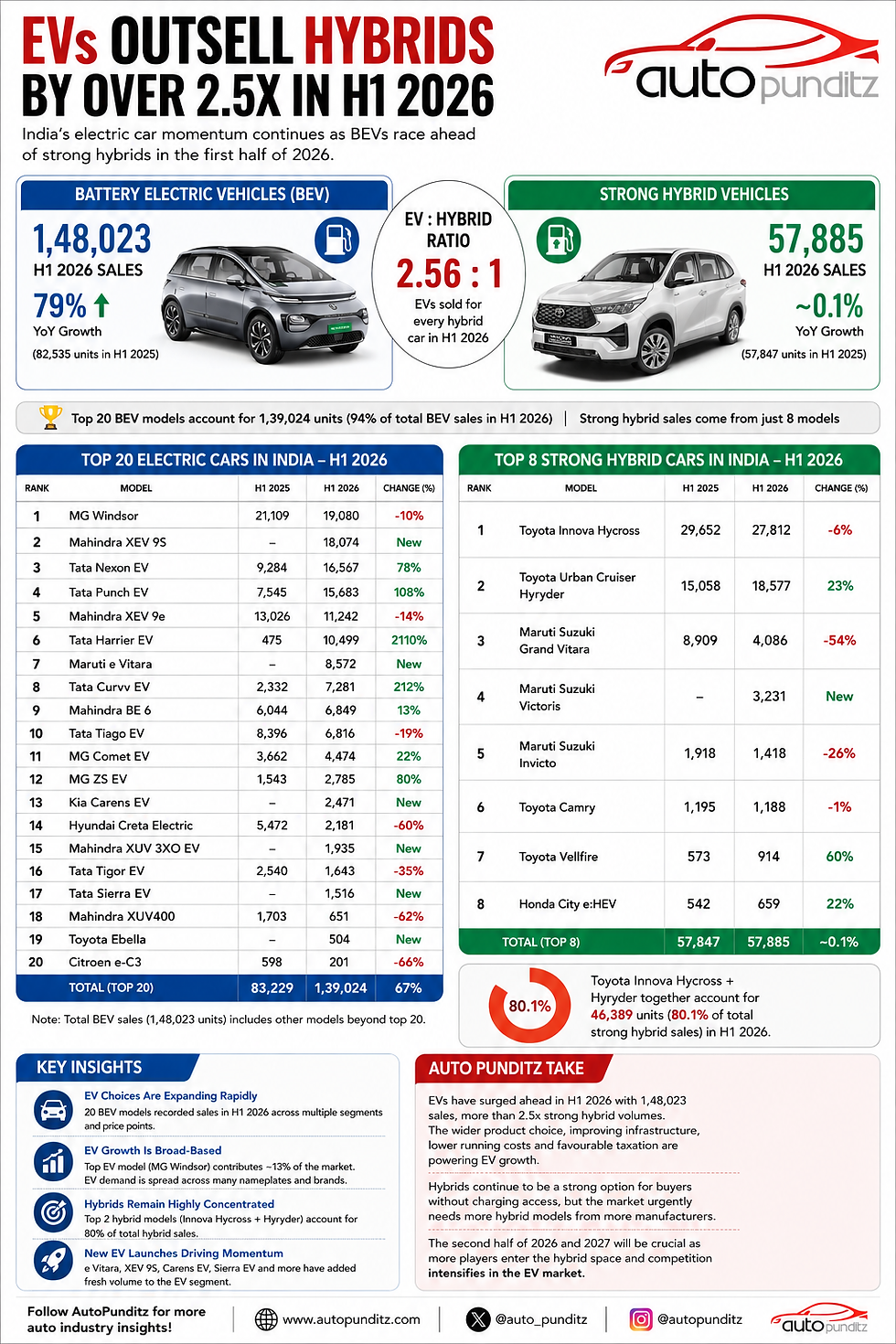
Auto Punditz Take
H1 2026 isn't simply an EV victory over hybrids. It highlights a fundamental difference in how India's two electrified-car markets are developing.
Electric passenger vehicles have reached 1.48 lakh units in six months, while strong hybrids remain below 58,000 units. More importantly, EV growth is coming from multiple manufacturers and multiple successful products.
The MG Windsor leads at 19,080 units, but Mahindra, Tata and Maruti all have meaningful volume contributors close behind. The top 20 EVs collectively delivered 1.39 lakh units.
Hybrids present almost the reverse picture.
The Innova Hycross is an exceptional success at 27,812 units, and the Hyryder is another strong performer at 18,577 units. But together those two vehicles account for roughly 80% of India's entire strong-hybrid market.
That concentration is both the hybrid segment's weakness and its biggest opportunity.
India has not necessarily chosen EVs over hybrids. Indian buyers currently have far more EVs to choose from.
If Hyundai, Kia and other mass-market manufacturers eventually launch competitive locally produced hybrids, particularly below ₹20 lakh, the sales equation could change significantly.
Until then, EVs have the structural advantage.
They have more manufacturers, more products, more price points and increasingly more consumer awareness. Total electric passenger-vehicle sales rising 79% YoY to 1,48,023 units in H1 2026 suggests that the category is moving rapidly beyond its early-adopter phase.
So the defining takeaway from H1 2026 isn't merely that EVs outsold strong hybrids by more than 2.5 times.
It is that India's electric-car market is becoming a broad, multi-brand industry, while strong hybrids remain a highly concentrated segment waiting for the next wave of products.
And that makes the second half of 2026 — and 2027 — particularly important for India's EV-vs-hybrid battle.


