


Govt May Delay E25 Mandate Amid Vehicle Compatibility Concerns: Why India's Ethanol Roadmap Could Take a Phased Approach
- Team Autopunditz
- Jul 8
- 4 min read
India's ambitious ethanol blending programme may take a more measured path than previously anticipated. Amid growing concerns over vehicle compatibility, fuel efficiency, and maintenance costs, the Government is reportedly considering delaying any immediate mandate to increase ethanol blending beyond the current E20 level.
The development comes just days after the nationwide debate around E20 fuel intensified, with reports highlighting concerns over mileage loss and potential impact on older vehicles. According to recent reports, policymakers are now leaning towards a phased approach, allowing consumers to gradually transition to higher ethanol blends instead of enforcing a nationwide E25 mandate.
Why Is The Government Reconsidering?
The primary concern is India's enormous existing vehicle fleet.
While India achieved nationwide availability of E20 petrol in April 2025, millions of vehicles currently on Indian roads were originally engineered for lower ethanol concentrations.
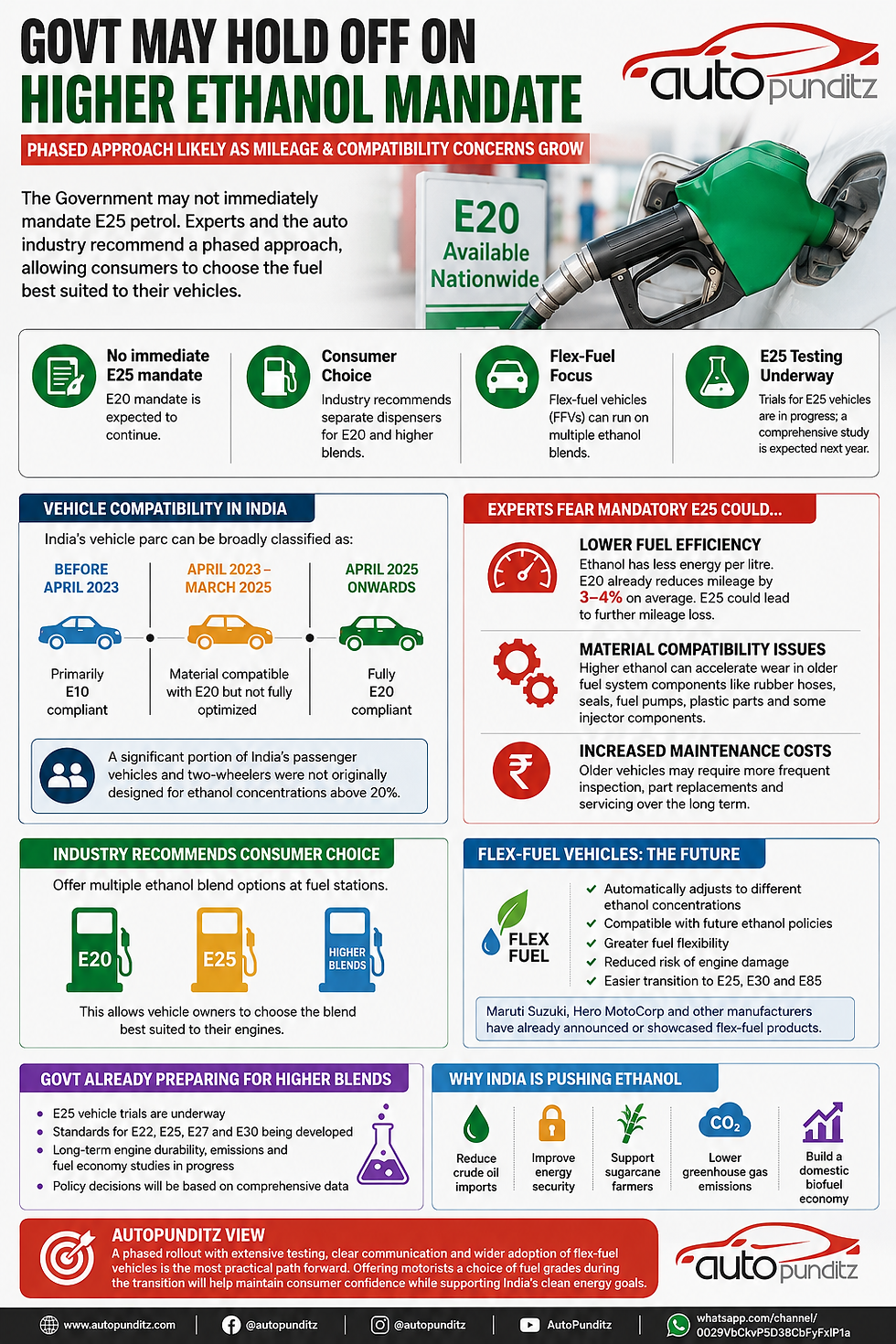
Broadly, the vehicle parc can be classified into three categories:
Vehicle Production Period | Compatibility |
Before April 2023 | Primarily E10 compliant |
April 2023 – March 2025 | Material compatible with E20 but not necessarily fully optimized |
April 2025 onwards | Fully E20 compliant |
This means a significant portion of India's passenger vehicles and two-wheelers were never originally designed for ethanol concentrations beyond 20%.
Experts Fear Mandatory E25 Could Affect Existing Vehicles
According to industry experts, moving directly from E20 to E25 without adequate preparation could create several challenges:
1. Lower Fuel Efficiency
Ethanol contains less energy per litre than petrol.
Increasing ethanol concentration generally results in:
Lower mileage
Higher fuel consumption
Increased running cost per kilometre
Most manufacturers estimate E20 reduces mileage by around 3–4%, although some consumers report larger real-world drops depending on driving conditions. Higher blends such as E25 could further affect fuel economy if engines are not specifically calibrated.
2. Material Compatibility
Higher ethanol concentrations can accelerate wear in older fuel systems.
Potential concerns include:
Rubber hoses
Fuel seals
Plastic components
Fuel pumps
Certain injector components
A recently reported Automotive Research Association of India (ARAI) study suggested that older E10 vehicles could experience accelerated wear of rubber fuel-system parts and that turbocharged engines require closer evaluation, although no significant issues were found for two-wheelers in the study.
3. Increased Maintenance Costs
Vehicles not specifically engineered for higher ethanol blends may require:
More frequent inspection of fuel system components
Replacement of degraded rubber parts
Engine recalibration in some cases
Additional servicing over long-term usage
Experts therefore recommend avoiding an abrupt increase in mandatory blending.
Industry Wants Consumer Choice Instead
Rather than replacing E20 with E25 nationwide, several industry stakeholders have suggested offering multiple ethanol blend options at fuel stations.
Under this proposal, consumers could choose between:
E20
E25 (future)
Higher ethanol blends for compatible vehicles
This approach would be similar to how different fuel grades are offered in several international markets and would allow owners of older vehicles to continue using the blend best suited to their engines.
Flex-Fuel Vehicles Could Be The Long-Term Solution
Instead of modifying millions of existing vehicles, the industry is advocating a faster rollout of flex-fuel vehicles (FFVs).
Flex-fuel vehicles are engineered to automatically adjust engine operation based on ethanol concentration and can run on multiple blends, depending on their design.
Benefits include:
Compatibility with future ethanol policies
Greater fuel flexibility
Reduced risk of engine damage
Easier transition towards E25, E30 and eventually E85
Several manufacturers, including Maruti Suzuki and Hero MotoCorp, have already announced or showcased flex-fuel products, while the government has been actively promoting this technology as part of India's biofuel strategy.
Government Already Preparing For Higher Blends
Although an immediate E25 mandate appears unlikely, India's ethanol roadmap continues to move forward.
Authorities are already:
Conducting E25 vehicle trials
Preparing standards for E22, E25, E27 and E30 fuels
Studying long-term engine durability
Evaluating emissions and fuel economy impacts
The ongoing E25 trial programme is expected to generate technical data that will guide future policy decisions before any nationwide rollout.
Why India Is Pushing Ethanol
The ethanol blending programme remains one of India's biggest energy transition initiatives.
Its objectives include:
Reducing crude oil imports
Improving energy security
Supporting sugarcane farmers
Lowering greenhouse gas emissions
Creating a domestic biofuel economy
India achieved nationwide E20 fuel availability well ahead of its original target, making it one of the fastest large-scale ethanol transitions globally. However, the recent public debate has highlighted the need to balance environmental goals with consumer confidence and vehicle compatibility.
Key Highlights
Government may not immediately mandate E25 petrol.
Existing E20 mandate is expected to continue.
Industry recommends consumer choice through separate E20 and higher-blend fuel dispensers.
Focus shifting towards flex-fuel vehicles capable of running on multiple ethanol blends.
Testing for E25-compatible vehicles has already begun, with a comprehensive study expected next year.
Auto Punditz View
The reported decision to hold back an immediate E25 mandate reflects a pragmatic shift rather than a reversal of India's ethanol ambitions. While the long-term benefits of higher ethanol blending—such as reduced oil imports, improved energy security and support for the agricultural sector—remain compelling, the transition must account for the realities of India's diverse vehicle fleet.
A phased rollout, backed by extensive testing, clear consumer communication and wider availability of flex-fuel vehicles, is likely to deliver better long-term outcomes than a rapid increase in mandatory blending. Providing motorists with a choice of fuel grades during the transition could also help maintain consumer confidence while allowing the industry to adapt to future ethanol targets.
Such an approach would strike a balance between India's clean-energy objectives and the practical concerns of millions of vehicle owners, ensuring that the next phase of the ethanol programme is both technically robust and consumer-friendly.


