


JLR Rewrites Its EV Roadmap: Next-Generation Velar to Offer Both Electric and Hybrid Power
Upcoming luxury SUV to debut as an EV before gaining a hybrid variant, reflecting changing realities in the global premium car market
For much of the past five years, premium automakers have projected an all-electric future. Ambitious targets, billion-dollar investments and dedicated EV platforms suggested that internal combustion engines would gradually disappear from luxury showrooms. However, evolving customer preferences and uneven EV adoption are prompting manufacturers to rethink that strategy.
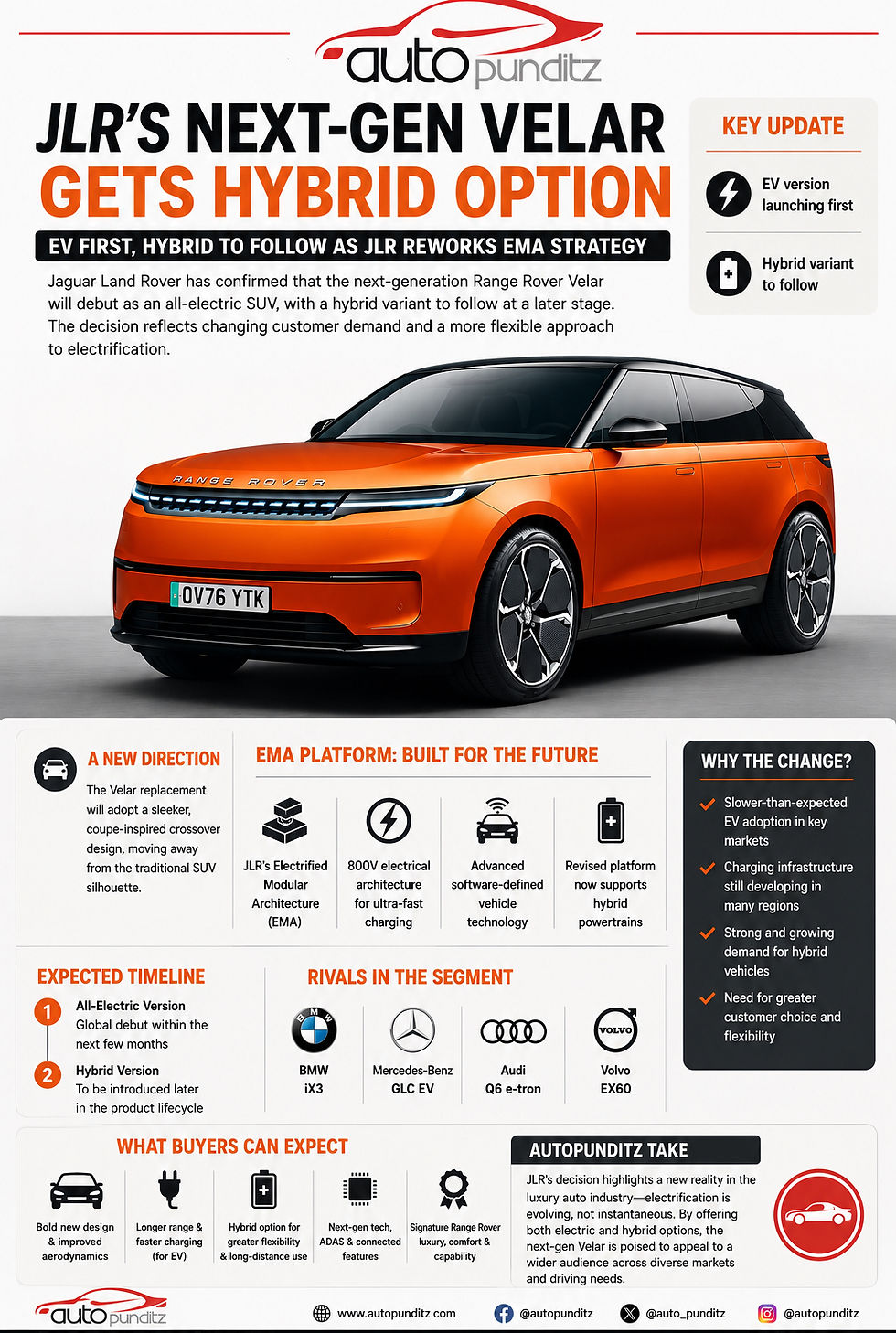
The latest example comes from Jaguar Land Rover (JLR), which has confirmed that the successor to the Range Rover Velar will eventually be offered with a hybrid powertrain, despite being developed primarily as an electric vehicle. The decision represents more than just another model update—it highlights how even premium brands are embracing a more flexible approach to electrification.
An EV-First Strategy, But Not an EV-Only Future
The all-new Velar replacement is expected to make its global debut within the next few months as one of the first production models based on JLR's Electrified Modular Architecture (EMA). Initially conceived as a dedicated electric vehicle platform, EMA is now being adapted to support hybrid powertrains as well.
According to JLR, the electric version will arrive first, while a hybrid derivative will follow later. Although the company has not disclosed the exact hybrid technology, the move itself signals a significant shift from its earlier EV-only roadmap.
Rather than committing customers to a single propulsion system, JLR is creating room for multiple technologies that can better suit different markets and buyer preferences.
More Than a Replacement for the Velar
The upcoming model is expected to move beyond the traditional SUV proportions of the current Velar. Spy photographs and industry reports indicate a lower, sleeker crossover with coupe-inspired styling designed to improve aerodynamic efficiency without compromising Range Rover's premium identity.
This new positioning places it in direct competition with a growing number of premium electric crossovers expected over the next few years, including the next-generation BMW iX3, Porsche Macan Electric, Mercedes-Benz GLC EV and Audi Q6 e-tron.
The redesign also reflects changing customer expectations, where efficiency, technology and software capabilities are becoming just as important as luxury and performance.
EMA Platform Brings New Technology
The revised EMA platform is expected to underpin several future JLR products and introduce a host of technological upgrades.
Expected highlights include:
800V electrical architecture enabling ultra-fast charging
Advanced battery technology for improved efficiency and range
Software-defined vehicle architecture with over-the-air updates
Next-generation driver assistance features
Compatibility with both battery-electric and hybrid powertrains
This flexibility allows JLR to adapt its future products without requiring separate vehicle architectures for different propulsion technologies.
Why Hybrids Are Making a Comeback
JLR's decision mirrors a wider trend emerging across the global automotive industry.
While electric vehicle sales continue to grow worldwide, adoption rates vary significantly between regions. In many markets, customers continue to cite charging infrastructure, higher purchase costs and long-distance usability as reasons for delaying a full transition to EVs.
Hybrids, particularly plug-in hybrids, have therefore emerged as an important bridge technology, offering lower emissions while retaining the convenience of conventional refuelling.
Several major manufacturers have already adjusted their electrification roadmaps by extending hybrid programmes or delaying all-electric targets. Instead of treating hybrids as a temporary solution, many are now positioning them as an integral part of the transition towards zero-emission mobility.
A Pragmatic Move for Global Markets
For JLR, introducing a hybrid version of the Velar successor is not simply about increasing sales volumes. It is also about ensuring that the product remains relevant across diverse global markets where electrification is progressing at different speeds.
Countries with mature charging infrastructure may naturally favour the electric version, while regions where public charging networks remain limited could continue to generate strong demand for hybrid alternatives.
The dual-powertrain strategy also provides greater resilience against fluctuations in EV demand and changing regulatory environments.
What Buyers Can Expect
Although official specifications remain under wraps, the next-generation model is expected to become one of the most technologically advanced vehicles in JLR's portfolio.
The electric version is likely to launch first, followed by a hybrid variant that broadens the model's customer base. More details regarding battery sizes, performance figures, hybrid configuration and market-specific launch timelines are expected closer to its official unveiling.
Auto Punditz Take
JLR's latest decision demonstrates that the luxury automotive industry is entering a more balanced phase of electrification. Rather than pursuing battery-electric vehicles at all costs, manufacturers are increasingly recognising that customer demand, charging infrastructure and regional market conditions will determine the pace of transition.
By redesigning its EMA platform to accommodate both electric and hybrid powertrains, JLR is future-proofing one of its most important upcoming products while offering buyers greater choice. The next-generation Velar is therefore more than just a new luxury SUV—it represents a broader shift in how premium automakers are preparing for an evolving automotive landscape where flexibility may prove to be as valuable as electrification itself.


