


Suzuki e SKY Gets 310 Km Range; Japan Sales Begin November 16
Suzuki has announced that its new e SKY electric kei car will go on sale in Japan on November 16, 2026. The company’s first mini passenger EV for its domestic market combines a compact footprint with a claimed 310 km driving range, strengthening Suzuki’s presence in the small electric car segment.
Developed around the idea of making the switch from petrol to electric easier, the e SKY prioritises everyday usability, efficiency and manoeuvrability. For Indian buyers, it also offers an interesting glimpse into Suzuki’s approach to smaller EVs, although Maruti Suzuki has not announced an India launch for this model.
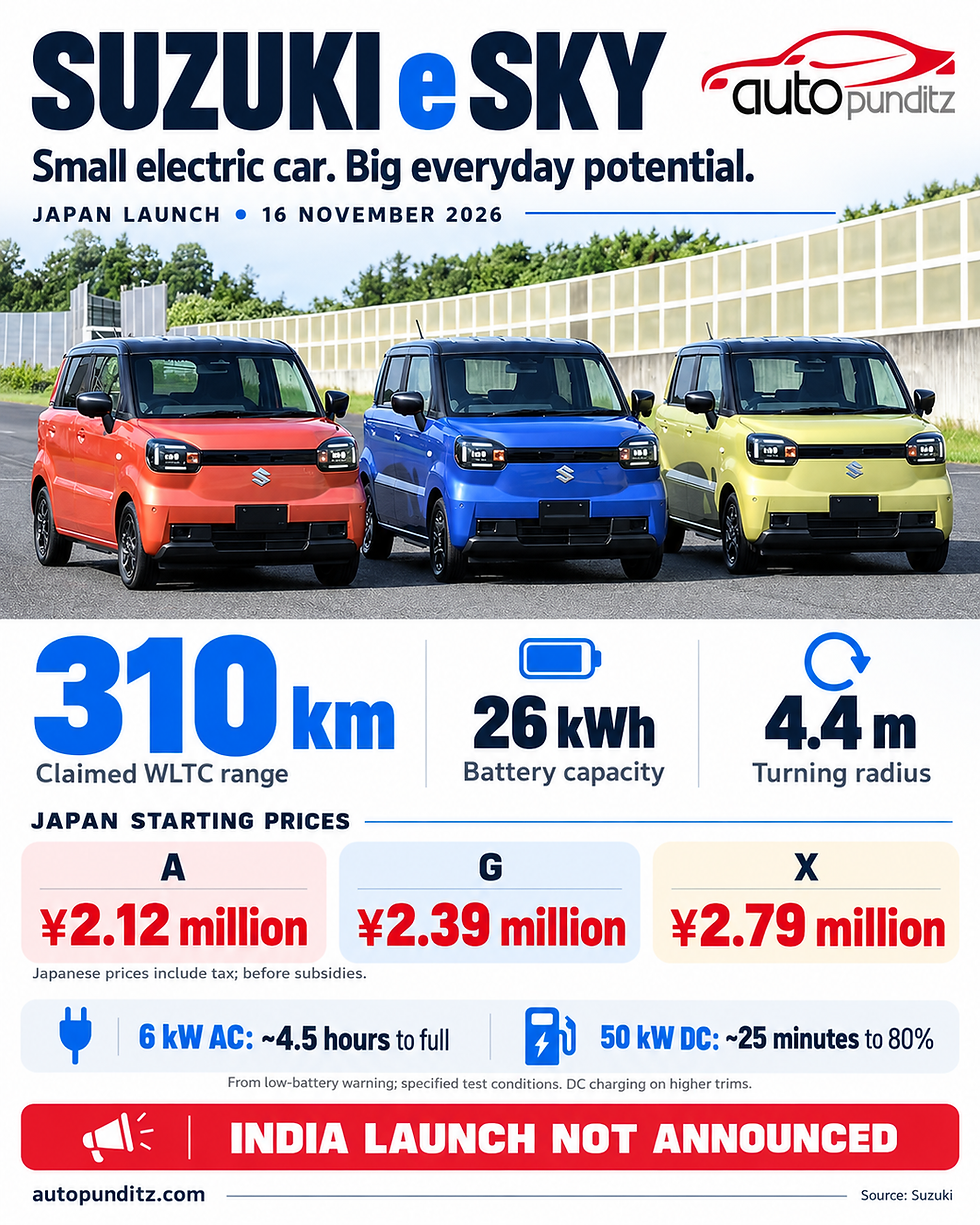
Suzuki will offer the e SKY in three variants, with Japanese prices starting at ¥2.12 million (~Rs.13 Lakh).
Variant | Starting price in Japan |
A | ¥2,120,000 |
G | ¥2,390,000 |
X | ¥2,790,000 |
These are Japanese manufacturer-listed prices inclusive of consumption tax, before applicable subsidies. The entry-level A variant is available on a made-to-order basis. All three versions have a 26 kWh battery and two-wheel drive. These overseas prices should not be interpreted as indicative Indian launch prices.
The e SKY’s dimensions underline its city-focused positioning. Its narrow body should help on congested streets, while the tall roof and upright proportions are intended to make efficient use of the available space.
Dimension | Suzuki e SKY |
Length | 3,395 mm |
Width | 1,475 mm |
Height | 1,625 mm |
Wheelbase | 2,460 mm |
Ground clearance | 140 mm |
Minimum turning radius | 4.4 metres |
The dimensions place it within Japan’s compact kei-car format, with an overall length of less than 3.4 metres. Underneath, Suzuki uses its dedicated HEARTECT-e electric vehicle platform, an eAxle and regenerative braking. The company attributes the car’s efficiency to weight reduction and improvements across these systems. Its claimed range is 310 km per charge, while the certified WLTC-mode AC energy consumption figure is 97 Wh/km, which Suzuki describes as class-leading as of October 2026.
The range figure is a test-cycle claim. Actual distance between charges will depend on driving speed, weather, cabin cooling or heating, passenger load and traffic conditions.
Charging provisions cover both home charging and quicker top-ups. Suzuki’s published charging times use the point at which the low-battery warning illuminates as the starting condition.
Charging method | Quoted charging time |
3 kW AC | Approximately 8 hours to full |
6 kW AC | Approximately 4.5 hours to full |
50 kW DC | Approximately 25 minutes to 80% |
The quoted times apply under specified conditions, including a traction-battery temperature of approximately 25°C. They should therefore not be described as conventional 0–100% or 10–80% charging figures.
Equipment availability varies by variant. Suzuki’s dealer information confirms that the X receives a display-audio system with an all-round camera and Suzuki Connect-compatible communication hardware as standard. This package is optional on the G and unavailable on the A. Connected navigation can provide charging-station availability information and display the reachable driving area based on remaining battery charge.
The X also offers adaptive cruise control with stop-hold functionality and lane-keeping assistance, adding convenience beyond the car’s basic urban commuting role. For India, the e SKY’s significance currently lies in its engineering direction. There is no confirmed Indian launch date or price, and its Japanese introduction should not be treated as an announcement of an electric WagonR for India.
From an Auto Punditz perspective, the appealing part of this approach is the focus on extracting useful range from a relatively small battery. A compact EV that is easy to park, efficient in daily use and practical to charge at home could suit many urban households.
Whether that approach translates into a successful Indian product would depend on local pricing, cabin requirements, ground clearance and charging compatibility. The e SKY provides a useful example of Suzuki’s small-EV thinking; its relevance to Indian buyers will become more concrete only when Maruti Suzuki announces a corresponding product strategy.


