Tata vs Mahindra vs Hyundai: The Battle for India's No. 2 Car Brand Intensifies in 2026
Tata Motors leads with 5.76 lakh units in January–September 2026, ahead of Mahindra's 5.42 lakh and Hyundai's 4.72 lakh. A look at 15 years of sales data reveals how India's passenger vehicle hierarchy has been transformed.

India's passenger vehicle market is witnessing one of its most interesting competitive battles in years. While Maruti Suzuki continues to dominate the industry, the fight for the second-largest car manufacturer has become increasingly intense between Tata Motors, Mahindra and Hyundai.
For more than a decade, Hyundai occupied the No. 2 position in India's passenger vehicle market. However, the emergence of Tata Motors as a major SUV and electric vehicle manufacturer, coupled with Mahindra's aggressive SUV-led expansion, has fundamentally altered the competitive landscape.
In calendar year 2025, Mahindra overtook both Hyundai and Tata Motors to secure second place. But the situation has changed again in 2026. According to Auto Punditz's analysis of model-wise domestic dispatch data from January to September 2026, Tata Motors has taken the lead with 5,75,583 units, followed by Mahindra with 5,41,942 units and Hyundai with 4,71,724 units. The question now is whether Tata can maintain its advantage through the final quarter of 2026.
Tata vs Mahindra vs Hyundai: January–September 2026 Sales Comparison
Manufacturer | Jan–Sep 2026 | Jan–Sep 2025 | YoY Growth |
Tata Motors | 5,75,583 | 4,10,156 | +40.3% |
Mahindra | 5,41,942 | 4,46,697 | +21.3% |
Hyundai | 4,71,724 | 4,25,330 | +10.9% |
Source: Auto Punditz analysis of model-wise domestic passenger vehicle dispatch data.
Key Highlights
Tata Motors recorded the highest growth among the three manufacturers at 40.3%, adding 1,65,427 units over the corresponding period in 2025.
Mahindra maintained strong growth of 21.3%, with an increase of 95,245 units.
Hyundai grew 10.9%, adding 46,394 units, but at a slower rate than its two competitors.
Tata currently leads Mahindra by 33,641 units.
Mahindra has established a 70,218-unit advantage over Hyundai.
Tata's lead over Hyundai has widened to 1,03,859 units.
These figures highlight the intensity of the battle. All three manufacturers have increased volumes, but their relative positions have changed considerably.
How the Battle for No. 2 Evolved Over 15 Years
The rivalry becomes more interesting when viewed through the historical sales data.
Annual Domestic Passenger Vehicle Sales
Calendar Year | Tata | Mahindra | Hyundai | No. 2 Brand |
2011 | 2,96,698 | 2,02,694 | 3,73,709 | Hyundai |
2020 | 1,70,151 | 1,36,500 | 4,23,642 | Hyundai |
2022 | 5,26,821 | 3,32,872 | 5,52,511 | Hyundai |
2023 | 5,50,871 | 4,33,001 | 6,02,078 | Hyundai |
2024 | 5,62,473 | 5,28,460 | 6,05,433 | Hyundai |
2025 | 5,78,772 | 6,25,603 | 5,71,878 | Mahindra |
Figures represent complete calendar years, not financial years. Source: Auto Punditz historical dispatch database.
2011–2020: Hyundai's Long-Standing Dominance
In 2011, Hyundai sold approximately 3.74 lakh passenger vehicles, considerably ahead of Tata Motors at 2.97 lakh units and Mahindra at 2.03 lakh units. Hyundai's strength came from its established passenger car portfolio, including successful hatchbacks and sedans, supported in later years by models such as the Creta and Venue. Meanwhile, Tata Motors experienced a prolonged period of weaker sales before rebuilding its passenger vehicle portfolio, while Mahindra continued to rely primarily on utility vehicles. Even in 2020, Hyundai's annual volume of 4.24 lakh units was substantially higher than either rival.
2021–2024: Tata and Mahindra Close the Gap
The competitive landscape began changing rapidly from 2021. Tata Motors expanded its market presence through the Nexon, Punch, Tiago and its growing electric vehicle portfolio. Mahindra, meanwhile, benefited from a renewed SUV lineup featuring the Thar, XUV700, Scorpio-N and XUV 3XO. By 2022, Tata had narrowed Hyundai's annual sales advantage to just 25,690 units. In 2024, Hyundai still occupied second place with 6.05 lakh units, but Tata had reached 5.62 lakh units and Mahindra was close behind at 5.28 lakh units. The gap between the three manufacturers had narrowed dramatically.
2025: Mahindra Creates History
Calendar year 2025 marked a major change in the Indian automotive industry's sales hierarchy. Mahindra recorded 6,25,603 domestic passenger vehicle dispatches, overtaking both Tata Motors and Hyundai. Tata finished third with 5,78,772 units, while Hyundai slipped to fourth position with 5,71,878 units. For a manufacturer whose passenger vehicle strategy is overwhelmingly SUV-focused, Mahindra's achievement demonstrated the growing importance of SUVs in the Indian market. However, its leadership among the three would face a fresh challenge in 2026.
Historical Market Share: 2011–2026 (Interactive Chart)
Tata Motors: Punch, Nexon and Sierra Power the Growth Story
Tata Motors has emerged as the strongest performer among the three manufacturers in the first nine months of 2026. Its cumulative volume increased from 4.10 lakh units in January–September 2025 to 5.76 lakh units in the corresponding period of 2026.
This translates into an impressive 40.3% growth.
Tata Motors' Top-Selling Models: Jan–Sep 2026
Model | Sales |
Tata Punch | 1,82,269 |
Tata Nexon | 1,74,524 |
Tata Sierra | 62,574 |
Tata Tiago | 62,512 |
Tata Harrier | 27,915 |
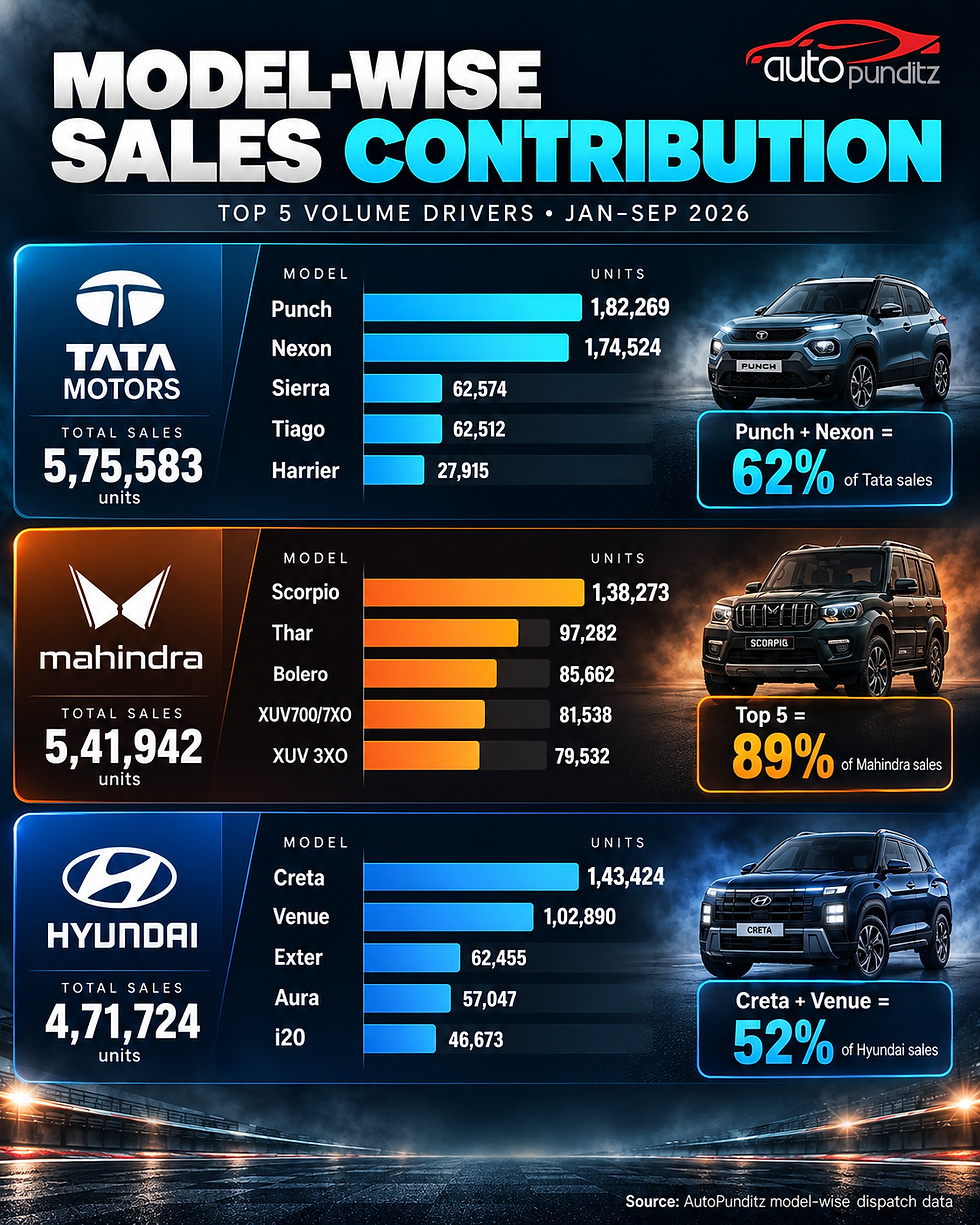
The Punch and Nexon are clearly the pillars of Tata's sales performance. Together, these two nameplates contributed 3,56,793 units, accounting for approximately 62% of Tata Motors' total passenger vehicle dispatches during the period. The Punch recorded 49.5% year-on-year growth, while the Nexon grew 27.7%. Another important development has been the contribution of the revived Tata Sierra. With 62,574 units dispatched during January–September 2026, the Sierra has become an important addition to Tata's expanding SUV portfolio. Tata's growth story is therefore being supported by high-volume compact SUVs and incremental volumes from newer models. At the same time, the concentration of sales in the Punch and Nexon shows how important these two models remain to the company's overall performance.
Mahindra: An SUV-Driven Challenger With a Strong Portfolio
Mahindra's transformation over the past few years has been equally significant. Unlike Tata Motors and Hyundai, which compete across hatchbacks, sedans and SUVs, Mahindra's passenger vehicle volumes are driven almost entirely by SUVs. The company recorded 5,41,942 units during January–September 2026, compared with 4,46,697 units in the corresponding period of 2025. This represents a healthy 21.3% increase.
Mahindra's Top-Selling Models: Jan–Sep 2026
Model | Sales |
Mahindra Scorpio range | 1,38,273 |
Mahindra Thar range | 97,282 |
Mahindra Bolero range | 85,662 |
Mahindra XUV700/7XO | 81,538 |
Mahindra XUV 3XO range | 79,532 |
Mahindra's biggest strength is the presence of several sizeable volume-generating SUV nameplates. The Scorpio range contributed 1.38 lakh units during the first nine months of 2026, making it the company's largest-selling model family. The Thar and Bolero also remained significant contributors, while the XUV700/7XO and XUV 3XO families strengthened the company's presence across different SUV price points. Together, these five model families generated approximately 4.82 lakh units, representing nearly 89% of Mahindra's passenger vehicle sales. Mahindra has also expanded its electric SUV portfolio through models such as the BE 6, XEV 9e and XEV 9S. Its SUV-focused strategy gives Mahindra considerable strength in a growing vehicle category. However, with Tata Motors recording faster overall growth in 2026, Mahindra will need to maintain high dispatch volumes through the final quarter to reclaim second place.
Hyundai: Growing Sales, but Facing Stronger Competition
Hyundai's position is particularly interesting because its decline in the manufacturer rankings does not mean that the company has stopped growing. During January–September 2026, Hyundai recorded 4,71,724 domestic passenger vehicle dispatches, representing 10.9% growth over the corresponding period in 2025. However, this was lower than Tata Motors' 40.3% growth and Mahindra's 21.3% expansion.
Hyundai's Top-Selling Models: Jan–Sep 2026
Model | Sales |
Hyundai Creta | 1,43,424 |
Hyundai Venue | 1,02,890 |
Hyundai Exter | 62,455 |
Hyundai Aura | 57,047 |
Hyundai i20 | 46,673 |
The Creta continues to be Hyundai's biggest individual volume contributor, recording more than 1.43 lakh units during the first nine months of 2026. The Venue has also performed strongly, contributing over 1.02 lakh units. Together, the Creta and Venue accounted for approximately 52.2% of Hyundai's domestic passenger vehicle dispatches.
However, the Creta's cumulative sales were 5.8% lower than the corresponding period in 2025, even as the Venue grew 26%. The Exter, Aura and i20 also recorded year-on-year growth. Hyundai therefore retains a competitive portfolio across SUVs, hatchbacks and sedans. Its immediate challenge is to accelerate overall growth in a market where its two closest rivals have been expanding more rapidly.
Market Share Comparison: Tata Gains, Hyundai Loses Ground
The change in rankings becomes even clearer when comparing manufacturer market shares.
Manufacturer | Jan–Sep 2026 Share | Jan–Sep 2025 Share | Change |
Tata Motors | 14.54% | 12.65% | +1.89 pp |
Mahindra | 13.69% | 13.78% | -0.09 pp |
Hyundai | 11.92% | 13.12% | -1.20 pp |
Market shares are calculated against total domestic passenger vehicle volumes represented in the Auto Punditz dataset. pp = percentage points.
Tata Motors has emerged as the biggest market-share gainer among the three manufacturers.
Its share increased by approximately 1.89 percentage points, reflecting growth considerably faster than the overall market.
Mahindra's share remained broadly stable, while Hyundai experienced a decline of around 1.20 percentage points.
This distinction is important: a manufacturer's sales can increase even while its market share declines, if the broader industry grows faster.
September 2026: Tata Retains Second Position
The most recent monthly dispatch figures show Tata Motors continuing to lead the three-way contest.
Manufacturer | September 2026 | YoY Growth |
Tata Motors | 68,810 | +15.3% |
Mahindra | 64,092 | +14.0% |
Hyundai | 57,166 | +10.9% |
Tata finished September 2026 ahead of Mahindra by 4,718 units and Hyundai by 11,644 units. More importantly, Tata has led both competitors in every month from January through September 2026, based on the model-level dispatch data. This consistency has allowed Tata to establish a meaningful advantage in the calendar-year rankings. However, wholesale dispatch rankings should not be confused with retail vehicle registrations, where differences in dealer inventory and registration timing can produce a different order.
Can Mahindra Overtake Tata Before the End of 2026?
With just three months remaining in the calendar year, the battle for second place is far from mathematically settled. Tata enters the October–December quarter with a 33,641-unit advantage over Mahindra.
To reverse the current ranking, Mahindra would need to dispatch at least 33,642 more passenger vehicles than Tata over the final three months of 2026. That requires an average monthly advantage of approximately 11,214 units. For Hyundai, the challenge is significantly greater. It currently trails Mahindra by 70,218 units and Tata by 1,03,859 units.
The October–December period will therefore be crucial, particularly as manufacturers adjust dispatch volumes to match festive demand, production availability and dealership inventory requirements. The final outcome will depend on whether Tata sustains its current momentum and how strongly Mahindra and Hyundai perform during the remaining months.
Model-Wise Sales Contribution in 2026
(Note: The above chart displays all 15 leading models on a common bar scale and allows you to switch between brands, sales volumes and market contributions.)
Auto Punditz Take: India's No. 2 Position Is No Longer Guaranteed
The most important conclusion from this analysis is not simply that Tata Motors currently occupies second place. It is how dramatically India's passenger vehicle market has changed.
Hyundai held a comfortable position behind Maruti Suzuki for years, supported by a strong portfolio of passenger cars and SUVs.
Tata Motors subsequently transformed its market position through products such as the Nexon and Punch, alongside its expanding electric vehicle portfolio.
Mahindra, meanwhile, demonstrated that a focused SUV strategy could generate enough volumes to overtake both competitors in 2025.
The 2026 numbers indicate that Tata's broader portfolio and newer product additions are currently producing the strongest overall growth. Mahindra remains a formidable challenger, with a well-established SUV lineup and a growing presence in electric vehicles. Hyundai, despite slipping in the rankings, continues to generate substantial volumes and remains a major force in the Indian passenger vehicle market.
The battle for India's No. 2 car manufacturer is no longer a one-sided contest. It has become one of the most important indicators of how competition and consumer preferences are evolving in the country.
For now, Tata Motors has the advantage. Whether it can convert that lead into a full-year second-place finish will become clear when the December 2026 figures are announced.
Data and methodology: Auto Punditz analysis of model-wise domestic passenger vehicle dispatches from January 2011 to September 2026. Calendar-year comparisons are used throughout, and January–September figures are compared with the same nine-month period of the previous year. Model families may include multiple generations and powertrains. Wholesale dispatches differ from retail registrations.