Audi India Plans Locally Manufactured Electric Car, Targets 15–16% Luxury Car Market Share by 2031
Audi India is evaluating local production of an electric vehicle as part of an ambitious strategy to double its luxury car market share over the next three to five years. New product launches, localisation and dealership expansion will be central to the German automaker's growth plans.
German luxury carmaker Audi is considering local production of an electric vehicle in India as it prepares an aggressive expansion strategy aimed at strengthening its position in the country's premium automobile market.
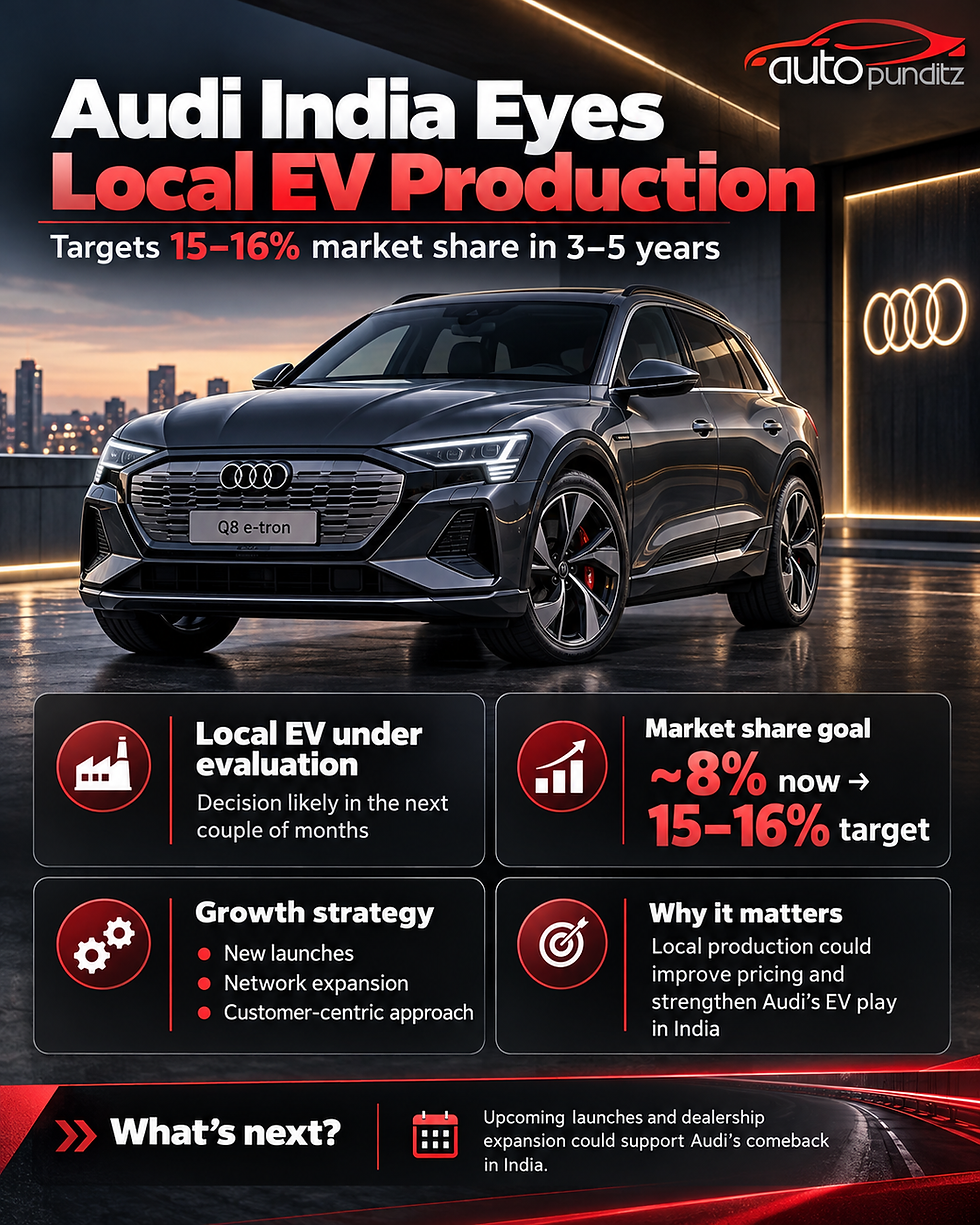
The company is targeting a market share of 15–16% over the next three to five years, compared with approximately 8% currently.
Audi India Brand Director Balbir Singh Dhillon has confirmed that the company is actively evaluating the feasibility of locally producing a battery-electric vehicle (BEV), with a decision expected within the next couple of months.
The proposed initiative forms part of a broader strategy involving new product introductions, stronger customer engagement and an expanded dealership footprint, particularly in Tier-II and Tier-III cities.
Audi Evaluates Local Electric Car Production in India
Local manufacturing could become a significant turning point for Audi's electric mobility ambitions in India.
Until now, high import duties on fully built luxury electric vehicles have been a major challenge in positioning premium EVs competitively in the Indian market.
Audi believes increased localisation could help address these challenges and strengthen the commercial viability of its electric vehicle portfolio.
Although the automaker has not disclosed which electric vehicle it is considering for local production, the decision could significantly influence its long-term product and pricing strategies.
The company has not yet announced a manufacturing investment, production capacity, localisation percentage or launch timeline for the proposed model.
Audi's earlier experience in India's luxury EV market has reinforced the importance of local assembly. The company has previously acknowledged that import duties substantially increase the prices of electric vehicles brought into the country.
Audi Targets Doubling Its Luxury Car Market Share
Audi is targeting a substantial improvement in its competitive position in India's luxury passenger vehicle market.
Parameter | Audi India's Position |
Current estimated market share | Approximately 8% |
Target market share | 15–16% |
Target timeline | Next 3–5 years |
Proposed EV strategy | Evaluate local production |
Key growth drivers | New launches, localisation and network expansion |
Primary competitors | Mercedes-Benz, BMW and JLR |
The company's strategy centres on three major priorities.
1. Customer-Centric Approach
Audi intends to strengthen its relationship with customers through improved ownership experiences, aftersales services and engagement initiatives.
As competition intensifies in India's luxury vehicle market, customer satisfaction and long-term brand loyalty will play an increasingly important role in driving repeat purchases.
2. New Product Launches
Audi is preparing to refresh its product portfolio with new-generation vehicles across multiple segments.
A stronger product pipeline could help the brand regain competitiveness against Mercedes-Benz and BMW, particularly in high-volume luxury SUV categories.
3. Dealership Network Expansion
The automaker is looking beyond India's metropolitan markets to identify new growth opportunities in smaller cities.
A wider dealership footprint could improve brand accessibility and support incremental sales growth.
Upcoming Audi Cars Could Drive Sales Recovery
Audi is preparing a broader product offensive in India, with several important vehicles expected to enter the market over the coming months.
Based on previously reported plans, the company's potential product pipeline includes:
Upcoming Model | Expected India Timeline |
New-generation Audi Q3 | Q4 2026 |
New-generation Audi A5 | First half of 2027 |
Audi Q9 flagship SUV | Second half of 2027, subject to final plans |
Future locally produced Audi EV | Under evaluation; launch timeline unconfirmed |
Note: These timelines are indicative and subject to official confirmation.
The new-generation Q3 could play a particularly important role in strengthening Audi's position in the competitive entry-level luxury SUV segment.
Meanwhile, the A5 could refresh the company's luxury sedan portfolio, while the flagship Q9 could potentially give Audi another contender in the full-size luxury SUV category.
These launches, alongside additional vehicles, could support Audi's recovery from 2027 onwards.
India-EU Free Trade Agreement Could Support Audi's Expansion
Another important element of Audi's India strategy is the proposed India-European Union Free Trade Agreement (FTA).
A trade agreement that reduces import duties on eligible European vehicles could potentially allow luxury car manufacturers to introduce additional models into India at more competitive prices, subject to its final provisions and implementation.
For Audi, this could create an opportunity to evaluate customer demand for different vehicles before committing to local assembly.
The company could pursue a dual approach:
Local production: Continue manufacturing or assembling core, higher-volume models domestically.
Imports: Introduce additional vehicles to broaden the portfolio and test customer demand before evaluating localisation.
Improved trade access could also create opportunities for India's wider automotive manufacturing and component industry.
However, the extent of these benefits will depend on the final trade provisions and applicable regulations.
Audi Plans Expansion Beyond Metro Cities
Audi India is also looking to expand its dealership network into smaller cities as premium vehicle demand spreads beyond traditional luxury car markets.
The automaker previously outlined plans to increase its dealership count from around 29 to approximately 40 by the end of 2027.
Much of this expansion is expected to focus on Tier-II and Tier-III cities, where rising incomes, improved infrastructure and growing demand for premium vehicles are creating opportunities for luxury carmakers.
A stronger dealership presence could help Audi reach customers who currently need to travel to larger cities to purchase or service their vehicles.
It could also improve brand visibility and strengthen the overall ownership experience.
Audi India's Sales Performance Highlights the Challenge
Audi's ambitious market-share target comes after a challenging period for the German luxury carmaker in India.
According to previously reported company figures, Audi recorded sales of approximately 4,510 vehicles in 2025, while deliveries stood at 1,896 units during the first half of 2026.
With India's luxury passenger vehicle market estimated at approximately 52,000 units in 2025 and expected to expand further, Audi sees considerable potential for growth.
However, the brand faces strong competition from Mercedes-Benz, BMW and Jaguar Land Rover, all of which have been strengthening their portfolios and customer reach.
Regaining market share will require a combination of competitive pricing, timely product launches, improved availability and a more extensive retail network.
Why Local EV Manufacturing Matters for Audi India
Local production could become a critical differentiator in Audi's electric mobility strategy.
Strategic Area | Potential Benefit |
Vehicle pricing | Reduced dependence on expensive fully built imports |
Competitiveness | Stronger positioning against rival luxury EVs |
Product availability | Greater flexibility to respond to demand |
Local sourcing | Opportunities to develop Indian supplier partnerships |
Long-term investment | Stronger commitment to India's premium EV market |
EV adoption | Potential to reach a wider group of luxury car buyers |
However, the actual financial advantages would depend on the selected manufacturing model, domestic component sourcing, production volumes and overall investment.
Simply assembling imported vehicle kits in India would not necessarily deliver the same cost advantages as deeper localisation.
Audi will also need to ensure its future electric cars offer competitive driving range, charging performance, technology, reliability and customer support.
India's Luxury EV Market Is Becoming More Competitive
The Indian luxury electric vehicle segment is evolving rapidly, with established premium manufacturers and newer entrants introducing advanced electric cars and SUVs.
Mercedes-Benz, BMW, Volvo and other premium brands have been expanding their electric vehicle offerings.
For Audi, localisation could potentially improve its ability to compete in a market where pricing remains an important purchase consideration, even among affluent buyers.
However, the premium EV market differs significantly from the mass-market electric vehicle segment.
Buyers expect a combination of strong performance, advanced technology, premium interiors, brand prestige and a seamless ownership experience.
Consequently, competitive pricing alone may not be sufficient to generate substantial sales growth.
Audi's product positioning and customer experience will be equally important.
Auto Punditz Analysis
Audi's renewed focus on India signals a potential shift towards a more aggressive growth strategy.
The automaker enjoys strong brand recognition, but its ability to compete consistently with Mercedes-Benz and BMW has been constrained by portfolio gaps, product availability and pricing challenges.
Three factors could determine whether Audi achieves its ambitious market-share target.
First, product competitiveness will be crucial. The new-generation Q3, upcoming A5 and potential flagship models must offer compelling value against established rivals.
Second, localisation could improve pricing flexibility. A locally assembled electric vehicle may help Audi reach a broader base of premium EV buyers, although the benefits will depend on the depth of localisation.
Third, dealership expansion could unlock incremental demand. Growth in Tier-II and Tier-III cities may give Audi access to customers who previously had limited interaction with the brand.
A significant improvement in market share will also require Audi to grow faster than India's overall luxury passenger vehicle market.
For example, assuming a hypothetical annual luxury market of 60,000 vehicles, a 16% market share would translate to approximately 9,600 annual Audi sales.
This would be more than double Audi's reported 2025 sales of 4,510 units, illustrating the scale of the company's ambitions.
The actual volume required will depend on how India's luxury car market evolves over the next three to five years.
Auto Punditz Verdict
Audi India's consideration of local electric car production is a promising development, particularly as electric mobility becomes increasingly important in the luxury passenger vehicle market.
Its target of increasing market share from approximately 8% to 15–16% within three to five years is ambitious and signals a renewed commitment to India.
However, the decisive factors will be the competitiveness of upcoming models, the pace of localisation, pricing flexibility and the effectiveness of Audi's expanded retail network.
If Audi successfully executes these initiatives, the coming years could mark a significant revival for the German luxury automaker in India.