


Best Entry-Level Electric Cars in India: Which Budget EV Should You Buy? Tata Tiago EV, MG Comet EV ,MG Windsor EV , Vayve Eva and Tata Punch EV
India’s affordable electric-car market offers choices for very different needs. Some buyers want a compact commuter that is easy to park, while others need a practical family car capable of occasional intercity journeys.
For most buyers, the shortlist begins with the Tata Tiago EV, MG Comet EV and Tata Punch EV. The MG Windsor EV is a step-up option for larger budgets, while the Vayve Eva needs separate consideration because its seating layout and availability differ from mainstream family cars.
Before comparing models, distinguish between battery-inclusive prices and Battery-as-a-Service prices. BaaS reduces the initial payment but adds battery-related payments under a contract.
Entry-level EV price comparison
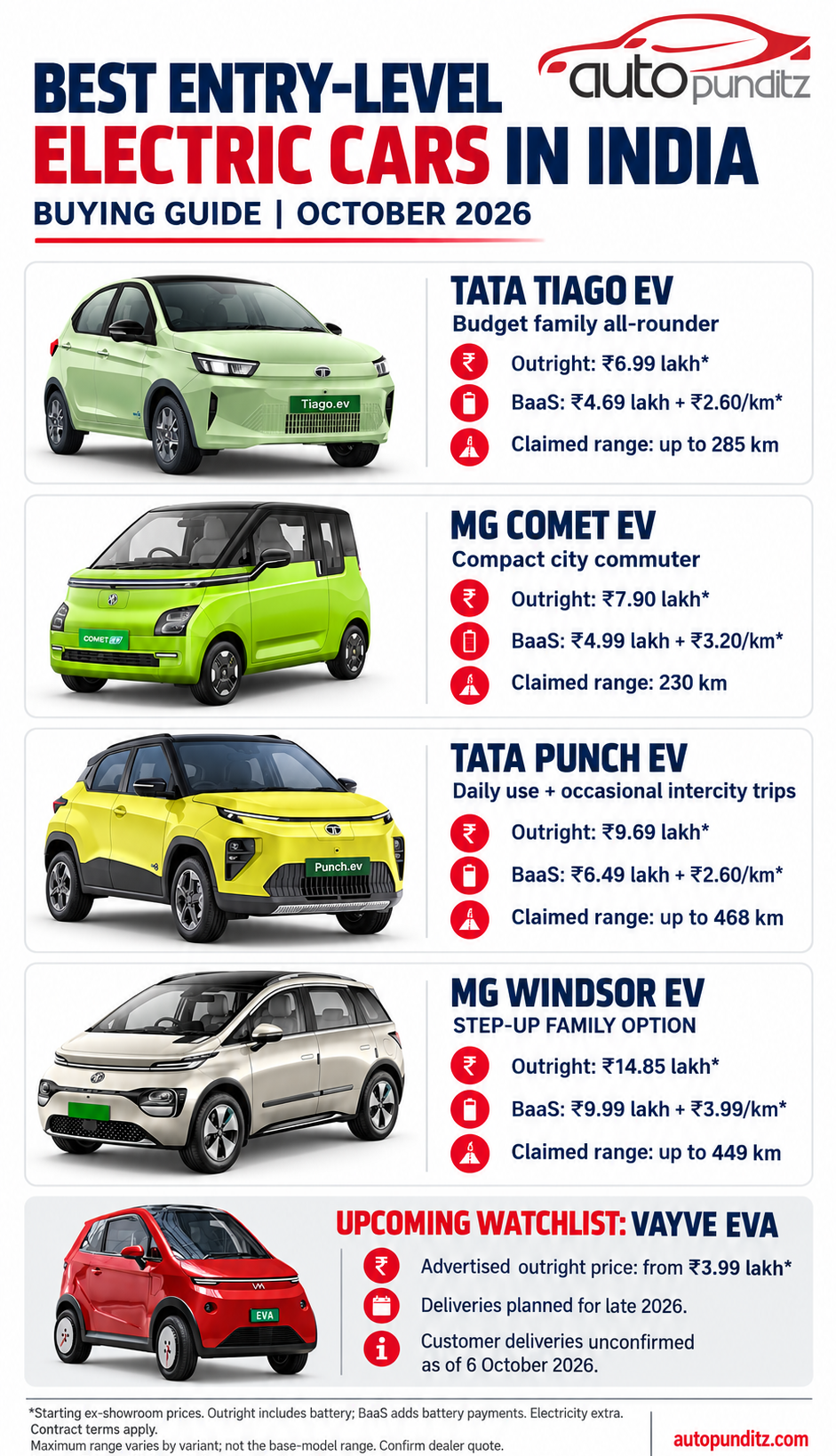
Model | Battery-inclusive starting price | BaaS starting price | Best suited to |
Tata Tiago EV | ₹6.99 lakh | ₹4.69 lakh + ₹2.60/km | Budget family use |
MG Comet EV | ₹7.90 lakh | ₹4.99 lakh + ₹3.20/km | Compact city commuting |
Tata Punch EV | ₹9.69 lakh | ₹6.49 lakh + ₹2.60/km | Daily driving and occasional intercity trips |
MG Windsor EV | ₹14.85 lakh | ₹9.99 lakh + ₹3.99/km | Families prioritising space |
Vayve Eva | ₹3.99 lakh | ₹3.25 lakh + ₹2/km; minimum billing applies | Niche urban use; availability needs confirmation |
Indicative ex-showroom starting prices checked for this October 2026 guide. Equipment, batteries and contractual terms vary. Maximum range figures below do not necessarily apply to the cheapest variant.
1. Tata Tiago EV: the budget family all-rounder
The Tiago EV is a sensible starting point for buyers seeking a familiar hatchback with everyday family usability. Its conventional rear doors make school runs, shopping trips and travelling with rear passengers straightforward.
Tata’s current product listing quotes a maximum certified range of 285 km, alongside a manufacturer-estimated C75 real-world range of approximately 205–215 km for the longer-range version. The older 293 km figure should therefore not be carried into a current-model comparison.
For buyers with predictable local travel, the priority should be the appropriate battery and essential equipment. Spending more on the highest trim is worthwhile only if its features will be used regularly.
AutoPunditz buying view: Start here if you want an affordable electric hatchback for several household duties. Test the rear seat and luggage space with your family before selecting a variant.
2. MG Comet EV: the compact city specialist
The Comet’s strongest advantage is its small footprint. At under three metres long, it suits congested streets and limited parking. MG lists a 17.4 kWh battery, four seats and a claimed range of 230 km.
Its two-door layout requires a practical compromise. Rear-seat access deserves attention if children or elderly passengers travel frequently, and luggage space should be checked with all seats occupied.
Charging also needs careful comparison. MG lists AC charging, with 7.4 kW capability on FC versions; buyers should not confuse that with DC rapid-charging capability.
AutoPunditz buying view: The Comet is particularly appealing for one- or two-person commuting or as a second household car. Buyers seeking one car for every occasion should compare its practicality closely with the Tiago.
3. Tata Punch EV: the stronger choice for mixed family use
The Punch EV deserves consideration when the car must handle daily commuting and occasional longer journeys. Its upright format and larger available battery broaden its appeal beyond short urban trips.
Current Tata specifications list 30 kWh and 40 kWh batteries, with the larger pack offering a certified range of 468 km. Tata separately quotes approximately 355 km under its C75 real-world estimate. The previously advertised 421 km figure relates to
an older specification.
Buyers should compare the price of the battery variant they actually need. The entry price does not include the largest battery or every feature shown in advertising.
AutoPunditz buying view: The Punch is our preferred upgrade from the Tiago for buyers who need a more versatile compact EV. For regular intercity use, assess charging stops along your usual routes before booking.
4. MG Windsor EV: worth stretching for when space matters
The Windsor sits above the core entry-level budget when purchased with its battery. MG lists the starting outright price at approximately ₹14.85 lakh, while the base BaaS option starts at ₹9.99 lakh plus ₹3.99/km.
It offers 38 kWh and 52.9 kWh batteries, with claimed ranges of 332 km and 449 km, respectively. The larger battery is offered in the more expensive Pro versions.
Its place on this shortlist is as a family-space upgrade. Buyers considering a higher Punch variant should also assess whether the Windsor’s passenger accommodation better meets their needs.
AutoPunditz buying view: Stretch to the Windsor when the additional space justifies the complete ownership cost. Compare equivalent purchase arrangements before deciding that a BaaS headline price makes it affordable.
5. Vayve Eva:
Eva’s manufacturer website advertises battery-inclusive prices of ₹3.99–5.99 lakh, with 9 kWh, 12.6 kWh and 18 kWh battery options. The corresponding manufacturer-described real ranges are 125 km, 175 km and 250 km. It's the cheapest EV announced in India and first solar-roof car. Deliveries haven't been confirmed.
Its capacity is two adults and one child, and the website currently shows pre-bookings closed. It should therefore be assessed separately from readily available conventional family hatchbacks.
AutoPunditz buying view: The Vayve Eva is an upcoming urban electric vehicle, with deliveries planned for late 2026. Customer deliveries are yet to be confirmed, so it remains a future option rather than an immediate purchase recommendation.
BaaS versus outright purchase: calculate the complete bill
A lower initial payment does not automatically mean lower ownership costs. Include battery payments, electricity, financing and contractual charges when comparing options.
For illustration, at 1,000 billable kilometres per month:
Battery charge | Monthly payment | Total over five years |
₹2.60/km | ₹2,600 | ₹1,56,000 |
₹3.20/km | ₹3,200 | ₹1,92,000 |
₹3.99/km | ₹3,990 | ₹2,39,400 |
These calculations assume unchanged rates for 60 months. They exclude electricity, fees, applicable taxes and minimum-billing effects.
Ask for the minimum monthly payment, contract duration, exit terms, battery ownership arrangements and resale-transfer conditions. Compare the same variant over your intended ownership period. Higher usage increases per-kilometre payments, but the complete contract determines which option offers better value.
Auto Punditz Take
Before booking, establish a reliable charging arrangement. Request an installation assessment covering parking permission, electrical capacity and costs.
Avoid treating certified range as a guaranteed distance between charging stops. Speed, weather, air-conditioning, passengers and terrain affect consumption; applying one fixed percentage reduction to every EV is too simplistic.
For a budget-conscious family, begin with the Tiago EV. Choose the Comet when compactness dominates your requirements, and consider the Punch EV when you need a wider mix of journeys. Move to the Windsor when space warrants the additional spending, while keeping Eva subject to confirmed availability.


