


Government Proposes Mandatory Automatic Emergency Braking for Cars in India from October 2030
India's Ministry of Road Transport and Highways (MoRTH) has proposed making Advanced Emergency Braking Systems (AEBS) mandatory for all new passenger car models from October 1, 2030. The requirement would be extended to all passenger car models still in production from October 1, 2032.
The proposal, outlined in a draft notification dated October 19, 2026, aims to reduce road accidents and improve passenger vehicle safety through the wider adoption of advanced driver assistance systems (ADAS).
If implemented, the regulation could significantly change how safety features are offered in India, potentially bringing automatic emergency braking to entry-level hatchbacks, compact SUVs, sedans and larger passenger vehicles.
Key Highlights
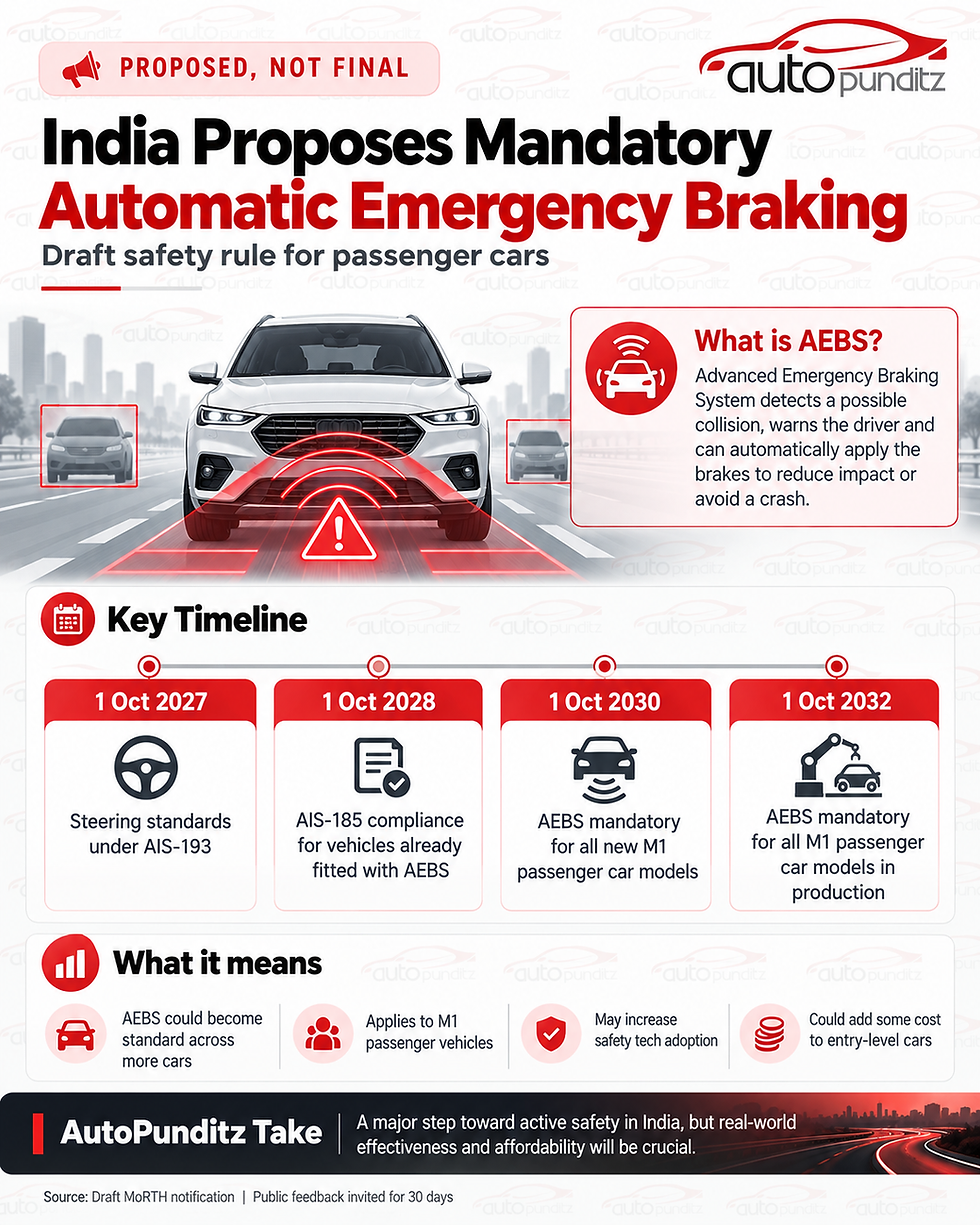
Proposed requirement | Implementation date |
Steering standards under AIS-193 | 1 October 2027 |
AIS-185 compliance for vehicles already fitted with AEBS | 1 October 2028 |
Mandatory AEBS on all new passenger car models | 1 October 2030 |
Mandatory AEBS on all passenger car models in production | 1 October 2032 |
These dates remain proposals, subject to final government notification.
What is Automatic Emergency Braking (AEBS)?
Advanced Emergency Braking System is an active safety technology designed to prevent collisions or reduce their severity. It typically uses cameras, radar or other sensors to monitor the road ahead and identify potential obstacles.
When the system detects a possible collision, it can alert the driver and automatically apply the brakes if the driver fails to respond adequately. Unlike airbags and seatbelts, which primarily protect occupants during a collision, AEBS is designed to intervene before an impact occurs.
However, its effectiveness depends on sensor visibility, road conditions, vehicle speed and the system's capabilities. It does not replace attentive driving.
Which Vehicles Will Be Covered?
The proposed mandatory fitment applies to M1-category vehicles, which include passenger vehicles with up to eight seats in addition to the driver's seat.
This would cover most passenger cars sold in India, including hatchbacks, sedans, SUVs and MPVs.
The draft also specifies that M1 and N1 vehicles already equipped with AEBS must comply with the AIS-185 standard from October 2028. N1 refers to goods vehicles with a gross vehicle weight not exceeding 3.5 tonnes.
Importantly, the draft does not establish mandatory AEBS fitment on every N1 vehicle under the same 2030 and 2032 timelines.
Additional ADAS Features Under Consideration
Beyond emergency braking, the government has proposed requirements relating to steering assistance, lane-keeping systems and driver monitoring.
Vehicles registered for commercial passenger transport, including taxis, could face additional safety equipment requirements from October 2029, particularly for lane-keeping and driver-alert technologies.
The broader regulatory changes are aimed at improving vehicle safety across personal and commercial transportation.
What Does This Mean for Indian Car Buyers?
The proposed regulation could have several important implications for the Indian passenger vehicle market.
Improved accessibility: AEBS could become standard even in affordable cars, rather than being limited primarily to higher variants.
Potential price increases: Additional cameras, sensors, processing hardware and calibration may increase manufacturing costs. No official cost estimates have been announced.
More safety technology: Automakers may expand their ADAS offerings as platforms are updated for compliance.
Improved collision prevention: AEBS could help reduce certain types of crashes, although performance will vary across driving environments.
An important distinction is that the proposal concerns new vehicles manufactured after the relevant deadlines. It does not currently require owners to retrofit AEBS to cars they already own.
Auto Punditz Take
Mandatory automatic emergency braking could mark an important shift from passive safety to active accident prevention in India's mass-market car segment.
India has progressively introduced safety measures such as airbags, ABS and electronic stability-related technologies. AEBS would take this approach further by allowing vehicles to intervene before a collision occurs.
The challenge will be ensuring that systems work reliably in Indian driving conditions, where mixed traffic, pedestrians, two-wheelers, unpredictable road behaviour and inconsistent lane markings can make collision detection more complex.
Affordability will also be important. Integrating AEBS into budget vehicles without substantially increasing prices could become a major engineering and cost-management challenge for manufacturers.
With the first proposed mandatory-fitment deadline still four years away, automakers would have time to prepare. However, successful implementation will depend on practical testing, system reliability and consistent enforcement of safety standards.
The proposal is not yet a final regulation. The government has invited public feedback for 30 days from publication of the draft Gazette notification before considering the rules for finalisation.


