India Notifies New Vehicle Crash-Safety Regulations: Stricter Crash Tests From October 2027
The Indian government has notified a comprehensive set of new vehicle safety regulations, introducing tougher frontal and side-impact crash-test requirements, enhanced pedestrian protection, improved rear-impact safety and revised standards for vehicle safety technologies.
The Ministry of Road Transport and Highways (MoRTH) issued notification S.O. 5723(E), dated 19 October 2026, published in the Gazette of India on 21 October 2026.
The revised regulations will be implemented in phases between October 2027 and October 2032, providing vehicle manufacturers time to update vehicle designs, safety systems and testing procedures.
The changes represent an important development for India's passenger vehicle industry, particularly as consumers increasingly consider crash-test ratings and advanced safety technologies when buying cars.
New Vehicle Safety Regulations: Implementation Timeline
Safety requirement | Effective date |
Revised frontal offset crash protection | 1 Oct 2027 — new models; 1 Oct 2028 — all applicable models |
Revised side-impact protection | 1 Oct 2027 — new models; 1 Oct 2028 — all applicable models |
Mandatory immobilisers for M1 vehicles | 1 Oct 2027 |
Revised foot-control standards | 1 Apr 2028 — new models |
Enhanced pedestrian protection | 1 Oct 2028 — new models |
Rear-impact fuel and EV powertrain protection | 1 Apr 2029 — all covered models |
Event Data Recorder technical standard | 1 Oct 2029 |
Frontal collision restraint-system protection | 1 Oct 2029 — new models; 1 Oct 2031 — all applicable models |
FlexPLI pedestrian leg-impact testing | 1 Oct 2032 |
Implementation dates as specified in the notified safety framework. Applicability depends on vehicle category and relevant standard.
Key Changes Under India's New Crash-Safety Regulations
1. Tougher Frontal and Side-Impact Crash Tests
From October 2027, newly introduced passenger vehicle models covered by the revised standards will need to comply with updated occupant protection requirements.
The new framework includes revised provisions for offset frontal collision protection under AIS-098 (Revision 1), lateral collision protection under AIS-099 (Revision 1), and steering mechanism behaviour during frontal impacts under AIS-096 (Revision 1).
Existing models covered by these standards will have until October 2028 to comply.
2. Enhanced Pedestrian Safety
India will strengthen pedestrian and vulnerable road-user protection requirements through AIS-100 (Revision 1), applicable to new models from October 2028.
From October 2032, the use of the Flexible Pedestrian Leg Impactor (FlexPLI) will become mandatory under the prescribed testing framework. This equipment helps assess the potential for leg injuries during vehicle-pedestrian collisions.
3. Stronger Rear-Impact Protection for Petrol and Electric Vehicles
From April 2029, all vehicles covered by AIS-101 (Revision 1) must meet updated rear-impact protection requirements.
The standard focuses on reducing the risks associated with fuel-system damage and electric powertrain hazards following a rear-end collision.
For EV manufacturers, this increases the importance of electric powertrain protection and post-crash electrical safety.
4. Event Data Recorder Standards
From October 2029, revised technical requirements under AIS-192 will apply to Event Data Recorders (EDRs).
These devices can capture important information associated with a crash, helping investigators understand the circumstances surrounding an accident.
Importantly, this notification does not make EDR installation compulsory in every passenger car. It specifies requirements for devices covered by the standard.
5. Mandatory Anti-Theft Immobilisers
From October 2027, M1-category passenger vehicles must be equipped with immobilisers conforming to AIS-076.
The systems help prevent unauthorised vehicle starting and offer an additional layer of security against vehicle theft.
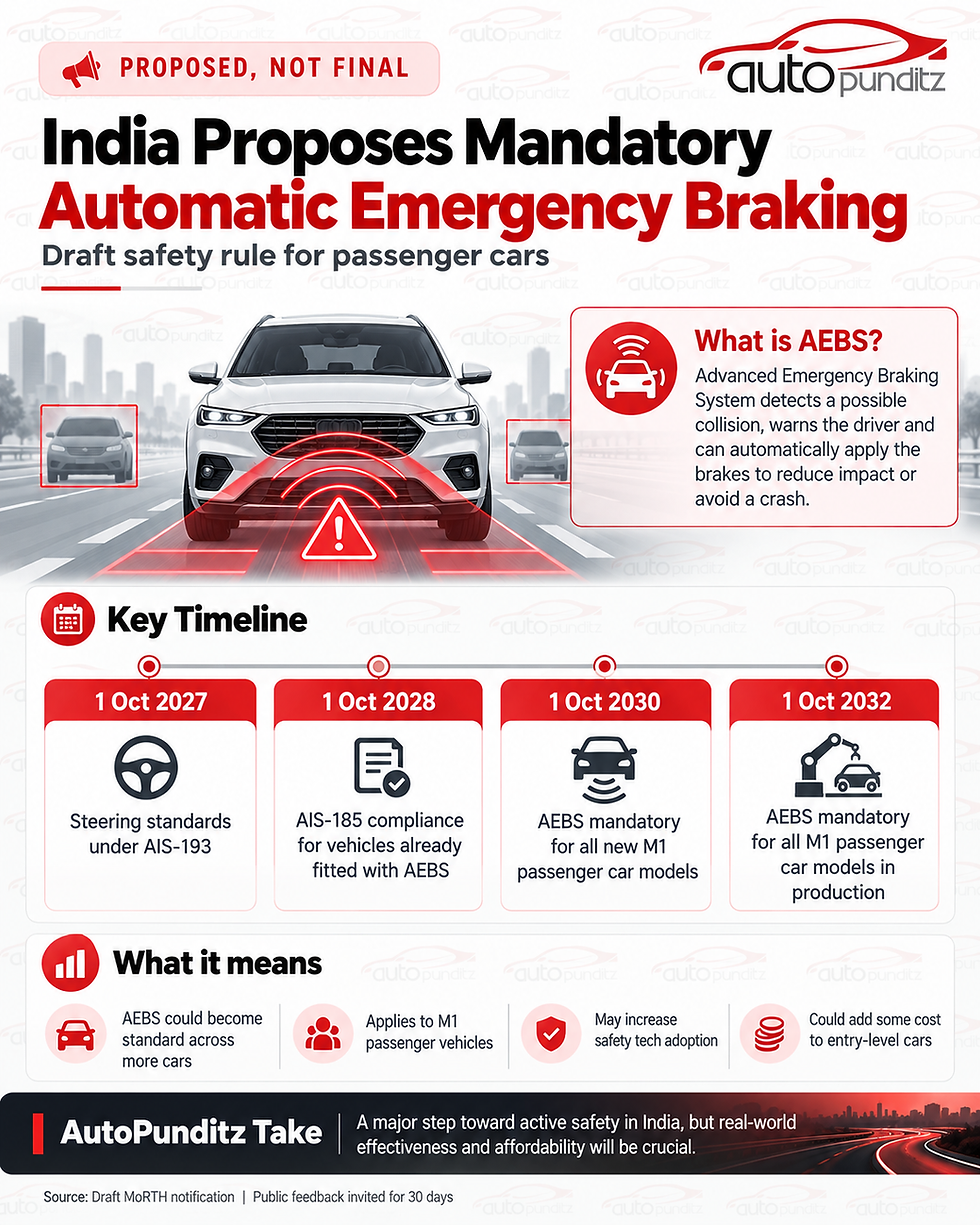
Government Also Proposes Automatic Emergency Braking From 2030
In a separate draft notification dated 19 October 2026, MoRTH has proposed making Advanced Emergency Braking Systems (AEBS) mandatory for M1-category vehicles.
If finalised, the requirement will apply from:
1 October 2030: New car models.
1 October 2032: All applicable models, including vehicles already in production.
AEBS can automatically apply the brakes when an imminent collision is detected and the driver fails to respond.
Unlike the crash-safety regulations already notified, the AEBS requirement remains a proposal, subject to final notification.
What Does This Mean for Indian Car Buyers?
The revised regulations could lead to stronger vehicle body structures, improved occupant restraint systems and better protection for pedestrians. Manufacturers may also need to undertake additional testing and engineering validation.
These developments could increase compliance and development costs, although any effect on vehicle prices will depend on manufacturer strategies and existing safety equipment.
Importantly, mandatory safety compliance and Bharat NCAP star ratings are different. A vehicle meeting the statutory requirements does not automatically qualify for a five-star Bharat NCAP rating.

Auto Punditz Take
India's revised crash-safety regulations mark a significant transition towards more comprehensive vehicle protection.
The emphasis on frontal, side and rear-impact safety, along with pedestrian protection, is particularly relevant as the market shifts towards larger SUVs and electric vehicles.
However, vehicle safety should not be judged solely by compliance with minimum crash-test regulations. Structural integrity, occupant restraint performance, crash avoidance and real-world safety outcomes remain equally important.
The next major development will be the proposed Bharat NCAP 2.0 framework, expected from October 2027, which aims to expand safety evaluations beyond conventional occupant crash protection.