Kia India Plans 10-Model Portfolio by 2030; Strong-Hybrid Seltos, EVs and CNG Cars in Focus
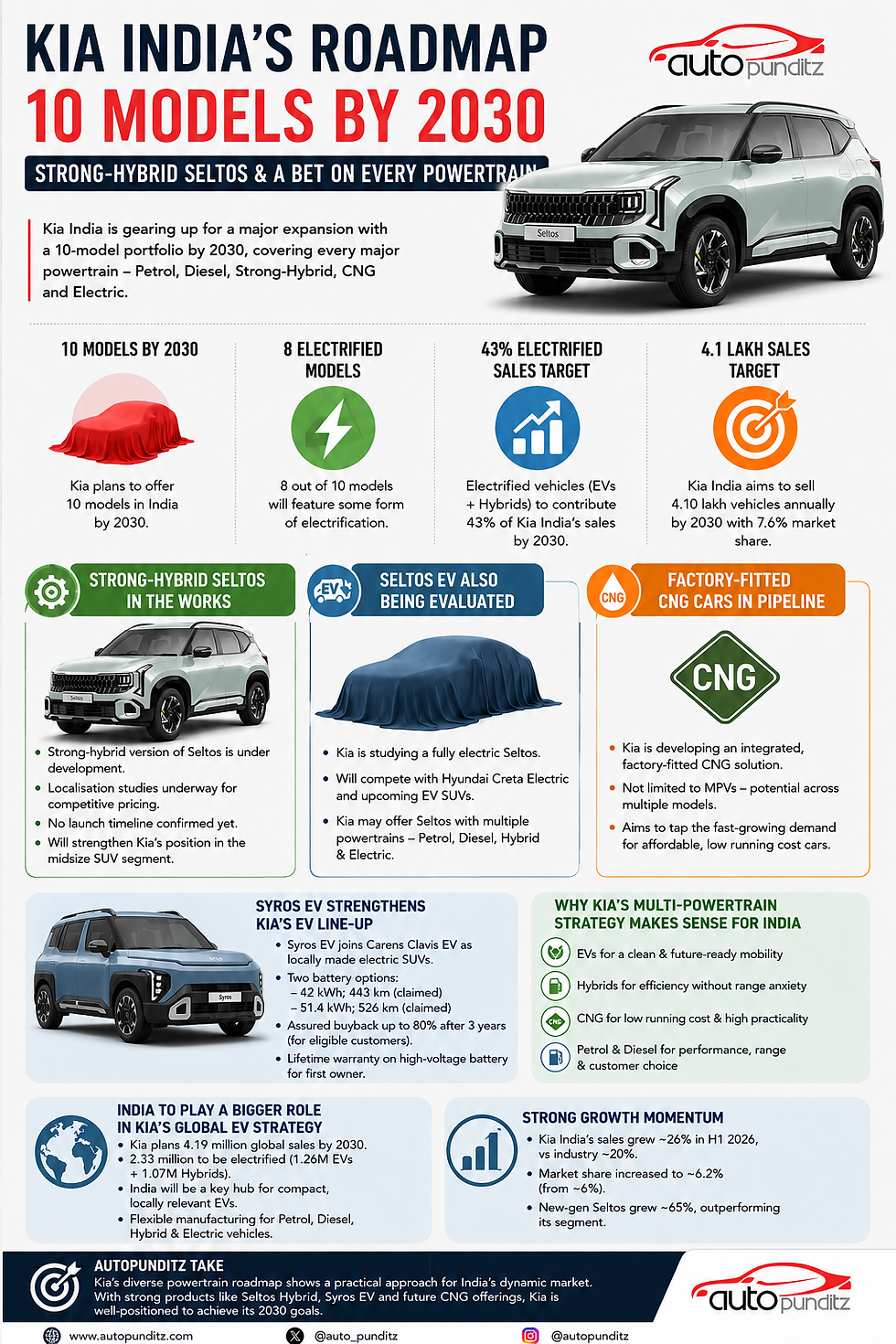
Kia India is preparing an aggressive expansion of its product portfolio, with plans to offer 10 models by 2030. The strategy will not revolve around one propulsion technology alone; instead, the carmaker intends to offer petrol, diesel, electric, strong-hybrid and factory-fitted CNG vehicles to address India’s diverse mobility requirements.
Of the 10 models Kia expects to have in India by the end of the decade, eight are planned to feature some form of electrified powertrain. This would include both battery-electric vehicles and strong hybrids, giving the company a broader product mix as it targets higher volumes and market share.
Kia’s approach reflects the uncertainty surrounding the pace at which different powertrain technologies will be adopted in India. While electric vehicles are steadily gaining acceptance, hybrids, CNG vehicles and efficient internal-combustion models continue to attract significant customer interest.
Strong-Hybrid Kia Seltos Under Development
One of the most important products in Kia’s future roadmap will be a strong-hybrid version of the Seltos.
Kia India has confirmed that it is working on the hybrid SUV, with localisation currently being studied to ensure that the technology can be offered at a competitive price. However, the company has not announced a launch timeline for the model.
The Seltos Hybrid could become a strategically important offering for Kia, especially as competition increases in the midsize-SUV segment. Rivals such as the Maruti Suzuki Grand Vitara and Toyota Urban Cruiser Hyryder have already established a market for strong-hybrid SUVs.
A hybrid powertrain could also help Kia improve the Seltos’ fuel efficiency without requiring customers to depend entirely on public charging infrastructure.
Globally, Kia has said it intends to diversify its hybrid portfolio across vehicle segments, including compact and full-size models. The company expects electrified vehicles—comprising EVs and hybrids—to account for 43 percent of its Indian sales by 2030.
Seltos EV Also Being Evaluated
Apart from the strong-hybrid model, Kia is studying the possibility of introducing a fully electric Seltos.
No concrete production or launch plan has been confirmed yet. However, an electric Seltos would allow Kia to compete more directly with the Hyundai Creta Electric and other upcoming midsize electric SUVs.
The possibility also highlights the flexibility of Kia’s long-term product strategy. A single nameplate could eventually be offered with conventional petrol, diesel, hybrid and electric powertrains, depending on market demand and regulatory requirements.
Factory-Fitted CNG Cars in the Pipeline
Kia is also working on factory-fitted CNG technology for the Indian market.
The company currently does not sell a factory-produced CNG vehicle, although dealer-level retrofit solutions have previously been offered for select models. Kia has now indicated that engineering work on an integrated factory CNG solution is progressing.
The study is reportedly not limited to MPVs such as the Carens. Kia is examining the potential of CNG across other models in its portfolio, depending on customer demand and segment suitability.
A factory-fitted CNG model could help Kia enter a rapidly growing part of the passenger-vehicle market currently dominated by Maruti Suzuki, Tata Motors and Hyundai.
CNG vehicles remain particularly relevant for cost-conscious private buyers, fleet customers and urban users seeking lower running expenses without transitioning to an EV.
Syros EV Strengthens Kia’s Local Electric Portfolio
Kia’s electrification strategy is already becoming more visible with the Syros EV.
The electric compact SUV joins the Carens Clavis EV as one of Kia’s locally manufactured electric vehicles. Meanwhile, premium models such as the EV6 and EV9 have helped establish the company’s electric brand positioning in India.
The Syros EV is being offered with two battery choices. The larger battery version has a claimed tested range of up to 526 km, while the 42 kWh version offers a claimed range of 443 km. The two configurations are intended to serve customers with different driving patterns, ranging from everyday urban use to longer intercity travel.
Kia is also attempting to address concerns around EV resale value and long-term battery ownership.
For eligible personal buyers, the company has introduced an assured buyback programme offering up to 80 percent of the vehicle’s value after three years. An introductory lifetime warranty on the high-voltage battery is also being offered to the first owner.
Kia is studying whether such battery-warranty coverage could eventually be transferred with the vehicle to a subsequent owner, which could strengthen confidence in the used-EV market.
India to Play a Bigger Role in Kia’s Global EV Strategy
India is expected to become one of Kia’s key production locations for compact, locally targeted electric SUVs.
Under its wider Plan S strategy, Kia aims to sell 4.19 million vehicles globally by 2030. Of these, approximately 2.33 million units are expected to be electrified vehicles, including 1.26 million battery EVs and 1.07 million hybrid vehicles.
The company also plans to retain flexible production capabilities for petrol, diesel, hybrid and electric vehicles at its manufacturing facilities, enabling production volumes to be adjusted according to market demand.
This flexible manufacturing approach will be particularly relevant in India, where the transition towards electrification is unlikely to be uniform across all regions, price segments and customer groups.
Kia Targets 4.1 Lakh Annual Sales by 2030
Kia India is aiming for annual sales of around 4.10 lakh vehicles by 2030, which would give the company an estimated market share of 7.6 percent.
According to the company, its sales grew by approximately 26 percent during the first half of 2026, compared with industry growth of around 20 percent. Its passenger-vehicle market share consequently increased to approximately 6.2 percent from around 6 percent during the corresponding period.
The latest-generation Seltos has been an important contributor to this growth. Kia said the SUV recorded growth of nearly 65 percent during the period, outperforming the wider midsize-SUV category.
To reach its 2030 target, Kia will need to expand beyond its existing portfolio of the Sonet, Syros, Seltos, Carens Clavis, Carnival, EV6 and EV9. The addition of mass-market EVs, strong hybrids and CNG models could help the manufacturer enter new customer segments while reducing dependence on any single propulsion technology.
A Multi-Powertrain Strategy for India
Kia’s roadmap represents a pragmatic approach to India’s evolving passenger-vehicle market.
Battery-electric vehicles will remain central to the company’s long-term strategy, but Kia does not expect EVs to replace conventional vehicles immediately. Strong hybrids could serve customers seeking significantly better efficiency without charging dependence, while CNG models could attract buyers prioritising low operating costs.
Petrol and diesel engines are also likely to remain part of the portfolio, particularly in segments where long-distance capability, affordability and established refuelling infrastructure continue to influence purchase decisions.
Rather than attempting to predict one winning technology, Kia appears to be preparing for multiple possible outcomes.
Auto Punditz Take
Kia’s decision to support multiple powertrains could prove especially suitable for India, where vehicle usage varies dramatically across cities, highways, smaller towns and rural markets.
The strong-hybrid Seltos could become the most commercially significant addition to the portfolio. The Seltos is already one of Kia’s strongest nameplates, and an adequately localised hybrid version could offer a combination of performance, fuel efficiency and convenience.
At the same time, the Syros EV and future locally manufactured electric SUVs will help Kia participate in the expanding mass-market EV segment. Factory-fitted CNG vehicles could provide an additional volume opportunity at the more price-sensitive end of the market.
The success of the strategy will ultimately depend on localisation, pricing and the speed at which Kia brings these products to showrooms. However, its target of 10 models and 4.1 lakh annual sales makes it clear that India will remain a strategically important market for the Korean manufacturer through the end of the decade.