


Petrol vs CNG vs Hybrid vs EV: Which Is Cheapest to Run in India as Crude Oil Crosses $100?
India’s car buyers are increasingly looking beyond the purchase price of a vehicle. With crude oil once again trading above $100 a barrel, running cost is becoming an equally important part of the buying decision.
The timing is significant. India’s passenger vehicle market has already been moving away from conventional petrol-only choices. In August 2026, CNG/LPG, hybrids and electric vehicles collectively accounted for a larger share of passenger vehicle registrations than petrol/ethanol.
So, if fuel costs remain elevated, which powertrain makes the most financial sense for an Indian car buyer today?
We compare petrol, CNG, strong hybrid and electric vehicles on their approximate energy cost per kilometre.
Note: The calculations below are illustrative. Actual running costs vary according to the vehicle, city, fuel/electricity tariff, driving conditions and individual driving style.
Crude Oil Above $100 Puts Fuel Costs Back in Focus
Brent crude has moved above the $100-per-barrel mark amid concerns surrounding global oil supplies.
India is particularly sensitive to crude-price movements because the country imports the majority of its crude-oil requirements. Exchange-rate movements can add another layer of pressure because crude is largely traded in US dollars.
However, a rise in international crude prices does not necessarily mean an immediate equivalent increase in Indian petrol prices.
Retail fuel prices also depend on taxes, refining and marketing economics, exchange rates and pricing decisions by oil marketing companies.
For consumers, therefore, the more useful exercise is to understand what different powertrains already cost to operate—and what happens if petrol becomes more expensive.
Petrol vs CNG vs Hybrid vs EV Running Cost
For our comparison, we assume a vehicle is driven 1,200km every month.
We use the following illustrative assumptions:
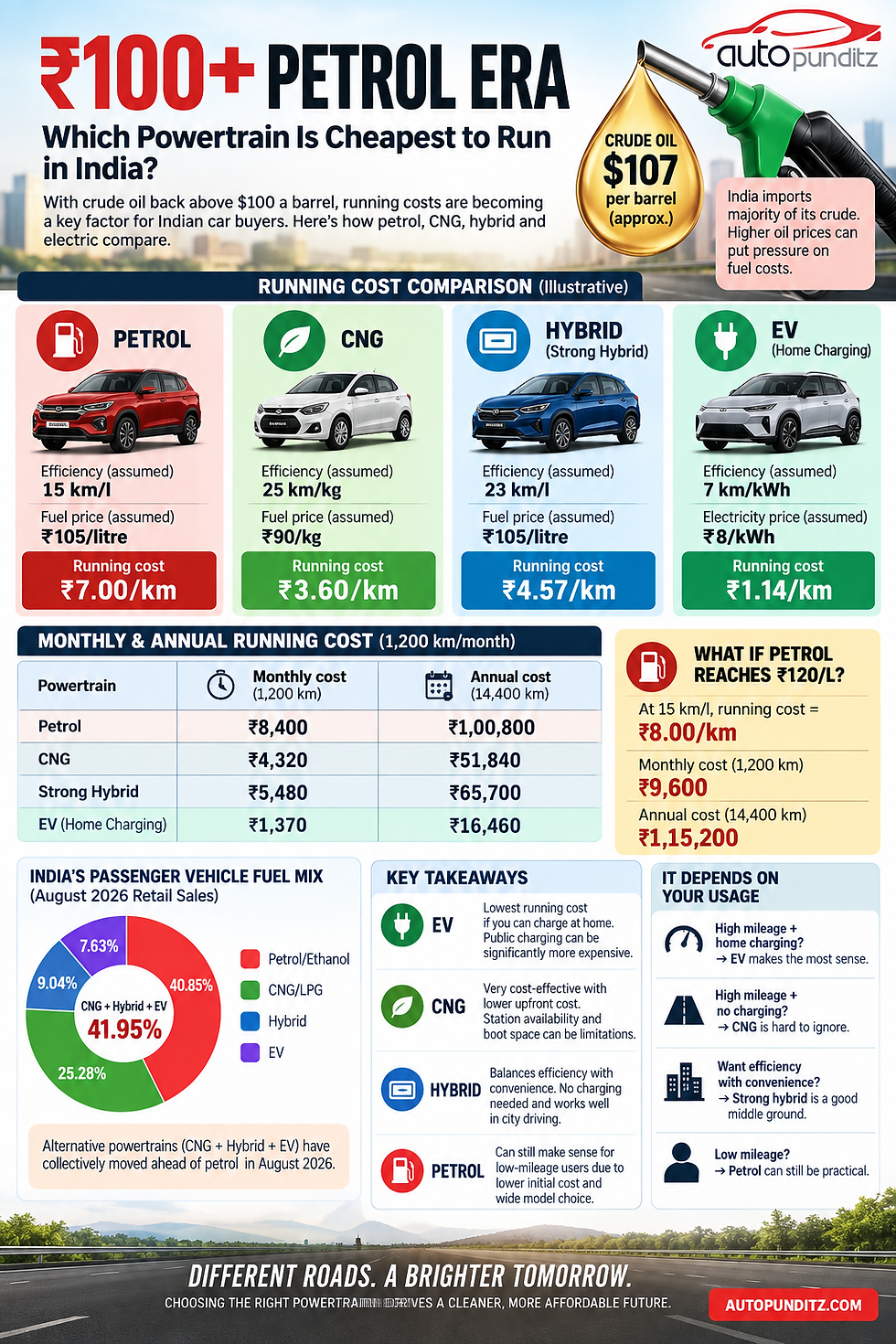
Powertrain | Efficiency assumption | Fuel/Energy price | Approx. cost/km |
Petrol | 15 km/l | ₹105/litre | ₹7.00 |
CNG | 25 km/kg | ₹90/kg | ₹3.60 |
Strong Hybrid | 23 km/l | ₹105/litre | ₹4.57 |
EV – Home Charging | 7 km/kWh | ₹8/kWh | ₹1.14 |
The difference is substantial.
Under these assumptions, a conventional petrol car costs more than six times as much per kilometre in energy as a home-charged EV.
CNG, meanwhile, costs almost half as much to run as petrol.
Monthly Running Cost
At 1,200km per month, the approximate expenditure works out to:
Powertrain | Monthly running cost |
EV – Home Charging | ₹1,370 |
CNG | ₹4,320 |
Strong Hybrid | ₹5,480 |
Petrol | ₹8,400 |
For a buyer covering this distance consistently, the difference becomes significant over an entire year.
Annual Running Cost
At 14,400km per year:
Powertrain | Approx. annual energy cost |
EV – Home Charging | ₹16,460 |
CNG | ₹51,840 |
Strong Hybrid | ₹65,700 |
Petrol | ₹1,00,800 |
On energy costs alone, the home-charged EV in our example saves approximately ₹84,000 annually compared with petrol.
But that does not mean every buyer should automatically choose an EV.
Running cost is only one component of total ownership cost.
EV: Cheapest to Run If You Can Charge at Home
For a buyer with access to reliable home charging, an EV has an enormous operating-cost advantage.
At an electricity tariff of ₹8/kWh and efficiency of 7km/kWh, the electricity expense works out to approximately:
₹1.14/km
Even if the electricity tariff rises moderately, it remains substantially below our petrol, hybrid and CNG examples.
There is, however, an important distinction.
Home charging and public charging aren't the same
EV economics are strongest when most charging takes place at home.
Public DC fast chargers can charge considerably more per unit of electricity. Depending on the charging network, vehicle efficiency and tariff structure, relying heavily on public fast charging can substantially increase the effective running cost.
This creates two quite different EV ownership cases:
EV + home charging = exceptionally low running costs
EV + frequent public fast charging = considerably smaller financial advantage
Anyone comparing EV and ICE ownership should therefore factor in where the vehicle will actually be charged.
CNG Remains a Powerful Option for High-Mileage Buyers
CNG occupies an interesting position in the Indian market.
At an illustrative ₹90/kg and 25km/kg efficiency:
Running cost = ₹3.60/km
That's almost half our conventional petrol-car figure.
CNG vehicles also generally have a smaller upfront price premium than comparable EVs and do not require buyers to install charging infrastructure.
The trade-offs include CNG station availability, potential refuelling queues and packaging compromises caused by the cylinders.
Manufacturers are increasingly addressing the latter through twin-cylinder and underbody CNG solutions, allowing more usable luggage space.
And consumer demand indicates that CNG is no longer a niche powertrain.
Strong Hybrid: The Middle Ground
Strong hybrids cannot match the running cost of a home-charged EV.
They may not beat CNG either.
But they solve a different problem.
A strong hybrid provides substantially better fuel efficiency than a conventional petrol vehicle while requiring no external charging and retaining normal petrol-station convenience.
At our assumed 23km/l:
Running cost = approximately ₹4.57/km
That could make hybrids particularly attractive to urban buyers who want better efficiency but either cannot install a charger or do not want to depend on CNG infrastructure.
Strong hybrids can also perform particularly well in stop-and-go urban conditions, where regenerative braking and electric assistance are used frequently.
Petrol Still Makes Sense for Some Buyers
Looking only at ₹/km can make petrol appear difficult to justify.
But total ownership economics depend heavily on annual usage.
A buyer driving only 5,000–7,000km annually may take many years to recover the higher purchase price of an EV or strong hybrid through energy savings alone.
Petrol vehicles also offer:
widespread refuelling infrastructure;
typically lower initial prices than equivalent hybrids or EVs;
broad model and variant availability;
familiar servicing and ownership patterns.
For low-mileage buyers, therefore, purchase-price savings can sometimes outweigh fuel savings.
The calculation changes considerably for someone driving 15,000–20,000km every year.
What If Petrol Reaches ₹120 Per Litre?
This is where the sensitivity to fuel prices becomes clearer.
Assuming the same 15km/l efficiency:
₹120 ÷ 15 = ₹8/km
At 1,200km per month, petrol expenditure would rise to:
₹9,600 per month
or
₹1,15,200 annually.
Compared with our home-charged EV assumption of approximately ₹16,460 annually, the difference would approach ₹99,000 every year.
A strong hybrid delivering 23km/l at ₹120/litre would cost approximately ₹5.22/km, demonstrating why improved efficiency becomes increasingly valuable as fuel prices rise.
India's Buyers Are Already Moving Beyond Petrol
This isn't merely a theoretical comparison.
August 2026 passenger-vehicle retail data showed a significant change in India's powertrain mix:
Powertrain | August 2026 share |
Petrol/Ethanol | 40.85% |
CNG/LPG | 25.28% |
Hybrid | 9.04% |
EV | 7.63% |
Together:
CNG + Hybrid + EV = 41.95%
That put these alternative powertrains collectively ahead of petrol/ethanol.
The more interesting takeaway is that no single technology is replacing petrol.
Instead, buyers are splitting among several alternatives depending on their requirements.
Which Powertrain Makes Sense for Whom?
EV: Best suited to high-mileage users with reliable home charging who can absorb the potentially higher initial purchase price.
CNG: Particularly compelling for cost-conscious, high-mileage users who have convenient access to CNG stations.
Strong Hybrid: Attractive for buyers seeking lower fuel consumption without depending on either charging or CNG infrastructure.
Petrol: Can remain sensible for low-mileage users who prioritise a lower initial purchase price, easy refuelling and maximum model choice.
Purchase Price Still Changes the Equation
One major caveat remains.
A vehicle with a ₹1.14/km energy cost isn't necessarily cheaper to own than one costing ₹3.60/km.
Suppose an EV costs ₹3 lakh more than a comparable CNG vehicle. The lower electricity cost needs to recover that initial premium before the EV becomes cheaper on a cumulative basis.
The correct buying calculation is therefore not simply:
Which vehicle has the lowest ₹/km?
It is:
Purchase price + financing + energy + insurance + maintenance + resale value over the planned ownership period.
This is why different powertrains can all make financial sense for different buyers.
Auto Punditz Take
India's passenger vehicle transition increasingly looks less like:
Petrol → EV
and more like:
Petrol → CNG + Hybrid + EV
Each technology is solving a different consumer problem.
EVs offer the lowest running cost when home charging is available.
CNG delivers strong economics without requiring a charger.
Strong hybrids combine improved efficiency with conventional refuelling convenience.
Petrol continues to work for buyers whose annual usage isn't high enough to justify paying more upfront for an alternative powertrain.
The latest crude-oil spike makes those differences increasingly important.
If $100-plus crude persists and eventually translates into higher Indian pump prices, running cost could become an even bigger influence on which powertrain Indian consumers choose next.
And India's August sales data suggests that shift is already well underway.


