India Electric Two-Wheeler Sales Cross 15 Lakh in Just Nine Months of 2026
India’s electric two-wheeler market has entered a new phase of growth, with registrations crossing 15 lakh units within the first nine months of 2026.
According to vehicle-registration data available through the government’s Vahan portal, around 15.61 lakh electric two-wheelers were registered between January and September 2026. That compares with approximately 9.61 lakh units during the corresponding period of 2025, representing growth of roughly 62% year-on-year.
The significance of the milestone becomes even clearer when compared with the whole of last year. India registered approximately 13.42 lakh electric two-wheelers during the entire calendar year 2025, meaning the industry has already exceeded last year’s annual volume with three months of 2026 still remaining.

September 2026 Electric Two-Wheeler Sales Approach 2 Lakh
September was another strong month for the category.
Electric two-wheeler registrations increased approximately 7.7% month-on-month to 1.97 lakh units, according to Vahan-based data cited by ET Auto.
The growth indicates that electric scooters and motorcycles are increasingly moving beyond their earlier niche position in India’s two-wheeler market.
Several factors are supporting adoption, including:
Lower day-to-day running costs compared with petrol two-wheelers
A broader selection of family-oriented electric scooters
Expanding charging infrastructure
Improving vehicle range and battery technology
Wider dealer and service networks
Increasing participation from established two-wheeler manufacturers
Electric two-wheelers accounted for around 11.5% of overall two-wheeler registrations in September, according to Vahan-based industry data, highlighting how rapidly EV penetration has increased in the segment.
TVS Leads September 2026 Electric Two-Wheeler Market
The competitive landscape has also changed considerably.
Legacy two-wheeler manufacturers have strengthened their presence as electric mobility moves into the mainstream.
September 2026 Electric Two-Wheeler Market Share
Manufacturer | Market Share |
TVS Motor | 26.3% |
Bajaj Auto | 23.5% |
Ather Energy | 14.7% |
Hero MotoCorp / VIDA | 11.7% |
Ola Electric | 6.5% |
TVS Motor retained the No.1 position, capturing approximately 26.3% of the electric two-wheeler market during September.
Bajaj Auto followed closely with around 23.5%, while Ather Energy secured approximately 14.7%.
Hero MotoCorp-backed VIDA continued its rapid expansion and accounted for around 11.7% of registrations.
Ola Electric, meanwhile, had approximately 6.5% market share during September, compared with around 7.6% in August.
Together, TVS Motor, Bajaj Auto, Ather Energy and Hero MotoCorp accounted for roughly 76% of electric two-wheeler registrations during the first nine months of 2026.
This concentration represents one of the biggest structural changes taking place in the Indian EV market.
Traditional Two-Wheeler Companies Strengthen Their EV Position
India’s early electric two-wheeler boom was driven largely by EV-focused startups.
That dynamic is now changing.
TVS Motor and Bajaj Auto have rapidly scaled products such as the TVS iQube and Bajaj Chetak, while Hero MotoCorp has expanded its VIDA portfolio and distribution footprint.
Ather Energy has also continued to build volumes with products including the Rizta alongside its performance-focused models.
Established manufacturers benefit from several advantages as EV adoption moves deeper into the mass market, including existing dealer networks, manufacturing capacity, brand recognition, financing relationships and extensive service infrastructure.
The shift towards practical family scooters is particularly important.
Early electric scooters were often positioned around technology or performance. Increasingly, buyers can choose products designed around everyday requirements such as storage, comfort, range, pillion usability and service availability.
That is bringing EVs closer to traditional scooters such as the Honda Activa and Suzuki Access in terms of the type of customer being targeted.
Ola Electric Faces Increasing Competitive Pressure
Perhaps the biggest change in the industry has been the redistribution of market share.
Ola Electric was previously one of India's dominant electric scooter manufacturers, but the rapid expansion of TVS, Bajaj, Ather and VIDA has considerably intensified competition.
Ola's approximately 6.5% September 2026 market share illustrates just how quickly the competitive landscape has evolved.
Competition is unlikely to ease.
Manufacturers are simultaneously investing in new vehicles, battery technology, manufacturing capacity, retail outlets and service networks.
The market is therefore transitioning from an early-stage EV race centred primarily around product launches into a considerably more mature contest involving scale, reliability, distribution and after-sales support.
Smaller EV Manufacturers Are Growing Too
Although the largest manufacturers dominate volumes, some smaller electric mobility companies have also expanded their presence.
River Mobility increased its market share to approximately 2.46% during January–September 2026, compared with around 1.27% during 2025.
Performance-oriented electric motorcycle manufacturers are growing from a smaller base as well.
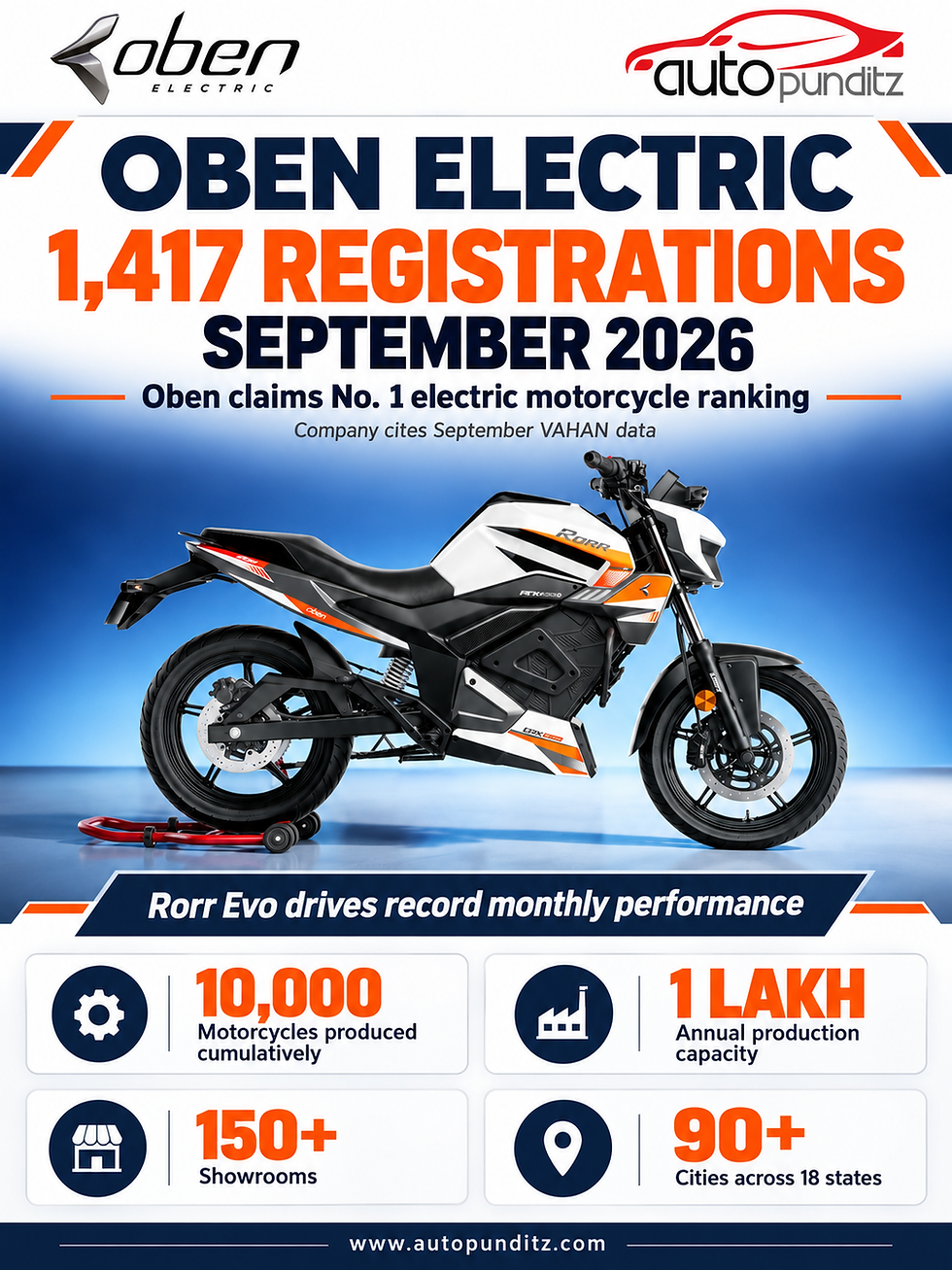
Ultraviolette's share increased to roughly 0.26%, while Oben Electric reached approximately 0.33% during the first nine months of 2026.
These volumes remain relatively small compared with India's leading electric scooter companies, but they indicate that the market is gradually expanding beyond mainstream scooters into electric motorcycles and differentiated mobility products.
India's Electric Two-Wheeler Market Could Be Heading Towards a Record Year
At 15.61 lakh registrations in nine months, 2026 is already certain to become India's biggest electric two-wheeler year if current figures hold.
A simple annualisation of the January–September registration rate would translate into approximately 20.8 lakh units for the full year.
This is not a sales forecast—monthly registrations can fluctuate substantially—but it illustrates the scale at which the market is currently operating.
Crossing the 20-lakh annual-registration level would represent another major psychological milestone for India's electric two-wheeler industry.
Auto Punditz Take
The most important story behind the 15-lakh milestone isn't simply that electric two-wheelers are growing.
It is how the market is growing.
Electric scooters are increasingly being purchased as practical alternatives to petrol scooters rather than primarily as technology products. At the same time, market leadership is shifting toward manufacturers capable of combining competitive vehicles with manufacturing scale, financing, dealerships and after-sales support.
The rise of TVS, Bajaj, Ather and VIDA illustrates this transition clearly.
With EV penetration in the two-wheeler segment now around double-digit levels, the next phase of competition will increasingly revolve around ownership experience—battery durability, service accessibility, resale value, charging convenience and total cost of ownership.
India's electric two-wheeler market has therefore moved beyond the question of whether meaningful EV adoption will happen.
The bigger question now is how quickly electric models can capture a substantially larger share of India's enormous scooter and motorcycle market.